Boat Stereo Power and Anchorage Etiquette: What the Music Costs the Battery, and How Far It Carries
A marine stereo is the one instrument aboard that is rated at its loudest second, paid for in its quietest hour, and judged from the next boat. The box says 280 watts; the bank sees two amps at the volume anyone actually listens to, and then sees most of an amp all night from a unit nobody switched off. The cockpit hears a pleasant 80 dB; the boat fifty metres away hears it too, and at midnight the air over the water bends the sound down towards them. This guide puts real current figures on the common head units and amplifiers, explains what RMS and peak and “marine grade” mean, says what the law regulates and what the harbour regulates, writes down the unwritten rules of a shared anchorage, and ends with the stereo at anchor, where its two jobs are to not eat the night's amp-hours and to not drown the alarm.
The short answer
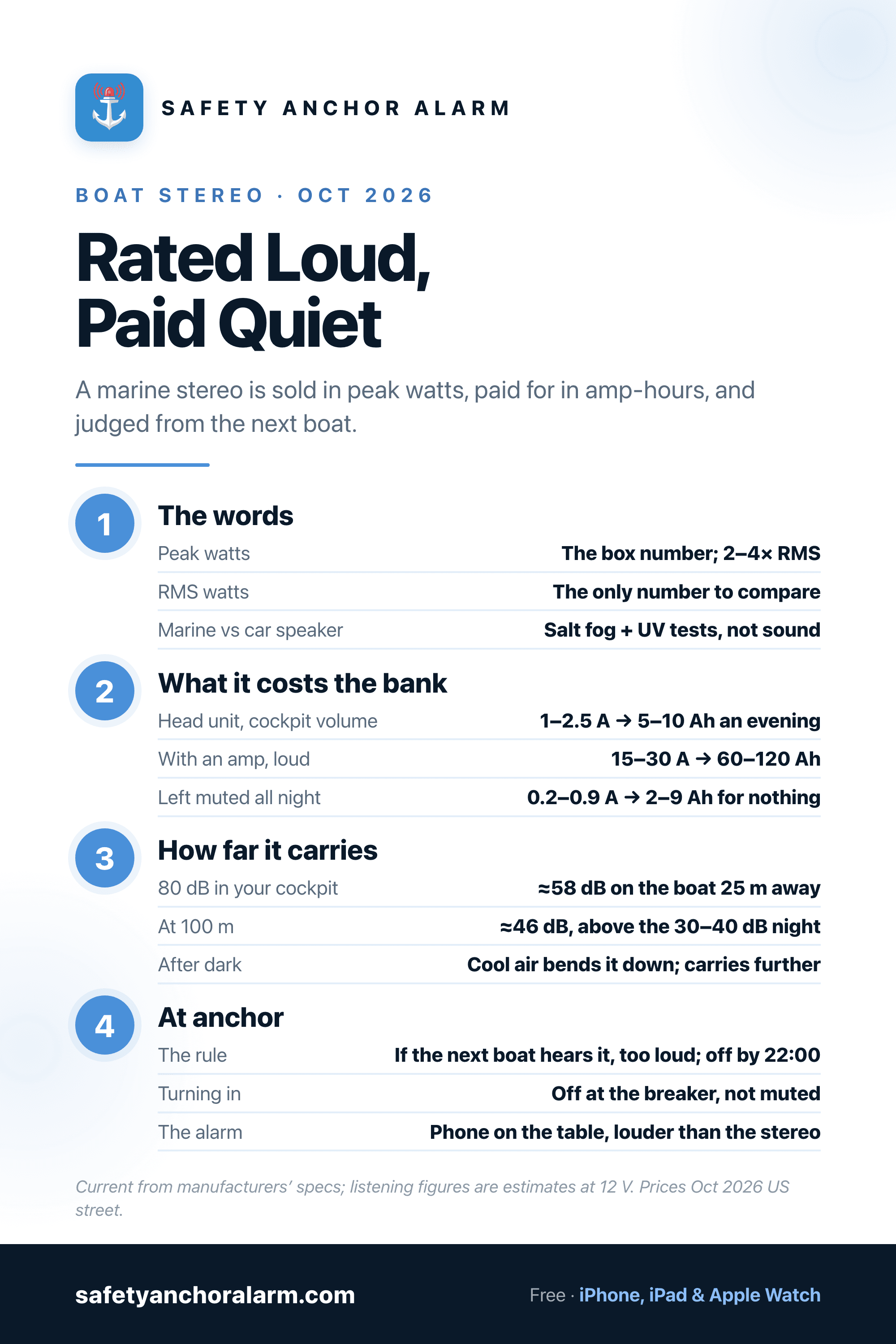
A boat stereo is sold in peak watts and paid for in amp-hours, and the two have little to do with each other. A head unit such as the Fusion RA60 or JL Audio MM50 ($250–430) is rated 4 × 22–26 W RMS, sold as “180–280 W”, and at cockpit volume draws 1–2.5 A from a 12 V bank: an evening of music is 5–10 Ah, a fraction of the fridge. Add an external amplifier and turn it up and the draw is 15–30 A, so the same four hours cost 60–120 Ah, the usable capacity of a 200 Ah lead-acid bank. The quieter drain is the unit left muted all night at 0.2–0.9 A, 2–7 Ah for nothing: switch it off at the breaker. Marine speakers differ from car speakers in salt-fog and UV testing, not in sound. On the water nothing absorbs the music: 80 dB in your cockpit is about 58 dB on a boat 25 m away and still 46 dB at 100 m, and at night the cooler air bends it downwards. US state law regulates your exhaust (Florida: 90 dB(A) at 50 ft), harbour rules regulate your music (Catalina's Two Harbors: quiet 10 pm–7 am, amplified music that disturbs others banned at any hour), and the anchorage convention is simpler: if the next boat can hear it, it is too loud, and it stops at 22:00. At anchor, switch it off rather than down when you turn in, and make sure the anchor alarm is louder than the stereo.
What the Stereo Really Draws
Output, muted and maximum current are from the manufacturers' specifications. The “cockpit volume” and “evening” columns are estimates for a 12 V system playing music at the level of a loud conversation for four hours: recorded music averages roughly a tenth of its peaks, and a class-D amplifier is 80–90 percent efficient, so the current at normal listening is a small fraction of the fuse rating. Prices are October 2026 US street prices.
| Unit | Price | Output | Idle | Cockpit volume | Flat out | 4-hour evening |
|---|---|---|---|---|---|---|
| Fusion MS-RA60 | $250 | 4 × 22 W RMS (“180 W”) | <0.19 A muted | 1–2 A | 8–10 A (15 A fuse) | 5–8 Ah |
| JL Audio MM50 | $430 | 4 × 25 W RMS | 0.1 A standby | 1–2 A | 8–10 A (15 A fuse) | 5–8 Ah |
| Fusion MS-RA210 (2 zones) | $400 | 4 × 26 W RMS (“200 W”) | <0.4 A muted | 1.5–2.5 A | 9–12 A | 6–10 Ah |
| Fusion Apollo RA670 (3 zones, DSP) | $550 | 4 × 26 W RMS (“280 W”) | <0.7 A muted | 2–3 A | 10–13 A | 8–12 Ah |
| Fusion Apollo RA770 (4 zones) | $650–700 | 4 × 70 W peak at 2 Ω (“280 W”) | <0.9 A muted, <0.2 A off | 2–3 A | 10–15 A | 8–12 Ah |
| + Rockford PM400X4 amplifier | $520 | 4 × 50 W RMS | Remote-switched off | +3–6 A | 30 A average, 60 A max | +12–25 Ah; 60–120 Ah loud |
| + Fusion MS-AP41200 amplifier | $650 | 4 × 150 W RMS | Remote-switched off | +4–8 A | up to 53 A | +15–30 Ah; 100 Ah+ loud |
Watts: RMS, Peak and the Number on the Box
Marine audio is sold on a number that means almost nothing. A Fusion RA60 is a “180 W” stereo; its specification sheet says 4 × 22 W RMS at 4 ohms. A Rockford M0-65 speaker is “250 W”; it handles 65 W RMS. The big number is peak power, the loudest instant the electronics can produce or the speaker survive, and it runs two to four times the RMS figure depending on how optimistic the marketing department was that year. RMS, root-mean-square or continuous power, is what the amplifier can deliver all evening and what the speaker can take without the voice coil cooking, and it is the only number worth comparing. Match a speaker's RMS handling to the RMS output of the channel driving it, a little over rather than under, and the system will play clean at any volume you will use.
The second thing the watt figure hides is how few of them you use. A typical 6.5-inch marine speaker has a sensitivity around 88–90 dB for one watt measured at one metre; that single watt is already the level of a loud conversation across a cockpit table. Every doubling of power adds 3 dB and every tenfold increase adds 10, so going from 1 W to the stereo's rated 22 W per channel adds about 13 dB and takes a pleasant evening to a party. Music is not a steady tone either: the average level of a recorded track sits roughly a tenth of its peaks, so an amplifier “playing at 25 W” is drawing power for perhaps 3 W most of the time. That arithmetic, not the fuse rating, is what the stereo costs the battery.
What It Costs the Battery
Put the two together and the head-unit numbers in the table fall out. A stereo playing at cockpit volume delivers a few watts per channel into four speakers, its class-D output stage turns 12 V into that with 80–90 percent efficiency, and its own display, Bluetooth radio and processor take the rest: 1 to 2.5 A, depending mostly on the unit's idle draw rather than on the music. Four hours is 5 to 10 Ah. For scale, the energy-budget guide puts a 12 V fridge at 30–60 Ah a day and a 10–12 m cruising boat at 100–150 Ah a day in total, so an evening of music at the volume you would use with neighbours is one or two hours of fridge. Turn the same head unit up until it is working, and the draw climbs towards 8–15 A; the 15 A fuse that every one of them carries is the ceiling, and four hours there is 35–50 Ah.
The drain nobody budgets for is the unit that is not playing. A modern stereo that is muted, or switched “off” at its own button, keeps its network connection, Bluetooth pairing and display memory alive. Fusion's own figures are under 190 mA for the RA60 muted, under 400 mA for the RA210, under 700 mA for the RA670 and under 900 mA for the RA770, which also lists up to 200 mA when off; JL Audio quotes 100 mA standby for the MM50. Call it 0.2 to 0.9 A for ten hours of darkness: 2 to 9 Ah, every night, for silence. On a boat whose house bank gives 100 usable Ah between charges, the muted stereo can cost more than the anchor light. The cure is a breaker or a switched circuit, and the habit of using it when you turn in.
The Amplifier Question
An external amplifier changes the arithmetic by an order of magnitude, and it is where boat audio becomes a battery problem rather than a line item. A Rockford Fosgate PM400X4 ($520, 4 × 50 W RMS) is rated by its maker at 30 A average current on music at full output and 60 A maximum; a Fusion MS-AP41200 ($650, 4 × 150 W RMS) draws up to 53 A. Played at the same cockpit volume as the head unit alone, either adds only 3 to 8 A, because the volume knob, not the amplifier, sets the power. Played at the volume the amplifier was bought for, a four-hour evening is 60 to 120 Ah: the usable half of a 200 Ah lead-acid bank, or the whole of a 100 Ah lithium, gone before the anchor light comes on. The battery guide explains why a bank cycled that deep ages in a season. An amplifier aboard belongs on a remote turn-on wire from the head unit so it sleeps when the stereo does, on its own fuse sized to the maker's figure, and with a wire gauge for that current, not for the head unit's.
The honest version of the amplifier question on a cruising boat is whether the volume it enables is one you can use anywhere other than offshore. On a sportsboat with tower speakers on a lake at noon, yes; the law and the etiquette below are about where and when. In an anchorage after dark, the amplifier's extra watts are the ones the next boat hears.
Marine Speakers Versus Car Speakers
A marine speaker is not a different kind of speaker; it is the same driver built to survive outdoors. The cone is polypropylene or a composite rather than paper, which goes soft when it gets damp. The basket and hardware are stainless or coated rather than plated steel. The crossover is sealed and often conformal-coated so salt spray does not bridge the terminals. The plastics are UV-stabilised and tested to ASTM D4329, and the whole unit is salt-fog tested to ASTM B117, usually for hundreds of hours, and carries an IPX6 or IPX7 water rating that a car speaker never has. None of this changes the sound; it changes the lifespan from a season to a decade in a cockpit coaming. At the 6.5-inch size the premium is small: a Rockford M0-65 pair is about $130, Kicker KM65 $230, JL Audio M3 $240, Fusion Signature $340, all 60–75 W RMS, against $60–120 for the car equivalent. Where a car speaker will do is a dry locker or a saloon bulkhead that never sees spray; everywhere else, pay the difference.
Zones, Plotter Control and Bluetooth
The feature that matters more than watts on a cruising boat is zones. The RA210 has two, the RA670 three and the RA770 four, each with its own volume and on-off, which means the cockpit can have music at conversation level while the foredeck and the saloon are silent, and at night the only zone running is the one somebody is sitting in. Fusion stereos also broadcast Fusion-Link over NMEA 2000, and Garmin, Raymarine, Simrad and Furuno displays show a media page that controls source, volume and zones from the helm; JL Audio's MediaMaster units do the same on most of them. If the boat already has a multifunction display on the backbone, the stereo appears on it with a drop cable and no second screen; a wired or wireless remote ($100–200) does the same job at the companionway. Bluetooth from a phone is the universal source and the universal weak point: it reaches about 10 m, drops when the phone goes below, and plays every notification through the cockpit. A unit with a USB socket and a wired phone, or a tablet left at the chart table, is the quiet alternative.
How Far the Music Carries
The reason anchorage etiquette exists is physics. Ashore, buildings, trees and the ground absorb and scatter sound; on the water there is nothing between your cockpit and the next boat but air and a flat surface that reflects rather than absorbs. In open air a sound falls by about 6 dB every time the distance doubles, and the table runs that arithmetic from a cockpit level of 80 dB, which is roughly what a stereo set for a cheerful evening produces where the people are sitting.
| Distance | Level | What it means |
|---|---|---|
| 2 m, your cockpit | 80 dB | Loud-conversation level; where the volume knob gets set |
| 25 m, the next boat in a tight anchorage | ≈58 dB | Every lyric, in their cockpit |
| 50 m, a normal gap between boats | ≈52 dB | Clearly audible over a quiet night |
| 100 m, the far side of a small bay | ≈46 dB | Still above the anchorage’s night background of 30–40 dB |
| 200 m | ≈40 dB | Faint but there; more on a still night with an inversion |
The night makes it worse. By day the air is warmest at the surface and sound bends upwards, away from listeners at water level; after sunset the water and the air just above it cool while the air aloft stays warmer, a temperature inversion, and sound now bends downwards and travels along the surface. It is why a conversation on a boat 200 m away is intelligible at midnight and inaudible at noon, and why the figures in the table are optimistic after dark. A quiet anchorage at night has a background of 30–40 dB, so music that reaches a neighbour at 46 dB is not a murmur under their own noise; it is the loudest thing they can hear.
The Law and the Harbour Rules
The law surprises people in both directions. In the United States the state vessel noise statutes are about engines, not stereos: Florida's 327.65 requires every engine to be effectively muffled and lets counties that adopt it enforce 90 dB(A) at 50 feet; New York applies 90 dB(A) in a stationary test and 75 dB(A) passing offshore; most states write their limits to the SAE J2005 stationary and J1970 shoreline procedures. A stereo is not an exhaust and these numbers do not apply to it. What applies instead is the layer below: municipal noise and nuisance ordinances, which typically use a “plainly audible at 25 or 50 feet” test or a decibel limit at the property line, and the rules of whoever manages the water you are floating on.
Those rules can be strict and specific. Catalina Island's Two Harbors harbour department requires all persons in its moorings, anchorages and harbour areas to observe quiet hours from 10 pm to 7 am, and separately bans excessively loud or amplified sound and music that disturbs other users at any time; the City of Avalon requires generators to be secured from 10 pm to 7 am. Marine parks and managed mooring fields often write similar terms into the permit you accept when you take the ball. Elsewhere in the world the picture is the same shape: national law is about engines, lights and discharge, and the music rule, where there is one, is local, posted at the harbour office, and enforced by the harbourmaster's launch. Where nothing is written down, the rule below is the one that applies.
The Unwritten Rules of a Shared Anchorage
Cruisers have worked these out over a long time and they are consistent from the Chesapeake to the Ionian. They are the same rules that govern how close to anchor, applied to sound.
- If the next boat can hear it, it is too loud. Not “too loud for them”; too loud, full stop. The test is made from their cockpit, not yours, and the fix is the volume knob, the zone switch, or a speaker that faces aft rather than abeam.
- Music off by 22:00. Earlier in a small or family anchorage, and the evening's last hour quieter than the first. Generators run between about 08:00 and 20:00; some anchorages say 22:00, none say later.
- Anchor for the party you are planning. A birthday, a crew reunion or a raft-up belongs at the far end of the bay, downwind of the fleet, and is announced by dinghy to the boats nearest you with a time it will end.
- Daytime is not free either. Most people at anchor on a Saturday afternoon are there for the quiet; the 80 dB in your cockpit is 50 dB on the paddleboard beside you. Afternoon music at conversation level is fine; a tower system at noon is a lake thing.
- Voices carry as far as speakers. The late conversation in the cockpit, the dinghy outboard at midnight and the halyard slapping the mast all travel the same way. The stereo is the one you can turn off with a button.
The Stereo at Anchor
Everything above comes together after dark, and for a boat whose night depends on an anchor alarm the stereo has two specific jobs. The night anchoring guide covers the routine; this is the audio part of it.
Leave the bank alone. The anchor light, the fridge and, if you run one from the plotter or a tablet, the anchor alarm all draw from the house bank until morning, and an amplifier evening that took 100 Ah out of it has already spent the night's margin. The phone-based anchor alarm runs on the phone's own battery, which is the point of it, but the phone charges from the same bank, and a low-voltage cut-out at 03:00 takes the charger, the anchor light and the plotter's alarm together. Budget the music like the fridge and switch the stereo off at the breaker, not muted, when you turn in: the 0.2–0.9 A it draws for nothing is the difference between a bank that is at 60 percent at dawn and one that is at the low-voltage alarm.
Be quieter than the alarm. An anchor alarm that goes off during the party is the one scenario the stereo can genuinely make dangerous. A phone's speaker produces around 80–85 dB at arm's length; a stereo at 80 dB in the same cockpit masks it, and the squall that drags the anchor arrives at 21:30 as often as at 03:00. Set the alarm app to its loudest tone with vibration, keep the phone on the cockpit table and not in a pocket, and when the wind rises during the evening, turn the music down first and look at the alarm second. The stereo also masks the one sound that matters more than any alarm: the neighbour calling across the water, or on channel 16, to tell you that you are dragging down on them.
The neighbour's night is part of yours. In a crowded bay the boats remembered in the morning are the one that dragged at 02:00 and the one that played until 01:00, and the second is the one people choose to be. The dragging guide covers the first. The second is a knob.
The Bottom Line
Compare stereos and speakers by RMS watts and ignore the peak figure. At the volume you will actually use, a head unit costs 5–10 Ah an evening and an amplifier at party volume costs the house bank its night; the drain that matters most is the unit left muted until morning, so switch it off at the breaker. Buy marine speakers for anywhere spray reaches, use zones so that only the cockpit plays, and put the stereo on the plotter if the boat has NMEA 2000. On the water nothing absorbs the music, and at night the air bends it towards the next boat, so the rule is the one cruisers already keep: if they can hear it, it is too loud, and it stops at 22:00. At anchor, be quieter than the alarm.

Safety Anchor Alarm
The music is the evening. The alarm is the night. Set the stereo so the next boat cannot hear it, switch it off at the breaker when you turn in, and let the phone that wakes you be the loudest thing aboard.
Download Free