Chartplotter Fishfinder Combo Explained: What You Are Really Buying
The electronics wall in a chandlery is a row of nearly identical screens with names like 93sv, Elite FS 9 and Helix 9 MSI+ G4N, priced from four hundred dollars to four thousand. They are all “chartplotter fishfinder combos”, and the label hides the two things that decide whether you bought the right one. First, a combo is two instruments sharing a screen, and most boats need one of them far more than the other. Second, the screen is the part you look at, but the sonar you get is decided by a plastic lump on the transom that the name only hints at. This guide sets out what each half does, how to read the names, what the box costs in 2026, where a combo stops and a multifunction display begins, and what the thing on the helm can and cannot do for you once the anchor is down.
The short answer
A chartplotter fishfinder combo is a GPS chartplotter and a sonar fish finder in one waterproof case with one screen. The plotter half draws your position on an electronic chart; the sounder half pings the water through a transducer and draws depth, bottom and fish. The number in the name is the screen size in inches; the letters say which sonar is inside (Garmin cv = down imaging, sv = side imaging too; Lowrance and Simrad 3-in-1; Humminbird MSI). In 2026 a 5-inch unit costs about $450, a 7 to 9-inch combo $750 to $1,400, and the point where a combo becomes a networked MFD with radar, AIS and autopilot is about $1,500 a screen. A cruising sailboat wants the cheap cv version for the depth picture; an angler pays for side imaging. Neither replaces a phone anchor alarm in the bunk, and the sounder is the better anchoring tool of the two halves.
Four Boxes That Look the Same on the Shelf
US street prices as checked on 30 September 2026, transducer included where a bundle is the normal way to buy. Prices move with the season; the categories do not.
| Box | What it shows | Sonar | Network | 2026 price | Who it is for |
|---|---|---|---|---|---|
| Chartplotter | Your position on an electronic chart; routes, waypoints, AIS if fed | None (or a single depth number from the network) | Usually NMEA 2000 | $400–1,500 | Cruising boat with a separate depth instrument |
| Fish finder | Sonar only: depth, bottom, fish; no chart | CHIRP, often down/side imaging; transducer in the box | Rarely | $150–800 | Small fishing boat, kayak, second sonar screen |
| Combo (cv / sv class) | Chart and sonar on one screen, split or full | Built in; cv = down imaging, sv / 3-in-1 / MSI = side imaging too | Top models yes; entry models no | $450–1,700 | Most boats under about 35 ft; the sailor's version is the cheap cv |
| MFD (networked) | Chart, sonar, radar, AIS, autopilot, engines, cameras | Built in or a black-box sounder on the network | NMEA 2000 backbone, Ethernet between displays | $1,500–5,000+ per display | Boats with radar and autopilot; two or more helm stations |
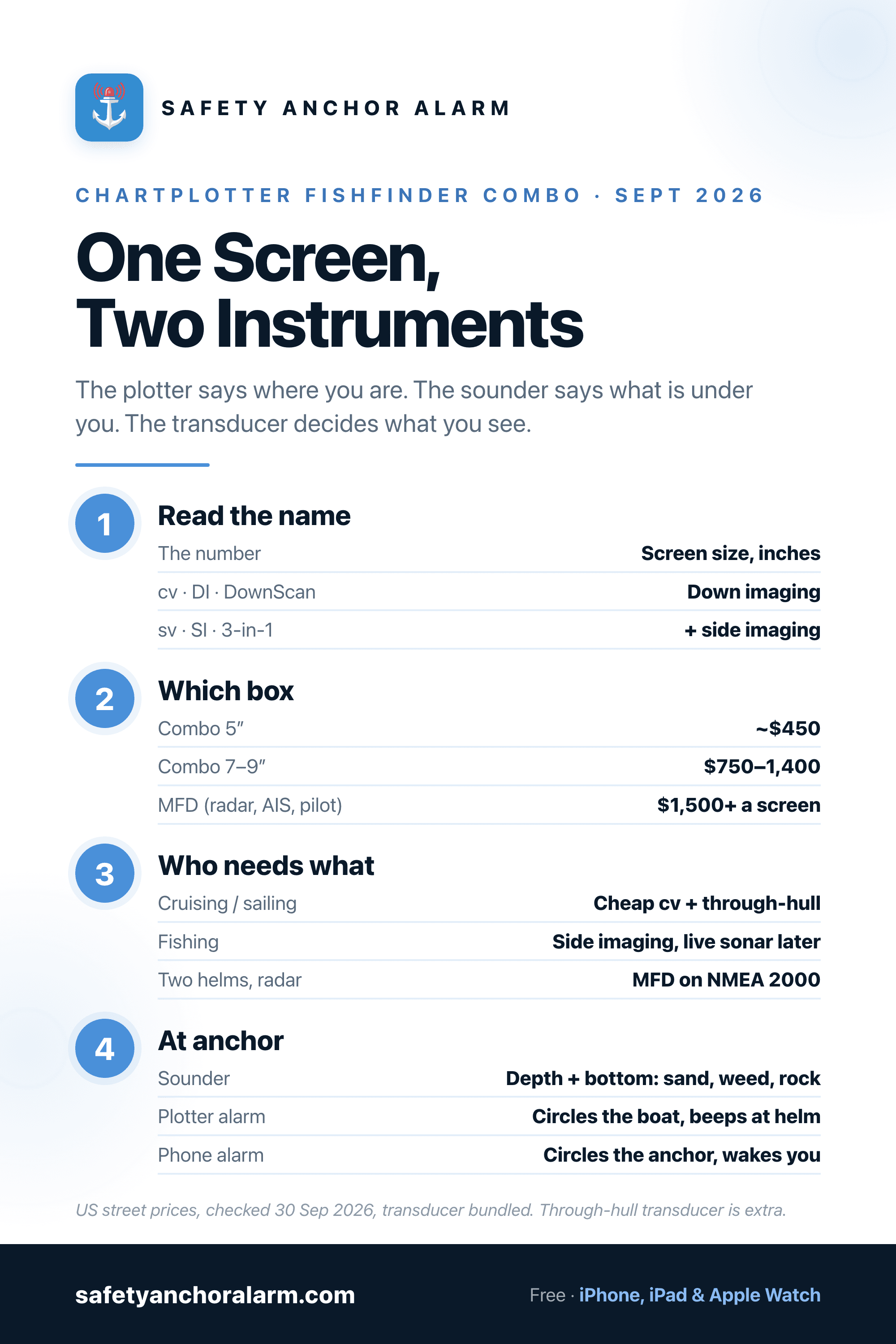
Two Instruments, One Screen
The name says it plainly and everyone reads past it. A combo is a chartplotter and a fish finder, which is to say a GPS and a sonar, and they have nothing in common except the case. They do not share a sensor, they do not need each other, and they answer two different questions.
The plotter answers where am I. A GPS receiver in the unit (or an external antenna on a networked one) fixes the boat every second, and the screen draws that fix on a vector chart: depths, contours, buoys, harbours, the wreck you did not know was there. Around it hang the navigation tools: routes, waypoints, cross-track error, the MOB button, and, on any unit with a network port, the AIS targets and radar overlay described in the marine radar guide.
The sounder answers what is under me. A transducer under the hull sends a pulse of sound downwards, listens for the echo, and the screen scrolls a picture of what came back: a hard line for the bottom, a fuzz for weed, an arch for a fish. It is a depth sounder that draws instead of counting, and that difference is why a boat that never fishes still wants one: a number says 4.1 metres, a picture says 4.1 metres and shoaling fast over rock.
The combo's trick is only that the two share a screen, split or one at a time. Its price is set almost entirely by three things: how big the screen is, which sonar the transducer can do, and whether the box can talk to the rest of the boat.
Reading the Name
Every brand encodes the same three facts in the model name, and once you can read one you can read them all. The number is the screen size in inches. The letters after it say which kinds of sonar the unit and its bundled transducer support. A suffix or a generation tag says whether it networks.
| Model | Screen | Sonar in the name | Charts in the box | 2026 street |
|---|---|---|---|---|
| Garmin ECHOMAP UHD2 93sv | 9 in | CHIRP + ClearVü + SideVü | Garmin Navionics+ (region) | ~$1,200–1,400 with GT56 |
| Garmin ECHOMAP UHD2 54cv | 5 in | CHIRP + ClearVü down only | Garmin Navionics+ (region) | ~$450–500 |
| Lowrance Elite FS 9 | 9 in | Active Imaging 3-in-1 (CHIRP, down, side) | C-MAP | ~$950–1,100 |
| Humminbird Helix 9 MSI+ G4N | 9 in | Dual Spectrum CHIRP + MEGA Down + Side | CoastMaster / LakeMaster | ~$1,000–1,300 |
| Simrad NSX 3009 | 9 in | Active Imaging 3-in-1 | C-MAP | ~$1,700 |
| Raymarine Axiom 2 Pro 9 S / RVM | 9 in | S: 1 kW CHIRP · RVM: RealVision MAX 3D | LightHouse; Navionics or C-MAP card | from ~$2,750–3,350 |
- Garmin ECHOMAP. 54cv, 73cv, 93sv: first digit is the size, second the generation, and the suffix is the sonar. cv means CHIRP plus ClearVü, which is a down-imaging picture straight beneath the boat. sv adds SideVü, a picture out to either side. UHD2 is the current family; Ultra 2 is the big-screen version. GPSMAP is the MFD line above it.
- Lowrance. Elite FS is the combo, HDS Pro the MFD, Eagle the budget line. “Active Imaging 3-in-1” on the box means the transducer does CHIRP, down scan and side scan.
- Humminbird. Helix is the combo family. DI is down imaging, SI side imaging, MEGA the higher-frequency version of either, and G4N the generation with an Ethernet port. Solix and Xplore sit above it.
- Simrad and B&G. Same parent as Lowrance, same 3-in-1 transducers. GO and NSX are the combos; NSS and the B&G Zeus and Vulcan are the sailing-flavoured MFDs.
- Raymarine. Axiom 2 is an MFD family rather than a combo. The Pro S has a single high-power CHIRP channel and is aimed at cruising and sailing boats; the Pro RVM adds RealVision MAX 3D sonar for anglers, and Axiom 2 XL is the glass-bridge size.
The Transducer Is the Real Purchase
A combo's sonar is only as good as the transducer, and the transducer is usually the last thing anyone reads about. Three things about it decide what you will actually see.
What it can do
- Traditional CHIRP sweeps a band of frequencies instead of one, which separates fish from bottom and bottom from weed far better than the old 200 kHz ping. It is the depth picture, and every combo has it.
- Down imaging (ClearVü, DownScan, DI) uses a thin high-frequency beam to draw a near-photographic slice of what is directly under the keel: structure, weed beds, a cable. Useful on any boat.
- Side imaging (SideVü, SideScan, SI) sweeps the same beam out to each side, up to a couple of hundred feet in good conditions, and draws the bottom as if from above. It is a fishing and a survey tool; a sailboat rarely uses it.
- Live sonar (Garmin LiveScope, Lowrance ActiveTarget, Humminbird MEGA Live) is a separate transducer and black box, $1,000 or more on top, showing fish moving in real time. It is why a bass boat carries three screens and why a cruising boat does not need to.
Where it goes
- Transom mount is what comes in the bundle: a bracket on the back of the boat, fine for outboards, RIBs and anything with a flat transom, and useless once the boat heels or the stern is a metre above the waterline.
- Through-hull is a fitting through the bottom, bronze or plastic, sometimes with a tilted element so it points straight down on a deadrise hull. It is the sailboat and inboard answer, it needs a haul-out, and it is a separate purchase of $150 to $600 that the bundle price does not include.
- In-hull glues inside a solid glass hull and shoots through it. No hole, some signal loss, and no side imaging.
What it plugs into
Transducers are not interchangeable between brands and often not between generations of the same brand. Whatever unit you choose, the transducer is a commitment to that family, which is the real reason boats stay with one make for a decade.
Charts: the Region Card and the Renewal
A combo ships with charts for one region built in, and the choice of brand is also a choice of chart. Garmin units come with Garmin Navionics+ for the region on the box, with a year of updates included and an annual renewal after that; without the renewal the charts keep working but stop updating. Lowrance, Simrad and B&G ship C-MAP; Humminbird ships its own CoastMaster or LakeMaster; Raymarine ships LightHouse charts and reads Navionics or C-MAP from a card. The practical points are two: a unit bought for US coastal waters needs a new chart card for the Mediterranean or the Caribbean, and on all of them the tide and current overlays, the satellite imagery and the community-sourced depth layers are subscription features.
None of them are a reason to trust the chart more than the sounder. Charted depths in an anchorage are surveyed soundings that may be decades old and are corrected to chart datum, not to tonight's tide; the sounder is reading the water you are actually floating in.
Screen Size and Where It Lives
Seven inches is the smallest screen on which a split chart and sonar view is readable from the wheel, and nine is the size most people wish they had bought. Five-inch units belong on a tiller or a kayak. Twelve and above are flybridge and pilothouse sizes and come with MFD prices. Three questions decide the mounting: can it be read in full sun (every current unit is rated for it, the cheap ones less well), can it be worked with wet hands (buttons or keypad-plus-touch beat touch alone in spray), and can it be seen from where you steer, which on a sailboat with a wheel usually means a pod or a bulkhead by the companionway rather than the transom.
Where a Combo Ends and an MFD Begins
The other thing the price buys is a network port. An entry combo is an island: GPS, sonar and charts, and nothing else. Add NMEA 2000 and the unit can show wind, depth from another transducer, engine data and AIS targets; add Ethernet and it can share sonar and charts with a second display, drive a radar and take an autopilot. At that point the box is a multifunction display, and the sonar is often a separate black box on the network rather than something built into the screen. The combo lines from each brand now do most of this above nine inches, which is why the boundary is more a price than a category: about $1,500 a screen in 2026 is where a boat starts paying for the network rather than the picture.
A boat with one helm, no radar and no autopilot does not need an MFD, and the extra money is better spent on a good through-hull transducer and a second, smaller screen in the bunk or the saloon.
What a Phone Cannot Do, and What It Can
The chart half of a combo now runs on any phone: Navionics, C-MAP, iNavX, and the free apps in the best sailing apps guide draw the same vector charts from the same GPS chip. The sonar half does not, for the simple reason that there is no transducer; the castable sonar balls that pair with a phone are fishing toys, not depth instruments for a boat under way. So the fixed combo earns its place at the helm on depth alone, and the phone earns its place for planning, for a second view in the cockpit, and at night, in the bunk, for the anchor.
The Combo at Anchor
Once the hook is down the two halves change places. The chart, which did all the work on the way in, has told you everything it knows. The sounder has just become the most useful instrument on the boat, and the plotter's anchor alarm is the feature everybody uses and nobody quite trusts.
The sounder picks the spot. Depth under the keel at the moment of the drop is the number that sets the scope, and the bottom picture tells you whether it is worth dropping at all: a thick, soft bottom return with a faint second echo is sand or mud that will hold, a hard bright line with a strong second echo is rock or hard pan that will not, and a fuzzy layer above the bottom is weed the anchor will skate across. Circling the intended spot once with the sounder on full screen is a two-minute habit that saves a night, and it is the same habit the fishing-boat anchoring guide uses to put the boat up-current of the structure.
The plotter's anchor alarm circles the boat. Every combo has one: it takes the position when you arm it, draws a radius round it and beeps if you leave. The chartplotter alarm versus app comparison goes through the three problems in detail: the circle is centred on where the boat was when you pressed the button, which is a rode-length behind the anchor; the beeper is at the helm and you are not; and the whole instrument network stays on all night to keep it running, on the same battery as the fridge.
The honest arrangement is the one most cruising boats end up with. The combo at the helm chooses the spot and, if you like, keeps a second alarm for the person on watch in the cockpit. The anchor alarm on the phone is set at the moment of the drop with the circle centred on the anchor, lives beside the bunk on its own battery, and wakes the one person who has to do something about it. The phone's fix is worse than the combo's external antenna, typically 3 to 5 metres against 1 to 2, and the GPS accuracy guide explains why the alarm radius carries a margin for exactly that. The instruments can go off at bedtime; the phone stays awake.
The Bottom Line
A chartplotter fishfinder combo is a GPS and a sonar in one case. Read the name for the screen size and the sonar, then read the transducer for what you will really see. A cruising boat wants the plain CHIRP and down-imaging version and a proper through-hull transducer; an angler pays for side imaging and, later, live sonar; a boat with radar and autopilot has already crossed into MFD territory. At anchor the sounder is the half that matters, the plotter's alarm is a cockpit alarm centred on the boat, and the one that circles the anchor and wakes you is in your pocket.

Safety Anchor Alarm
The combo's alarm circles the boat and beeps at the helm. The anchor alarm on your phone circles the anchor, runs on its own battery and wakes you in the bunk. Run both; trust the one beside you.
Download Free