The Hard Part Was Never Doing the Job
Changing an impeller is twenty minutes. Remembering whether you changed it last season, at what engine hours, and whether the spare you bought is in the cockpit locker or under the aft bunk — that is the part that actually goes wrong. It is why we said, in our boat maintenance checklist, that the schedule only works if you can see when each job was last done.
Most boats answer that with a paper log at the nav station, a spreadsheet that has not been opened since March, and a folder of receipts. Marine Logbook is the same record kept somewhere you will actually have with you — and, more usefully, somewhere you can search.
What Goes In It
Ten purpose-built entry types rather than one blank page, so things can be found later by what they are. For the wider question of what belongs in a boat's log at all — and what you can safely leave out — see what to record in a ship's log. If your log has to count toward a qualification, the RYA and ASA logbook guide covers what an examiner accepts as sea-time evidence.
| Entry | What it holds |
|---|---|
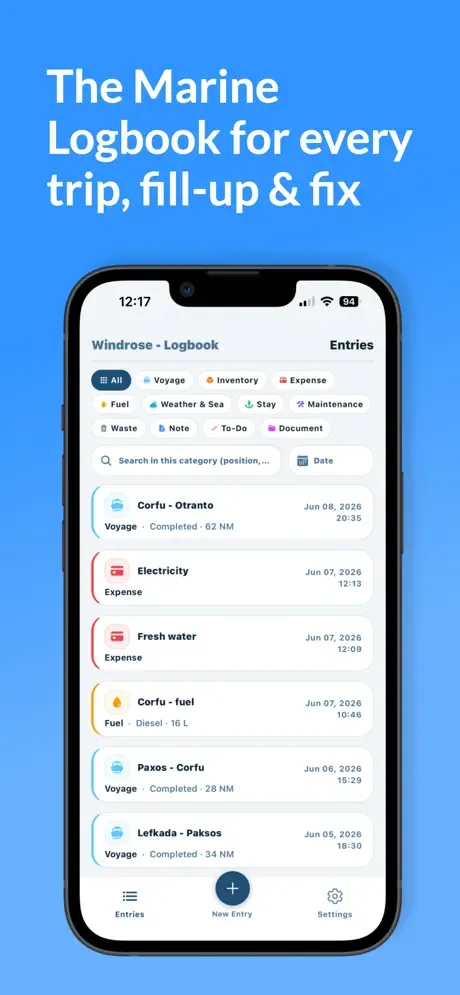
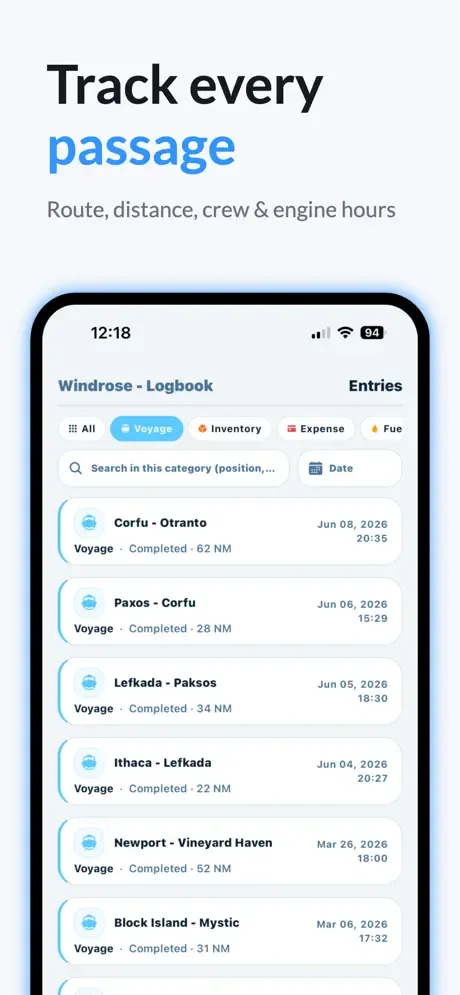
| Voyage | Route, distance, crew and engine hours for every passage |
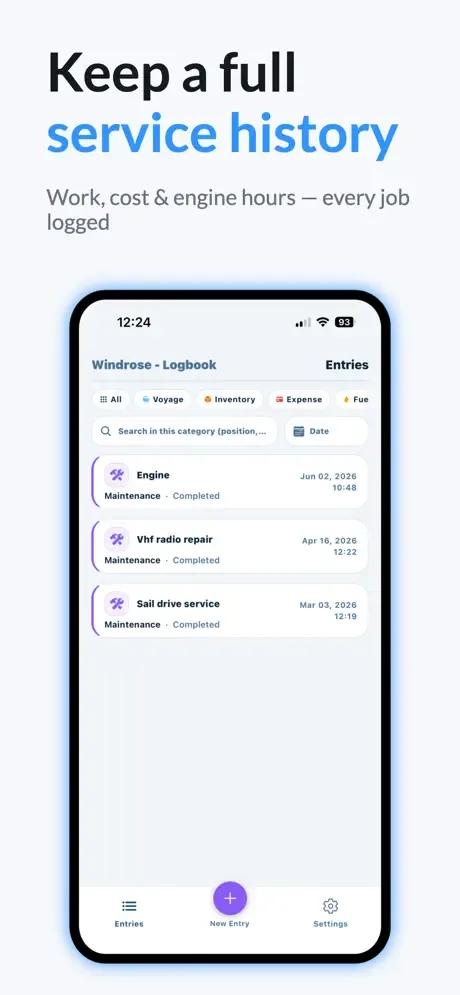
| Maintenance | The work, the cost, the engine hours — and when it is next due |
| Fuel | Every fill-up, so consumption stops being a guess |
| Expense | Marina fees, parts, chandlery, sorted by type |
| Inventory | What is aboard and which locker it is in |
| Weather & Sea | Conditions logged against the passage they belong to |
| Stay | Marinas and anchorages, with what they charged |
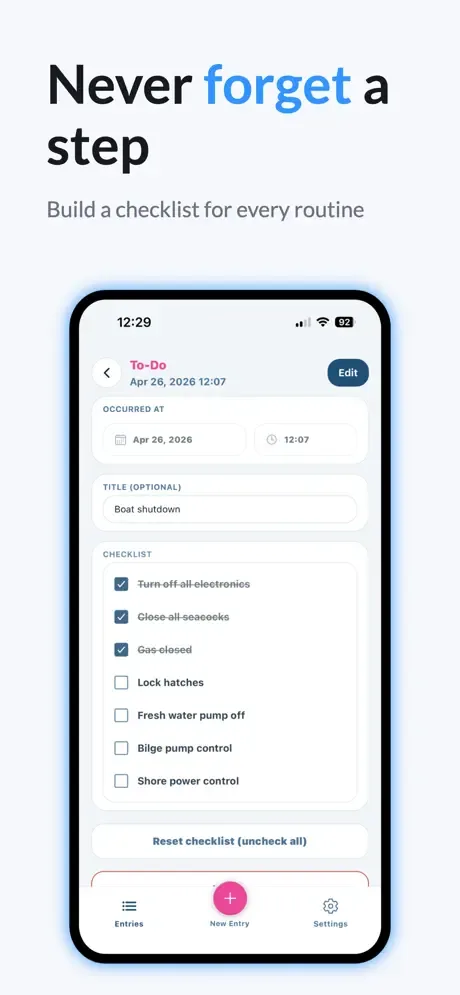
| To-Do | Reusable checklists for the routines you repeat |
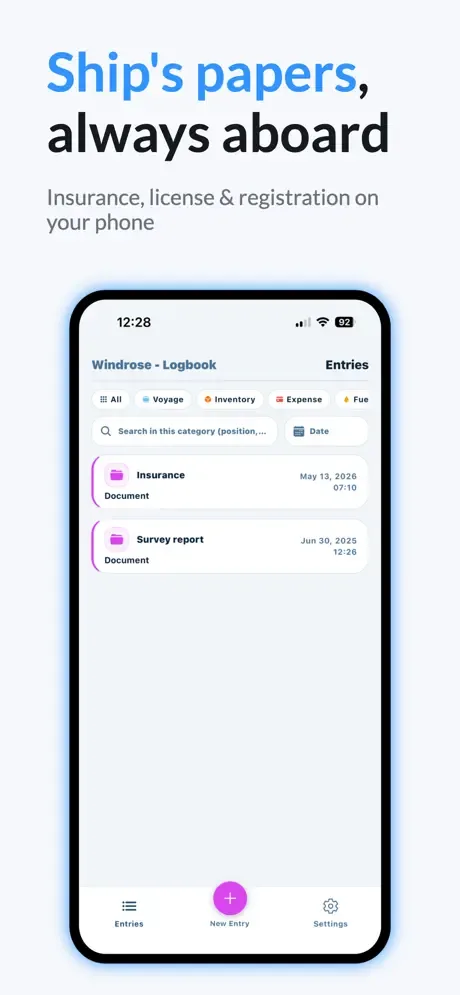
| Document | Insurance, registration, licence — aboard on your phone |
| Note | Everything that does not fit a form |
What It Looks Like
Three Things It Is Genuinely For
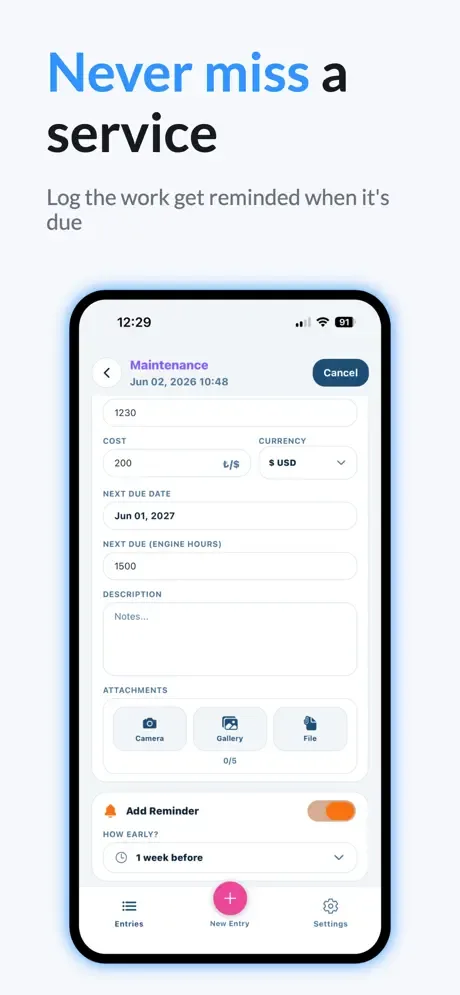
Never missing a service
Every maintenance entry can carry a next-due date and a next-due engine-hours figure, with a reminder before it lands. Boat jobs run on three clocks — the calendar, the hours, and the condition of the part — and a reminder that understands two of them is the difference between a service history and a pile of receipts.
Finding the part you already own
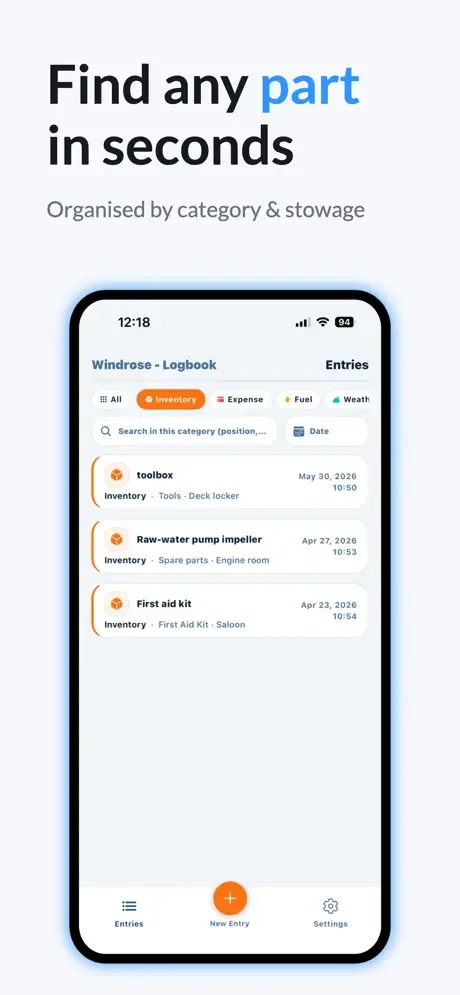
The inventory records what is aboard and where it is stowed — the raw-water pump impeller in the engine room, the first aid kit in the saloon, the toolbox in the deck locker. Most boats own the spare twice because nobody could find the first one.
Knowing what the boat actually costs
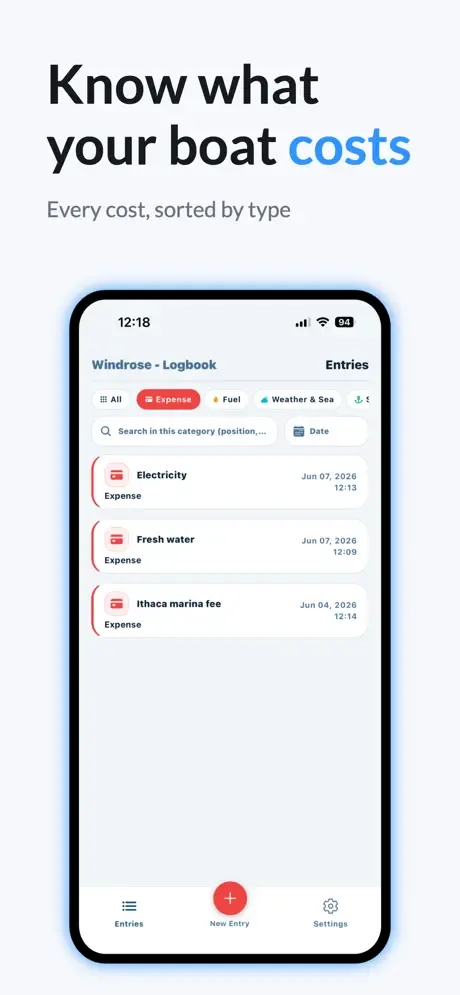
Fuel, marina fees, parts and yard bills logged as they happen add up to the number almost nobody has: the real annual cost of the boat. That matters more than it sounds — as we worked through in the cost of living on a sailboat, the bucket that wrecks budgets is the one that arrives in lumps and gets averaged away.
The day it pays for itself
A documented service history is worth real money when you sell, and it is what an insurer or a surveyor asks for when something has gone wrong. Marine Logbook exports to PDF and CSV, so the record leaves the app in a form somebody else will accept — which is the one thing a shoebox of receipts cannot do.
The Practical Details
- Works offline. Everything is on the device; iCloud backs it up when you are back in range.
- Photos and files attach to entries. A receipt, a wiring diagram, the survey report.
- Search across everything, or filter down to one category.
- Export to PDF or CSV whenever you need to hand the record to someone.
- The log carries your boat's name, so it reads as her record rather than a generic app.
- iPhone, iPad and Mac, in seven languages, with dark mode for the nav station.
- Free to download, with an optional subscription at $3.99 a month or $9.99 a year.
And While You Are at Anchor
Marine Logbook records what happened. Its sister app watches what is happening right now: Safety Anchor Alarm keeps a GPS anchor watch on your position all night and wakes you if the boat leaves its circle. Both are free to start, and between them they cover the two things a boat needs remembering for — the night you are asleep, and the year you are not looking.
Marine Logbook Questions
What is a marine logbook?
Is there an app to replace a paper boat log book?
Can it remind me when a service is due?
Does it work offline?
How much does Marine Logbook cost?
Read next
Boat Maintenance Checklist
The schedule on three clocks — calendar, engine hours and condition.
MaintenanceHow to Winterize a Boat
Every lay-up is also next spring's instructions — if you wrote it down.
SeamanshipBoat Pre-Departure Checklist
The five-minute routine — the kind of list worth keeping reusable.
Cruising LifeThe Cost of Living on a Sailboat
Three budgets, and why the one that arrives in lumps is the one to log.