Boat Pre-Departure Checklist
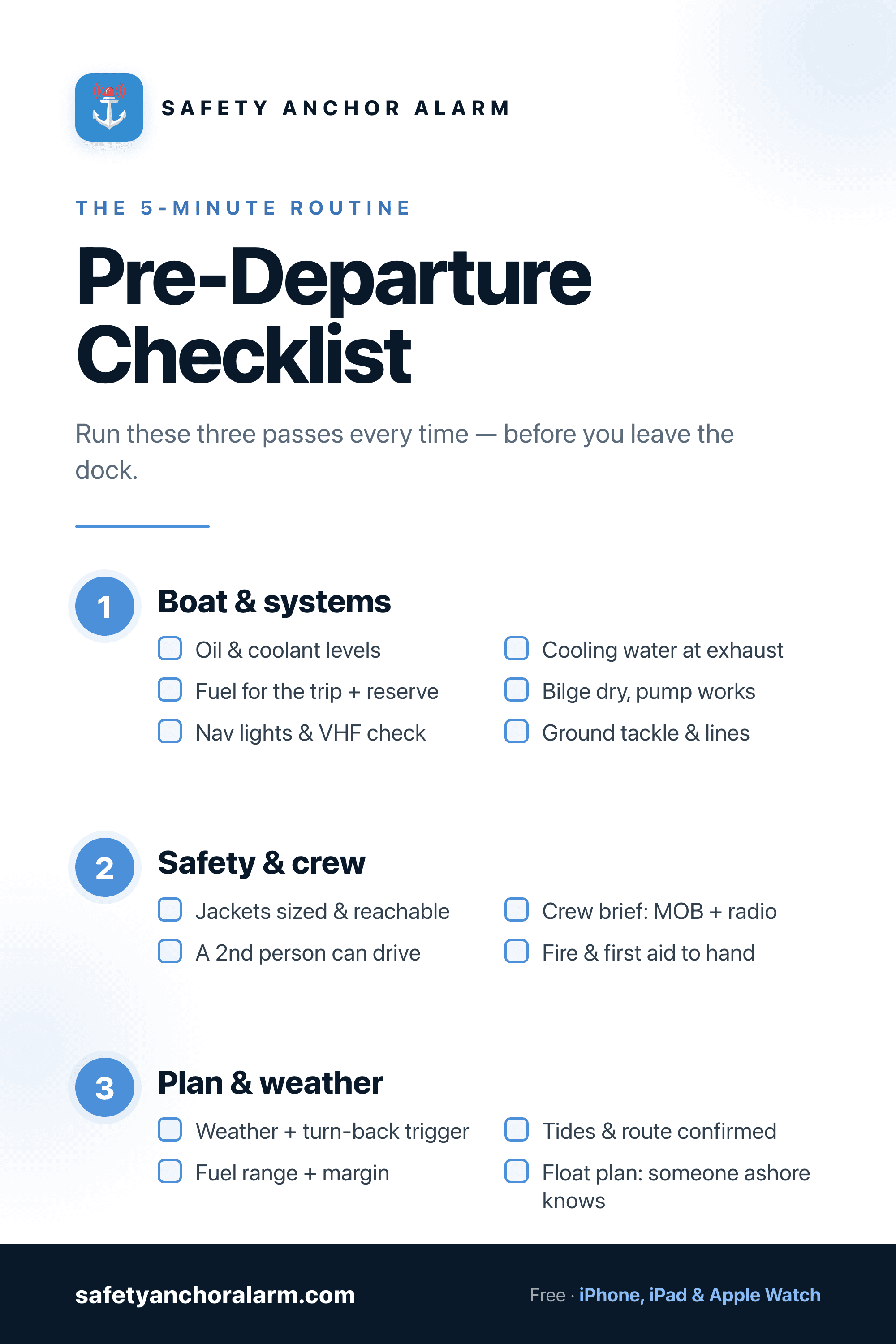
Before you leave the dock, run three quick passes: the boat and systems (fuel and oil levels, coolant, bilge dry, seacocks, steering, engine starts and throws cooling water, nav lights), safety and crew (jackets located and sized, crew briefed on man-overboard and the radio, fire and first aid to hand), and the plan (weather window, tides, route, fuel for the trip plus a margin, and someone ashore told when you are due back). It takes about five minutes, you do it every single time, and it works because it asks a different question from the maintenance schedule and the safety-gear list — not “is the boat sound?” but “is it ready to leave right now?”
Pass One — The Boat & Systems
This is the walk you do with one foot still on the pontoon. You are not servicing anything — that is the maintenance schedule's job — you are confirming that what was fine last time is still fine today.
- Engine, before the key. Oil and coolant levels, a look under the engine for fuel, oil or water, raw-water seacock open and strainer clear, belt tight.
- Engine, after the key. Cooling water out of the exhaust within a minute — no water, stop and find out why. Alarm buzzer silent, oil pressure and charge good.
- Fuel and water. Enough for the trip you are actually doing plus a reserve, not just “some in the tank”.
- Bilge. Dry, and the pump plus its float switch work when you test them.
- Steering and controls. Wheel or tiller full lock to full lock, throttle and gear crisp.
- Lights and electronics. Nav lights if there is any chance of being out after dark — check each one separately, since a dead sidelight changes what you are telling other boats — plus a VHF radio check, chartplotter and depth alive.
- On deck. Ground tackle ready and the bitter end made fast, dock lines and fenders sorted for the departure you are about to make, hatches shut.
Pass Two — Safety & Crew
The gear being aboard is the safety-equipment list's job; this pass is about it being reachable and your crew knowing what to do with it.
- Life jackets. One per person actually aboard, the right size, and where the person can reach it — not sealed under a cushion.
- The brief. Even with regulars, thirty seconds: where the jackets, flares and fire extinguisher are, how to make a VHF distress call, and what to do if someone goes over the side.
- One other person who can drive the boat. If you are the only one who can bring her home, you are single point of failure — brief a second person on the basics.
- First aid and fire to hand. You know where they are; make sure a guest would too.
Pass Three — The Plan & The Weather
The first two passes are about the boat. This one is about the day, and it is the pass most often skipped in good weather — which is exactly when a forecast turns.
- Weather window. Wind, gusts and sea state for the whole time you will be out, not just the hour you leave. Know your turn-back trigger before you go.
- Tides and route. Height and stream for your departure, passage and arrival; a quick look at hazards and the bolt-holes along the way.
- Fuel range. Enough for the planned trip and a margin for wind, current or a change of plan.
- The float plan. Tell a reliable person ashore your boat, your crew, your route, and the time to raise the alarm if they haven't heard from you. This is the single highest-value, lowest-effort line on the whole checklist: rescue starts far faster when someone knows you are overdue than when a stranger happens to notice.
Four Lists People Confuse — and Why It Matters
“Boat checklist” gets used for four completely different documents, and treating them as one is how something falls through the gap. Each answers a different question and runs on a different clock.
| Document | Question it answers | When / clock |
|---|---|---|
| Pre-departure check | Is the boat ready for this trip, right now? | Every departure |
| Maintenance schedule | Is the boat sound over the season? | Hours & calendar |
| Safety-equipment list | Is the required gear aboard and in date? | Annual / by law |
| Float plan | Does someone ashore know where I am? | Every departure, told to a person |
A perfectly maintained boat with a locker full of in-date flares can still leave the dock with an empty fuel tank, a crew who has never heard the word “man overboard”, and nobody ashore expecting them back. The pre-departure check is the only one of the four that catches that, because it is the only one about this trip, right now.
Make It a Habit, Not a Memory Test
The reason experienced crews use the same five-minute routine every time is that memory is the first thing to go when you are keen to get out in a fair-weather window. Run the three passes in the same order every departure and it stops being a checklist and becomes muscle memory. Keep the list somewhere you will actually see it — taped by the companionway, or as a reusable checklist in a logbook or sailing app you tick off and that timestamps the departure — and the one time the routine catches the open seacock or the flat starter battery pays for every time it didn't.
The Check After the Check: Arriving at Anchor
The pre-departure check gets you safely off the dock; it does nothing for the other end of the day. When you drop the hook for the night, run its mirror image — confirm the depth and a full circle of swing room, veer enough scope for the depth and wind, set the anchor by backing down, take a transit ashore, and set an anchor alarm to your own swing circle so a wind shift at 03:00 wakes you instead of the sound of the keel finding the bottom. If you sleep aboard, read how to anchor overnight for the full arrival routine.
Keeping the List Somewhere You Will Use It
A pre-departure check only works if it is the same check every time, which is an argument for a reusable list rather than memory. A marine logbook keeps these as to-do templates you tick off and reset for the next trip, alongside the maintenance record that tells you whether the thing you are checking was ever serviced.
The Bottom Line
A pre-departure checklist is not the maintenance schedule, the safety-equipment list or the float plan — it is the five-minute check that ties all three to this trip. Three passes: the boat and its systems, the crew and their safety, the plan and the weather. Do it in the same order every time until it is a habit, and finish the day with its opposite number — a properly set anchor and an anchor alarm on the nights you stay aboard.

Safety Anchor Alarm
GPS-powered anchor monitoring for iPhone, iPad and Apple Watch. The check the pre-departure list can't make for you — set the alarm to your own swing circle at anchor and it watches your position while you sleep, waking you the moment the boat starts to drag.
Download FreeFrequently Asked Questions
What should be on a boat pre-departure checklist?
How is a pre-departure check different from boat maintenance?
What checks should you do before starting a boat engine?
Should you tell someone before going boating?
What should you check before anchoring for the night?
Related Articles
Boat Maintenance Checklist
The seasonal schedule the pre-departure check assumes is already done — by interval and by system.
SafetyBoat Safety Equipment Checklist
What the Coast Guard requires by boat length, and when each dated item expires.
GuideHow to Anchor a Boat Overnight
Scope, setting, swing room and the overnight routine, step by step.
ToolAnchor Scope Calculator
How much rode to carry and what alarm radius to set for your depth and boat size.