Boat Safety Equipment Checklist
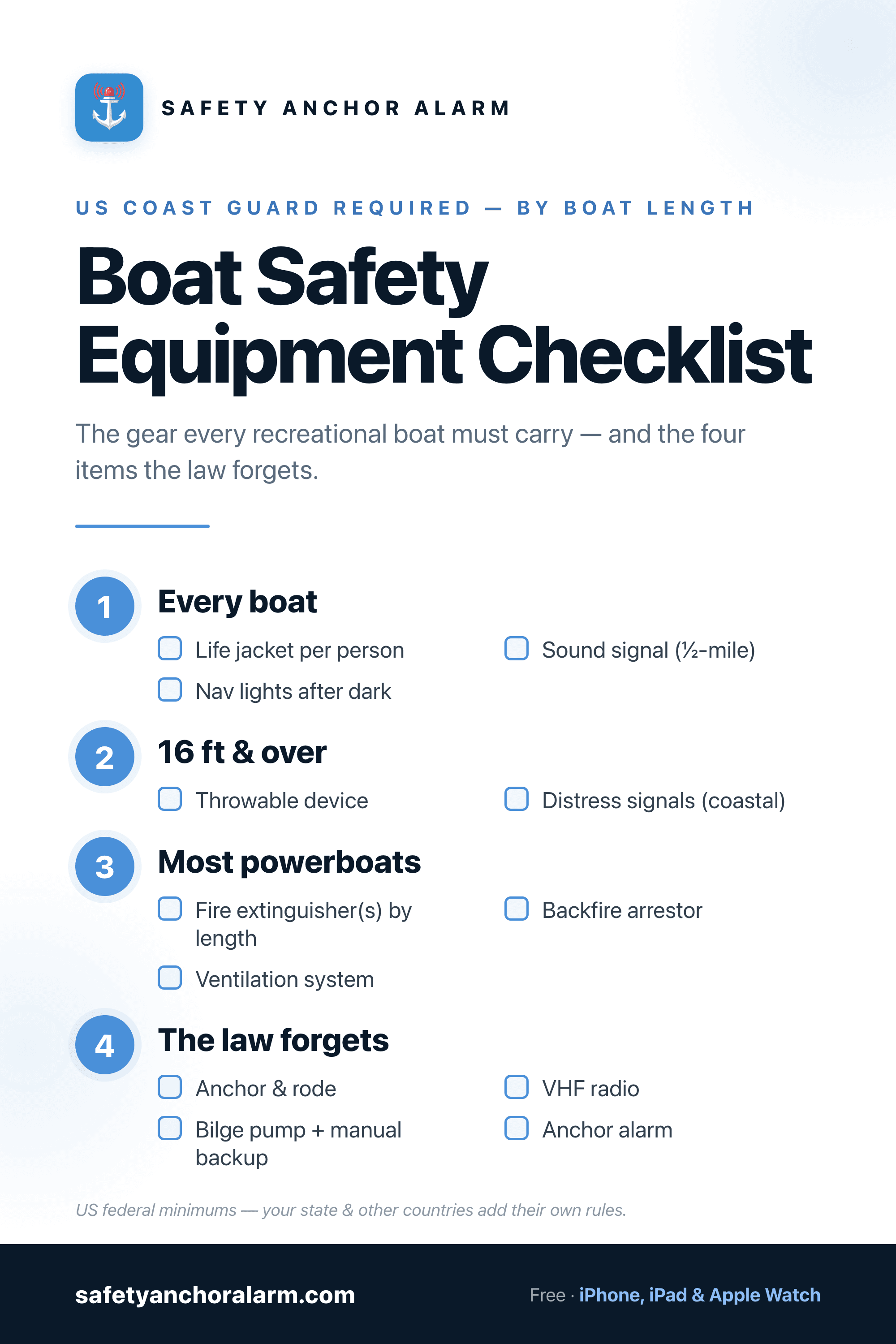
Every recreational boat in US waters must carry a Coast Guard-approved wearable life jacket for each person aboard, a sound-producing device audible for half a mile, and navigation lights if it runs after dark. Boats 16 ft and over add a throwable device; most powerboats add a fire extinguisher; coastal boats add visual distress signals; and boats under 26 ft must use an engine cut-off switch link. Below is the full requirement table by boat length, the two fire-extinguisher rules that fail more safety checks than anything else, and the gear that isn't on the legal list but is the reason people get home.
The Checklist, by Boat Length
Federal requirements scale with the length of the boat, not with how far you go. The table below is the federal minimum for recreational vessels in US waters. Your state adds to it — child life jacket ages, boater education cards, sometimes a second throwable — but no state subtracts from it.
| Equipment | Under 16 ft | 16 – 26 ft | 26 – 40 ft | 40 – 65 ft |
|---|---|---|---|---|
| Wearable life jackets | One per person | One per person | One per person | One per person |
| Throwable device (Type IV) | Not required | One, immediately available | One, immediately available | One, immediately available |
| Fire extinguishers (no fixed system) | 1 | 1 | 2 | 3 |
| Visual distress signals (coastal waters) | Night signals only, if out after dark | 3 day + 3 night, or 3 combination | 3 day + 3 night, or 3 combination | 3 day + 3 night, or 3 combination |
| Sound-producing device | 4-second blast, audible ½ mile | 4-second blast, audible ½ mile | 4-second blast, audible ½ mile | Whistle + bell at 65 ft (20 m) and over |
| Navigation lights | Sunset–sunrise and restricted visibility | Sunset–sunrise and restricted visibility | Sunset–sunrise and restricted visibility | Sunset–sunrise and restricted visibility |
| Engine cut-off switch link | Required (engine 3 hp or more) | Required (engine 3 hp or more) | Not required | Not required |
| Backfire flame arrestor | Petrol inboard engines | Petrol inboard engines | Petrol inboard engines | Petrol inboard engines |
| Ventilation system | Enclosed petrol engine/tank spaces | Enclosed petrol engine/tank spaces | Enclosed petrol engine/tank spaces | Enclosed petrol engine/tank spaces |
| Marine sanitation device | If an installed toilet is fitted | If an installed toilet is fitted | If an installed toilet is fitted | If an installed toilet is fitted |
| Oil & garbage placards | Not required | Not required | Both required | Both required |
Life Jackets: The Item That Is Almost Never Missing, and Almost Always Wrong
Boats rarely fail an inspection for having no life jackets. They fail for having the wrong ones, or the wrong number, or ones nobody could reach in time. The rule is one Coast Guard-approved wearable per person on board — not per berth, not per usual crew, per person actually aboard that day. Each has to be the right size and weight range for the person it is meant for, in serviceable condition, and readily accessible, which means not sealed in a vacuum bag under the V-berth cushions. The old Type I to V names and the new Level 50, 70 and 100 labels are decoded in the life jacket types guide.
Boats 16 ft and over also carry a throwable device — the ring or horseshoe buoy — and the standard for it is stricter: immediately available, meaning within arm's reach of the helm, not stowed. Inflatable life jackets only count as approved when they are actually being worn by anyone over 16, and they need their cylinder and bobbin checked; an inflatable with a spent cartridge is a shoulder bag with a whistle on it.
State law then layers on top, most commonly a hard requirement that children under a set age wear a life jacket at all times while under way. That age differs by state, so check the one you are boating in rather than the one you are registered in.
Fire Extinguishers: The Two Rules That Catch Everyone
More boats fail a Vessel Safety Check on extinguishers than on any other item, and it is almost never because there isn't one aboard. It is because of two rules that arrived quietly.
Rule one: a disposable extinguisher is expired 12 years after the date of manufacture stamped on the bottle — regardless of what the pressure gauge says. A full-reading, never-used extinguisher bought with the boat in 2013 is not legal equipment in 2026. Rechargeable extinguishers escape the 12-year wall, and since April 2022 recreational boats no longer need annual professional servicing, but a unit that has been fired at all must be recharged before it counts again. Which boats are exempt, which agent to choose and where to mount them are in the fire extinguisher requirements guide.
Rule two: boats of model year 2018 and newer must carry extinguishers labelled 5-B, 10-B or 20-B. The older B-I and B-II labels are only acceptable on boats built 2017 or earlier, and only while the extinguisher remains serviceable. Two more details trip people up: a 10-B counts only as a single 5-B despite holding more agent, and one 20-B may substitute for two 5-B units.
| Boat length | No fixed system | With fixed system |
|---|---|---|
| Under 16 ft | 1 | 0 |
| 16 to under 26 ft | 1 | 0 |
| 26 to under 40 ft | 2 | 1 |
| 40 to 65 ft | 3 | 2 |
An outboard-powered boat under 26 ft built so that petrol vapour cannot collect — no enclosed engine space, no built-in tank, no closed compartments where a portable tank lives — is exempt. Very few boats actually meet all of those conditions, so treat the exemption as something you have to prove rather than assume.
Visual Distress Signals: Where They Apply and When They Expire
Visual distress signals are only federally required on coastal waters — the Great Lakes, territorial seas, and waters directly connected to them up to a point where they narrow to two miles wide. On a small inland lake they aren't required at all, which is why so many boaters have never owned a flare.
Where they do apply:
- Boats 16 ft and over carry signals approved for both day and night use: three pyrotechnic day signals plus three night signals, or three day/night combination flares.
- Boats under 16 ft need night signals only, and only when operating between sunset and sunrise.
- Pyrotechnics expire. Flares must be within 42 months of their manufacture date. Out-of-date flares can stay aboard as extras — many crews keep them for exactly that — but they do not count towards the required three.
- The non-pyrotechnic route never expires. An orange distress flag for daytime plus a Coast Guard-approved electric SOS distress light for night satisfies the requirement with nothing to replace every three and a half years and nothing burning in your hand.
Engine Cut-Off Switch: The Newest Requirement
Since April 2021, operators of recreational vessels under 26 ft with an engine of 3 hp or more must use the engine cut-off switch link — the lanyard or wireless fob that kills the engine if the operator leaves the helm. Note the wording: not carry, use. The requirement applies when the boat is on plane or above displacement speed, and is relaxed for docking, trolling and operating from an enclosed cabin. It exists because a runaway boat circling back on the person who fell off it is one of the ugliest accidents on the water, and it is entirely preventable by a $10 clip.
What Isn't Required — and Matters More After Dark
The federal list is a floor, not a plan. It says nothing about the two things most likely to end a cruise badly: losing propulsion, and losing your anchorage overnight. Nothing in it requires an anchor.
- Anchor and adequate rode. Not required by law; the single piece of gear that stops a boat with a dead engine being set down on a lee shore. Size the rode for the deepest water you anchor in — our anchor scope calculator gives you the numbers for your depth and boat length.
- VHF radio. A phone loses signal offshore and calls one person; a VHF DSC call reaches the Coast Guard and every boat within range simultaneously. Beyond VHF range, a PLB, an EPIRB or a satellite messenger takes over; the beacon comparison explains which does what.
- Bilge pump and a manual backup. Electrical pumps stop when the battery goes under.
- First aid kit, spare fuel filters, tool roll. The unglamorous half of self-sufficiency.
- An anchor alarm. If you sleep aboard, the overnight watch is the gap in every legal checklist — nobody regulates whether you notice the anchor letting go at 03:00.
That last one is the reason this site exists. A GPS anchor alarm set to your own swing circle — rode out, plus boat length, plus a small GPS margin — stays silent while you swing normally and wakes you the instant the boat leaves that circle. Set it that way and read the overnight anchoring routine for the rest of the night watch; if you sail short-handed, solo anchor safety covers the same ground with no second pair of eyes.
Outside US Waters
The equipment list above is federal US law. Elsewhere the same gear appears under different authority:
- UK. There is no equivalent statutory equipment list for private pleasure craft under 13.7 m. The RYA and MCA publish strong recommendations instead, and your insurer or charter contract effectively becomes the requirement.
- EU / Mediterranean. Requirements are national and tied to how far offshore you go — France, Spain, Italy, Croatia and Greece each set their own zone-based lists (typically a coastal band and a 6-mile, 12-mile and offshore tier), and charter boats are surveyed against them. Croatia and Greece also require the boat's papers aboard alongside the gear; see anchoring rules in the Mediterranean for the permit and fee side of the same trip.
- Chartering anywhere. The boat comes with its inventory, but you sign for it. Walk the list at handover — flare dates, extinguisher stamps, jacket sizes for your actual crew — because on the water it is your problem, not the base's.
Make It a Recurring Check, Not a One-Off
Almost everything on this list has a date on it: flares at 42 months, disposable extinguishers at 12 years, inflatable jacket cylinders and hydrostatic bobbins on their own cycles, and a registration that renews. They all expire quietly, in a locker, between seasons.
The practical fix is to write the dates down once — item, location aboard, expiry — and check that record at the start of each season rather than rediscovering it during an inspection. Book a free Vessel Safety Check with the Coast Guard Auxiliary or US Power Squadrons if you want a second pair of eyes; there is no penalty for failing one, which makes it the cheapest way to find out what you are missing.
The Dates Are the Hard Part
Almost everything on this page carries an expiry: flares, the extinguisher's manufacture stamp, the liferaft service, the EPIRB battery. None of them announce themselves, and they never fall due at a convenient time. Logging each one with its next-due date in a marine logbook turns a shelf of dated equipment into something that reminds you before an inspection does.
The Bottom Line
Carry a wearable life jacket for every person aboard, a throwable if you are 16 ft or over, the right number of in-date extinguishers for your length, distress signals if you go coastal, a horn, lights after dark, and a cut-off switch link if you are under 26 ft. Then check the dates on all of it before the season, not during it. And because no regulation covers the hours you spend asleep at anchor, add the two things the law forgets: an anchor sized properly for your water, and an anchor alarm set to your own swing circle.

Safety Anchor Alarm
GPS-powered anchor monitoring for iPhone, iPad and Apple Watch. The safety item no regulation lists — set the alarm to your own swing circle and it watches your position while you sleep, waking you the moment the anchor starts to drag.
Download FreeFrequently Asked Questions
What safety equipment is required on a boat?
How many fire extinguishers does a boat need?
Do boat fire extinguishers expire?
Are visual distress signals required on all boats?
Is an anchor required safety equipment?
Related Articles
Night Anchoring Safety Tips
The routine that turns a night at anchor from a vigil into actual sleep.
SafetySolo Sailor Anchor Safety
Anchoring and standing watch alone, with no second pair of eyes.
ToolAnchor Scope Calculator
How much rode to carry and what alarm radius to set for your depth and boat size.
GuideHow to Anchor a Boat Overnight
Scope, setting, swing room and the overnight routine, step by step.