Boat Fire Extinguisher Requirements: How Many, Which Rating, When They Expire, and the Ten Seconds That Count
The small red bottle in the cockpit locker holds about ten seconds of powder. Everything the Coast Guard requires, and everything worth adding, is really about those ten seconds: whether the bottle is legal, whether it works, whether you can reach it, and whether you know what you will do with it. This guide takes the requirements straight from the regulation, which moved to a new part of the federal code in 2022 and changed more than most checklists noticed. It covers which boats must carry an extinguisher, how many, which labels count, when they expire, what “serviceable” now means, which agent to choose, where to mount them, how to use one, and what fire looks like at anchor.
The short answer
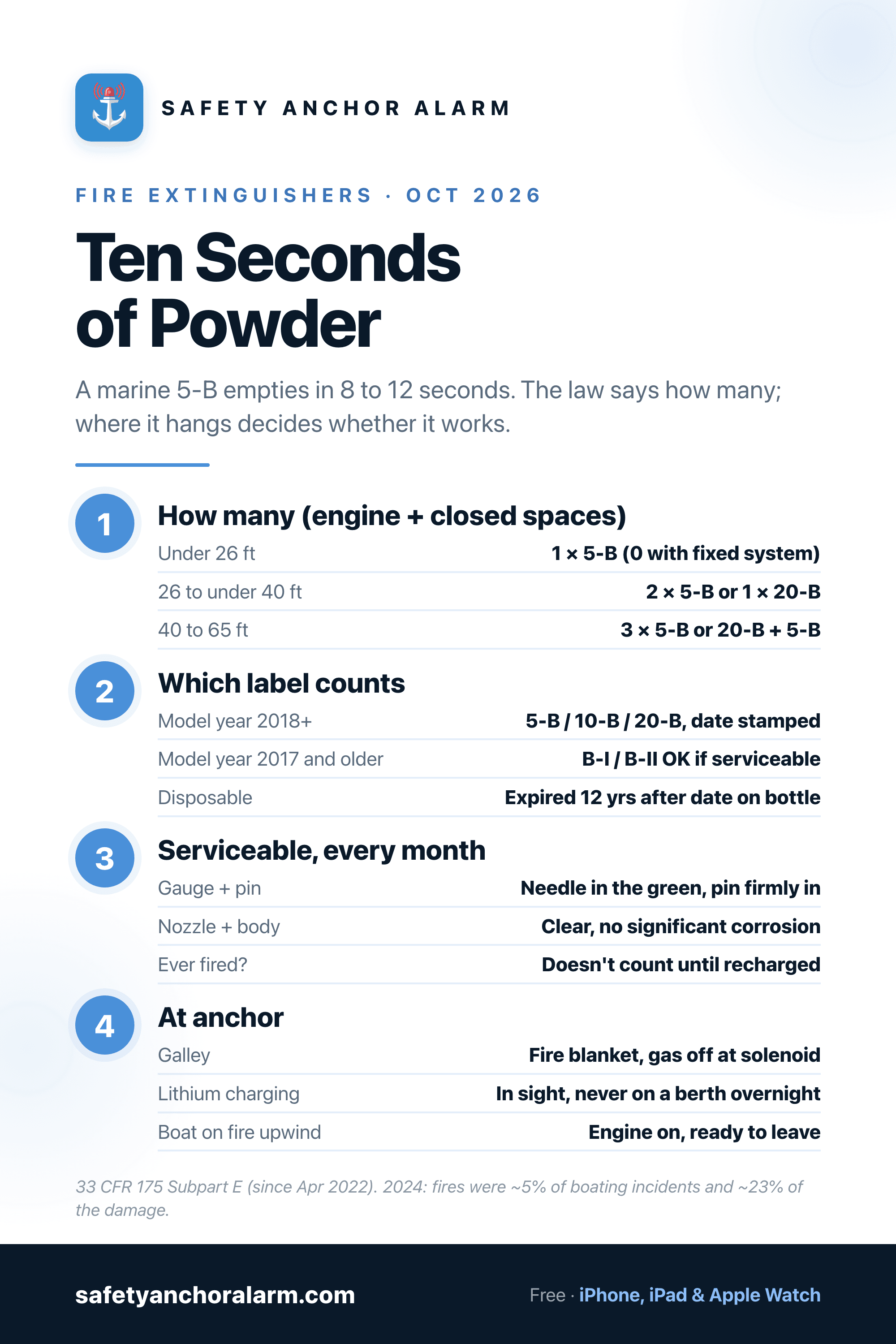
Under 33 CFR 175.320, a recreational boat with an engine carries Coast Guard-approved portable extinguishers by length: one 5-B under 26 ft, two 5-B (or one 20-B) from 26 to under 40 ft, and three 5-B (or a 20-B plus a 5-B) from 40 to 65 ft, one fewer with a fixed system in the engine space. Outboard boats under 26 ft are exempt only if nothing on them can trap fuel vapour: no cabin, no built-in tank, no closed lockers for tanks or flammables. Boats of model year 2018 and newer need 5-B, 10-B or 20-B units with a date stamp; older boats may keep serviceable B-I and B-II units. A disposable extinguisher is expired 12 years after its date of manufacture. Every unit must be readily accessible, unused, with the gauge in the green, the pin in, the nozzle clear and no significant corrosion. A typical marine 5-B empties in 8 to 12 seconds, so where it hangs matters as much as how many you carry.
How Many Extinguishers, by Boat Length
From table 1 of 33 CFR 175.320. “Fixed system” means an approved fixed extinguishing system in the machinery space. Larger ratings always satisfy a smaller requirement, but the only substitution the rule allows is one 20-B for two 5-B.
| Length | No fixed system | With fixed system | Typical boats |
|---|---|---|---|
| Under 16 ft | 1 × 5-B | 0 | PWC, bass boat, small runabout with a built-in tank |
| 16 to under 26 ft | 1 × 5-B | 0 | Bowrider, centre console, trailer sailer with a cabin |
| 26 to under 40 ft | 2 × 5-B, or 1 × 20-B | 1 × 5-B | Most cruising sailboats and express cruisers |
| 40 to 65 ft | 3 × 5-B, or 1 × 20-B + 1 × 5-B | 2 × 5-B, or 1 × 20-B | Large cruisers, motor yachts |
| Over 65 ft | By gross tonnage, in 20-B units, plus engine-room units | Superyachts |
Why the Rules Exist: Fuel, and Fire That Spreads
Boat fires are rare and expensive. In the Coast Guard's 2024 statistics, fire or explosion was the primary event in 208 of 3,887 reported incidents, about one in nineteen, but those fires accounted for roughly $20 million of the $88 million in reported property damage: nearly a quarter of all the damage from about 5% of the incidents. Most of them, 124, were fuel fires in or around the engine.
That is the hazard the rule is written for. When the Coast Guard rewrote the extinguisher rules in 2021 it looked at 1,175 fire and explosion incidents with a known cause from 2015 to 2019 and found 68% were fuel related, which is why the federal requirement is for Class B extinguishers, the class for flammable liquids. The same statistics carry a second warning in one line: the 26 fires of unknown origin in 2024 involved 69 vessels. Fire moves from boat to boat, in marinas and in tight anchorages, and the next section of this guide that matters to you may be about somebody else's boat.
Which Boats Must Carry One: It Is the Closed Spaces
The rule applies to every recreational vessel propelled by machinery, and then exempts one group: a boat under 26 ft, driven by an outboard, whose construction will not let explosive or flammable vapour collect. The regulation spells out what destroys that exemption. If any one of these is aboard, the boat needs an extinguisher:
| Condition | What it means in practice |
|---|---|
| Closed compartment under seats or thwarts | Where a portable fuel tank may be stowed. The tank does not have to be there today. |
| Double bottom | Not sealed to the hull, or not completely filled with flotation: vapour can pool in it. |
| Closed living space | A cuddy, a cabin, a head compartment. This is the one that catches small sailboats with an outboard. |
| Closed stowage for flammables | A locker holding fuel, oil, paint, solvents or other combustibles. |
| Permanently installed fuel tank | Any built-in tank, which is why every PWC and almost every console boat needs one. |
Bait wells, glove boxes, ice chests, open slatted floors and buoyant foam do not count. Read the list again and the logic is plain: the danger is not the engine but somewhere for heavier than air fuel vapour to pool out of sight. Two consequences surprise people. A small sailboat with an outboard and a cabin needs an extinguisher because of the cabin, not the motor. And a personal watercraft always needs one, because it has a built-in tank and a closed engine bay. A sailboat with no engine at all is outside the rule, though a stove aboard is a good reason to carry one anyway.
Which Labels Count: 5-B, 20-B and the Old B-I
For fifty years marine extinguishers carried a Coast Guard classification, B-I or B-II. The 2016 fire-protection rule dropped that system for the UL ratings used ashore, in which the letter is the class of fire and the number in front of it is the relative size of fire the unit put out in testing: 5-B replaced B-I, 20-B replaced B-II, and a 10-B sits between them. The rule that took effect on 20 April 2022 drew the line owners now live by:
- Model year 2018 and newer: 5-B, 10-B or 20-B extinguishers that carry a date of manufacture. A B-I does not count, however new it looks.
- Model year 1953 to 2017: either dated 5-B and 20-B units, or B-I and B-II units, as long as they are in good and serviceable condition.
- The only substitution: one 20-B for two 5-B. A 10-B satisfies a 5-B requirement but counts as one extinguisher.
To count at all, an extinguisher must be Coast Guard approved: the label says “Marine Type USCG Approved” with an approval number, and the approved list is public on the Coast Guard's CGMIX equipment database. Every Class B unit on the market also carries an A or C rating, or both, so the B:C or A:B:C on the label is not a choice between legal and illegal but between agents, which the section after next deals with.
When an Extinguisher Expires, and What Serviceable Means
The 2022 rule replaced a regime that had never suited boats. Since 2016, recreational owners had technically been bound by NFPA 10, the shore standard: monthly visual inspections, annual maintenance and written records, with rechargeable units serviced by a certified technician. The Coast Guard accepted that this was a real burden on people whose boat sits on a trailer for half the year, took recreational boats out of NFPA 10, and wrote a shorter standard into 33 CFR 175.310. Every portable extinguisher must:
- Be on board and readily accessible.
- Be of an approved type.
- Not be expired, and not appear to have been used. A unit that has been fired for a second, even if the gauge still reads green, does not count until it is recharged or replaced.
- Be in good and serviceable condition, which the regulation defines in four points: the gauge or indicator in the operable range, the lock pin firmly in place, the discharge nozzle clean and clear, and no visible signs of significant corrosion or damage.
“Expired” has a precise meaning for disposable (non-rechargeable) units, which is what almost every boat carries: one with a UL mark and a date of manufacture is expired 12 years after that date, regardless of the gauge. The date is stamped into the bottom of the bottle or printed as a year beside the UL label, and the bottle itself says it must be removed from service within 12 years. A boat bought new in 2014 with its extinguishers still in their brackets is carrying expired equipment in 2026. Rechargeable units have no 12-year limit under the federal rule; they last as long as they stay serviceable and are recharged after any use.
The federal rule sets no inspection interval, so set your own. Once a month in season, and at launch and haul-out: look at the gauge, the pin, the nozzle and the date, and on a dry-chemical unit, turn it upside down a few times and feel the powder fall. On a boat that vibrates for hours, powder can pack into the bottom of the bottle. A nozzle full of spider web or salt is the most common reason a unit that reads green fails a check.
Choosing the Agent
The legal minimum is any approved 5-B, which in practice is a 2 to 3 lb dry-chemical bottle. Beyond the minimum, the agent matters more than the size, because each one is good at different fires and bad for different things:
| Agent | Rating | Good for | The catch |
|---|---|---|---|
| Dry chemical, sodium bicarbonate | B:C | Fuel and electrical fires; the cheap standard marine unit | Powder everywhere; useless on embers in upholstery |
| Dry chemical, monoammonium phosphate | A:B:C | Covers cushions, wood and paper too | Residue turns corrosive with moisture: hard on engines and electronics |
| Carbon dioxide (CO2) | B:C | No residue at all | Heavy for its rating, blows away on deck, displaces the air in a small cabin |
| Clean agent (Halotron, FE-36) | B:C, some A:B:C | No residue, safe on electronics and engines | Several times the price of dry chemical for the same rating |
| Water, foam or a fire blanket | A (foam A:B) | Bedding, wood, paper; a blanket smothers a pan fire | Never water on fuel or a pan of oil |
A sensible cruising set uses the legal count as a floor and mixes agents: dry chemical at the helm and the companionway, where the job is a fuel fire and speed is everything; an A:B:C unit or a fire blanket within reach of the stove; and a clean agent unit near the main electrical panel and the engine, where a fire put out with phosphate powder can still cost you the engine. Fixed engine-room systems are clean agents too, fired by heat or by a pull handle at the helm, and they are normally wired to shut down the engines and blowers when they discharge, because a running engine draws the agent straight out of the compartment.
Where to Mount Them
The rule says “readily accessible” and leaves the rest to you. Ten seconds of agent means the extinguisher has to be in your hand within a few seconds of seeing smoke, so place them by the routes people move along, not the spaces that burn:
- Never only inside the space it protects. An extinguisher in the engine compartment, or in the locker under the stove, is in the fire.
- At every exit. One inside the companionway, one by the forward hatch on a boat you sleep on, so whoever wakes to smoke has one between them and the way out.
- At the helm, mounted, not loose in a locker under the lines and the fenders.
- In the bracket it came with, which is designed to hold it through a seaway. A loose bottle rolling in a cockpit locker gets its nozzle crushed and its pin knocked.
A fire port, a small hole with a cover in the engine box or hatch, lets you discharge a portable unit into the engine space without opening it. If you do not have one, the next haul-out is the time.
Using It: Ten Seconds
A typical marine 5-B empties in 8 to 12 seconds and reaches four to six feet. That is enough for a fire the size of a wastebasket and not for much more, so the decision before you pull the pin matters as much as the technique after it.
- Shout, and kill the fuel. Everyone on deck and into life jackets; engine off, fuel off, gas solenoid off, main battery switch off if the fire is electrical.
- Do not open the engine hatch. Air is what the fire wants. Discharge through the fire port, or crack the hatch only enough to get the nozzle in.
- Keep the wind at your back and stay between the fire and the way off the boat.
- Pull, aim, squeeze, sweep: pull the pin, aim at the base of the flames, not the smoke, squeeze, and sweep side to side until the bottle is empty.
- Watch it after. Fuel and upholstery reignite. Keep the second extinguisher in hand and the hatch shut.
Never put water on burning fuel or a pan of oil: it spreads the fire. A fire blanket or a lid smothers a pan fire. And decide in advance where the line is. If the first extinguisher has not put it out, the boat is no longer the safe place: Mayday on the VHF, everyone into the dinghy or the water in their jackets, and upwind of the boat. Fibreglass burns hot and fast; nobody has ever regretted leaving a fire too early.
Fire at Anchor
At anchor the engine is usually off, which removes the classic fuel fire and leaves three others.
The galley and the gas. Dinner for six on a two-burner stove, a pan of oil, and a boat swinging to a gust. Keep the fire blanket where the cook can pull it without reaching over the flame, shut the gas at the solenoid after every meal, and run the gas alarm if you have one: propane is heavier than air and settles in the bilge exactly like petrol vapour.
Charging. At anchor, everything gets charged at once: phones, power banks, drone and camera batteries, the electric outboard, an e-foil, sometimes a folding e-bike. The Coast Guard's 2025 safety alert on lithium-ion batteries puts the problem plainly: once a cell goes into thermal runaway it is very difficult to suppress, burns hotter and longer than other fires, and gives off toxic gas, so the strategy is early detection, containment and cooling with water. An extinguisher knocks the flames down; it does not stop the cell. Charge in sight, never on a berth overnight, and if a small device starts to hiss and smoke, it goes into a bucket of seawater or over the side if you can do that safely. The marine battery guide covers the lithium house bank, which is a different animal, built in with its own battery management system.
The boat upwind. The 69 vessels in 26 fires of unknown origin are the number to remember in a crowded anchorage. A burning boat upwind of you is a danger twice: the heat and embers coming down the wind, and its nylon rode, which melts, letting the boat drift down through the fleet. If you see it, start the engine, get the crew on deck, and be ready to lift the anchor or let it go on a buoyed line and come back for it.
Which is where the jobs divide honestly. The anchor alarm is not a smoke detector, and the smoke detector is not an anchor alarm. A boat you sleep on at anchor wants three alarms, each watching one thing: a smoke alarm in the saloon, a carbon monoxide alarm by the berths, and a position alarm on the phone, which the night anchoring checklist sets up properly. And after a night like the one above, when you have moved away from danger and re-anchored in the dark in a spot you did not choose, the position alarm is the one that lets you sleep again, because the hasty set is exactly the one most likely to drag.
The Bottom Line
The count is easy: one 5-B under 26 ft, two from 26 ft, three from 40 ft, one fewer with a fixed system, and a 20-B worth two 5-B. What decides whether a boat needs one at all is a closed space, not an engine. Boats from model year 2018 need dated 5-B, 10-B or 20-B units; disposables expire 12 years after the date on the bottle; and every unit must be reachable, unused, green on the gauge, pinned, clear at the nozzle and free of corrosion. Then go beyond the legal minimum: an extinguisher at every exit, a fire blanket by the stove, a clean agent by the panel, a fire port in the engine box, and a decision made in advance about when ten seconds of powder has done all it can.

Safety Anchor Alarm
The extinguisher is for the ten seconds after a fire starts. The anchor alarm on your phone is for the hours you are asleep, so that a drag wakes you while it is still a drag. Keep one in the bracket by the companionway; run the other every night.
Download Free