What Is an MMSI Number? How to Get One, Look One Up, and Why the Red Button Is Useless Without It
Every DSC radio and every AIS transponder asks for it before it will transmit, most of them let you type it exactly once, and the shop that sold the radio rarely explains what it is. The MMSI is the boat's phone number: nine digits that belong to the vessel, not to you and not to the set, that the red button sends to the coastguard and the transponder sends to every ship in range. This guide explains what the digits encode, how to get one in the US, the UK, Canada and Australia and what each costs, the domestic-only trap that catches US boats on their first trip to the Bahamas, why the radio locks the number after one entry, what to do with it when a boat or a radio changes hands, how to look one up, and the Coast Guard figure that says the registration behind the number matters more than the number.
The short answer
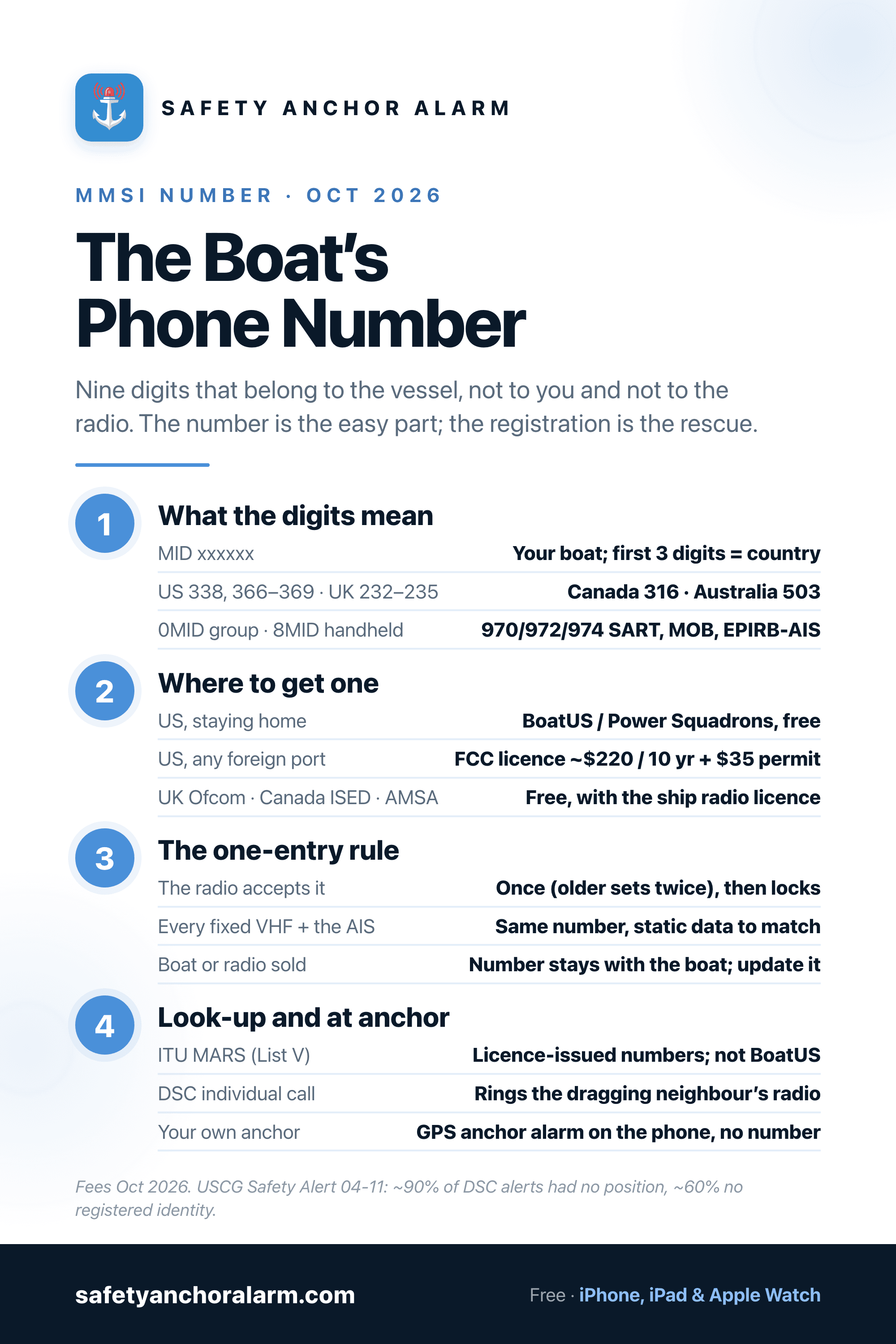
A Maritime Mobile Service Identity is a nine-digit number that identifies your boat in DSC and AIS. The first three digits are the country (338 and 366–369 US, 232–235 UK, 316 Canada, 503 Australia); the rest are assigned by the national regulator or an organisation it approves, and registered against the boat's name, type, length, colour and an emergency contact ashore. In the US a recreational boat under 65 ft that stays in US waters gets one free from BoatUS or the US Power Squadrons; a boat that will enter any foreign port, the Bahamas and Canada included, needs the FCC Ship Station Licence (about $220 for ten years) whose MMSI goes into the international database. In the UK it comes free with the Ofcom Ship Radio Licence; Canada and Australia issue it free. Enter it once, with the registration in front of you, because the radio locks it; give every fixed radio and the AIS the same number; and feed the radio a GPS. The Coast Guard found that roughly 90% of DSC distress alerts it received carried no position and 60% no registered identity, and those are the alerts it cannot act on. The number is the easy part; the registration is the rescue.
What the Nine Digits Mean
The scheme is set by the ITU and the shape of the number tells a receiver what kind of station is talking before it reads the rest. MID is the three-digit country code (the Maritime Identification Digits); x is any digit.
| Shape | What it is | Note |
|---|---|---|
| MID xxxxxx | A ship station: your boat | The ordinary case. Country code, then six digits the administration assigns. |
| 0 MID xxxxx | A group of ships | A fleet, a club, a rally. One DSC call rings every radio in the group. |
| 00 MID xxxx | A coast station | The coastguard. A DSC distress alert is acknowledged from one of these. |
| 111 MID xxx | A search-and-rescue aircraft | The helicopter that answers can call your radio by DSC. |
| 8 MID xxxxx | A handheld VHF with DSC | A portable that is not tied to one boat. Its own registration. |
| 98 MID xxxx | A craft carried by a parent ship | A tender, a liferaft, a rescue boat with its own transceiver. |
| 99 MID xxxx | An AIS aid to navigation | The buoy or the virtual mark on your plotter has an MMSI too. |
| 970 / 972 / 974 xxxxxx | AIS-SART / AIS MOB beacon / EPIRB with AIS | No country code: the next two digits are the manufacturer. Pre-programmed, never entered by you. |
The country codes you will meet
The first digit places the region: 2 is Europe, 3 is North America and the Caribbean, 4 is Asia, 5 the Pacific and South-East Asia, 6 Africa and the Atlantic islands, 7 South America. A country with a large fleet has several codes. The ones a cruising boat is most likely to see on an AIS screen:
| Region | Country · MID |
|---|---|
| North America & Caribbean (3) | United States 338, 366–369 · Canada 316 · Mexico 345 · Bahamas 308, 309, 311 · Bermuda 310 · BVI 378 · Antigua & Barbuda 304, 305 · St Vincent & the Grenadines 375–377 |
| Europe (2) | United Kingdom 232–235 · Ireland 250 · France 226–228 · Spain 224, 225 · Portugal 263 · Italy 247 · Malta 215, 229, 248, 249, 256 · Greece 237, 239–241 · Croatia 238 · Montenegro 262 · Slovenia 278 · Albania 201 · Turkey 271 · Germany 211, 218 · Netherlands 244–246 · Belgium 205 · Denmark 219, 220 · Norway 257–259 · Sweden 265, 266 · Finland 230 · Poland 261 · Gibraltar 236 · Monaco 254 |
| Asia & Pacific (4, 5) | Thailand 567 · Australia 503 · New Zealand 512 · Marshall Islands 538 |
| Open registries elsewhere | Panama 351–357, 370–374 · Liberia 636, 637 · Cayman Islands 617 |
Two things the table tells you on the water. A 3xx number on a charter yacht in the Caribbean is not necessarily American: 378 is a BVI boat, 375 to 377 a Grenadines one. And a ship whose name says Hamburg but whose number starts 351 is Panamanian for the purposes of its radio, which is who its flag administration is when the rescue centre needs the owner.
What the Number Does
Think of it as a phone number with caller ID. On the VHF, the Digital Selective Calling side of the radio (the red button and the menu behind it, explained in the VHF guide) uses it three ways. Held for five seconds, the red button sends a distress alert on channel 70 carrying your MMSI, the nature of distress if you selected one, and your position if the radio has a GPS feed; every DSC radio in range sounds its alarm and the coast station acknowledges by number. An individual call lets you dial another boat's MMSI, which rings that radio even if its crew have the volume down on 16, and switches both sets to a working channel. And a group call to a 0-prefix number rings every boat in a rally or a club at once.
On the AIS, the MMSI is simply who you are. The transponder broadcasts it in every position report, and the name, type and length you entered are attached to it in the static message every six minutes. A target that has an MMSI and no static data appears on a ship's bridge as a bare nine-digit number of unknown kind, which is the target an officer most easily ignores. The same number is what you register an EPIRB, an AIS MOB beacon or a DSC handheld against, so that a beacon going off at sea resolves to a boat in the rescue centre's database rather than to a serial number.
How to Get One, by Country
The ITU allots the country codes; each country decides who hands out the numbers and whether to charge. The pattern is the same almost everywhere: the MMSI comes with the ship radio licence, and the licence is free or nearly so. The United States is the exception, with two routes that are not interchangeable.
| Where | Who issues it | Cost | Valid | Recorded in |
|---|---|---|---|---|
| United States, staying in US waters | BoatUS · US Power Squadrons · Shine Micro (FCC-approved issuers) | Free (BoatUS: free to members, $25 otherwise) | US waters only; recreational, under 65 ft, not required by law to carry a radio | US Coast Guard database (MISLE) only |
| United States, visiting any foreign port | FCC Ship Station Licence (+ Restricted Radiotelephone Operator Permit) | About $220 for ten years ($150 regulatory fee + application fee) · permit $35 for life | Worldwide; required for Canada, Mexico and the Bahamas as much as for the Pacific | ITU international database (MARS / List V) |
| United Kingdom | Ofcom Ship Radio Licence (Ship Portable Radio Licence for a handheld) | Free online, for life; details must be revalidated every ten years | Worldwide; operator needs an SRC (one-day RYA course) | ITU international database |
| Canada | ISED (Innovation, Science and Economic Development Canada) | Free | Worldwide; Restricted Operator Certificate (Maritime) for the operator | ITU international database |
| Australia | AMSA, through the beacon registration site | Free | Worldwide; marine radio operator certificate for the operator | ITU international database |
| Elsewhere | The national telecoms regulator, with the ship radio licence | Free to a modest fee, by country | Worldwide; an SRC-equivalent operator certificate is the norm in Europe | ITU international database, where the administration notifies it |
The United States: free if you stay, $220 if you leave
A recreational boat under 65 ft that is not required by law to carry a radio needs no FCC licence to use a VHF in US waters, and the FCC has approved three organisations to issue MMSIs to such boats: BoatUS (free to members, $25 to anyone else), the US Power Squadrons (free) and Shine Micro. Sea Tow was the fourth for years and has withdrawn, which is worth knowing because older guides, and until recently this site, still name it. The form takes ten minutes: boat name, type, length, colour, home port, the people usually aboard, an emergency contact. The number arrives by email, and that is the whole process.
What the form says in its small print is the part that matters. The free number is for a boat that will not communicate with or visit a foreign port, and the examples the form gives are Canada, the Bahamas, Mexico and the Caribbean. It is recorded in the Coast Guard's own database only. A Bahamian rescue coordinator, or a Canadian one in the Gulf Islands, who receives a distress alert from a BoatUS number has no way to find out whose boat it is. For any foreign voyage the FCC requires a Ship Station Licence, about $220 for ten years (a $150 regulatory fee plus the application fee), which issues an MMSI that is notified to the ITU and therefore visible to every rescue centre in the world, and a Restricted Radiotelephone Operator Permit for the person using it ($35, valid for life, no exam). Boats over 65 ft and commercial boats need the FCC licence wherever they go.
The practical rule follows from the next section: decide before you program anything. A boat on the Chesapeake that will one day do the Bahamas should get the FCC number now, because the free number cannot be upgraded, only replaced, and replacing it means a dealer visit for the radio and another for the AIS.
The United Kingdom, Canada and Australia: it comes with the licence
In the UK every boat with a VHF needs a Ship Radio Licence from Ofcom, free when applied for online, issued for life, with the condition that you confirm the details every ten years. The MMSI and the call sign are generated with the licence and printed on it. A DSC handheld that is not tied to one boat gets a Ship Portable Radio Licence and its own 8-prefix number. The operator needs a Short Range Certificate, the one-day RYA course. Canada issues MMSIs free through ISED, and the operator needs the Restricted Operator Certificate (Maritime). Australia issues them free through AMSA on the same site that registers beacons. All three notify the number to the ITU, so a British boat in Croatia or a Canadian boat in Mexico is in the database the local rescue centre searches.
Why the Radio Only Lets You Enter It Once
The international DSC standard says that once the MMSI is stored, the user should not be able to change it without the manufacturer's involvement, and every radio sold in the last fifteen years honours that. Newer sets allow a single entry; older ones two; after that the menu greys out and the number is changed by the manufacturer or a dealer, sometimes by a remote procedure, sometimes by sending the set in. AIS transponders do the same. The reason is the one the whole system rests on: a number that could be edited by anyone would be a number nobody could trust on a distress alert.
So the sequence is fixed. Get the number first, from the right source for the waters you will visit. Register it fully. Then program the radio with the registration document in front of you, read the nine digits back before you confirm, and put the same number into every fixed VHF aboard and into the AIS, with the AIS static data (name, type, length) matching the registration word for word. The exceptions the Coast Guard allows are an AIS-SART, which is pre-programmed, and a handheld that is not dedicated to the boat, which carries its own 8-prefix identity. One boat, one number, every box.
When the Boat or the Radio Changes Hands
The Coast Guard's phrase is that the MMSI belongs with the vessel, not the user, and Ofcom's is that the call sign and MMSI stay with a vessel for life regardless of changes of ownership or name. The consequences for the six situations a boat owner actually meets:
| Situation | What to do |
|---|---|
| Buying a used boat | Ask for the MMSI and who issued it. US: the seller transfers the BoatUS registration to you, or you register the same number afresh. UK: the number stays with the vessel; the seller surrenders the licence, you apply for a new free one quoting the same MMSI and call sign. |
| Buying a used radio or AIS | It probably carries the previous boat's MMSI, locked. Have the dealer or manufacturer reset it before you fit it, then enter yours. A radio transmitting another boat's identity is an FCC violation and, worse, a wrong phone number on a distress alert. |
| Selling the boat | US: use the issuer's transfer (BoatUS has a 'Transfer to New Owner' button, which cancels your registration). UK: surrender the licence; the MMSI goes with the boat. Either way, update it, or the coastguard phones you about a boat you sold. |
| Replacing a radio, keeping the boat | Same number into the new set. The MMSI is the boat's, not the radio's, so nothing changes in the registration except, if they ask, the equipment list. |
| Adding an AIS transponder | Same number as the DSC radio, entered once, with the static data (name, type, length) matching the registration. One boat, one identity, every box. |
| Moving abroad with a US domestic number | Get the FCC licence and its new MMSI before you leave, and have the radio and AIS reprogrammed to it. The free number cannot be upgraded; it is replaced. |
The failure every rescue centre has seen is the stale registration: a boat sold three years ago, the radio still carrying its number, the emergency contact a previous owner's ex-wife in another state. The alert arrives, the number resolves, the phone call goes to someone who says they sold the boat. Updating a registration takes five minutes on the issuer's site and is the single most useful thing in this article.
How to Look an MMSI Up
The question comes up two ways: a boat on the AIS with no name, and a number in a DSC call log. Where you look depends on who issued the number. The ITU MARS database (the online form of List V, the List of Ship Stations) is free, public and holds about a million ship stations with name, call sign, flag and the administration that licensed them, but it contains only what national administrations have notified: FCC, Ofcom, ISED and most licence-issued numbers are there, the free US domestic numbers are not, because they live in the Coast Guard's database and are never sent to Geneva. The ITU's own FAQ says as much: if your number does not appear, your administration has not notified it.
For a vessel that carries an AIS transponder, MarineTraffic and VesselFinder show the name and type against the MMSI, because the vessel itself has broadcast them; a boat with no AIS, or a BoatUS number on a DSC-only radio, is invisible there. The first three digits you can always decode yourself from the table above, which is often enough to answer the question that prompted the search. What no public source gives you is the registration behind the number: the owner, the emergency contact, the description. That is held for the rescue centre, and it is the reason the number is worth registering rather than merely possessing.
The Registration Is the Rescue
When Rescue 21, the Coast Guard's coastal VHF network, came online, it could for the first time receive DSC distress alerts directly, and the first thing the Coast Guard learned from them was published as a safety alert in 2011: approximately 90% of the VHF DSC distress alerts it received contained no position, and approximately 60% no registered identity. Its wording was that it cannot effectively respond to such an alert, and that a search may be suspended when it cannot communicate with the vessel, cannot find out who the vessel is from any other source, and has no position. A red button pressed on a radio with no GPS wire and an unregistered number produces exactly that alert: a dot that is not on the chart, from a boat that is not in the book.
The fix is the two steps the alert asked for. Register the number and keep the registration current, so that the watchstander has the boat's description and someone to phone before you have finished saying your name on 16. And connect the GPS: most radios sold since the mid-2010s have one built in, the rest take a two-wire NMEA feed from the plotter, and the GPS guide covers which receiver aboard feeds what. A radio that shows a position on its own screen is a radio that will send one. The safety equipment checklist has both as line items for a reason.
The MMSI at Anchor
Nothing about the number changes when the anchor goes down, but three of the things it does are things that happen in an anchorage, and one thing it is often assumed to do, it does not.
It rings the neighbour. The boat that anchored too close at dusk and is now dragging down on you at 02:00 is on your AIS as a name and an MMSI. A DSC individual call to that number sounds an alarm on their radio even with the cockpit speaker off and the crew asleep, which a voice call on 16 to a radio turned down does not. It is the politest and fastest way to wake a boat that does not know it is moving, and it works the other way: a neighbour who sees you drag can ring you. It needs your radio on and your number registered, and it needs theirs.
It makes the red button a position, not a question. If the alarm goes off and the boat is on the rocks before you can get the engine started, the distress alert from a radio with a GPS feed puts your position on the coast station's screen without anyone typing a latitude with wet hands at night. The dragging guide covers the sequence before that point; the radio is the step after the sequence has failed.
It identifies you to the ship coming in. On the AIS, your number with a name and a type attached is what a ship entering the bay at night reads. Below 2 knots a Class B reports every three minutes and draws a few tenths of an amp; the AIS guide covers why it is worth leaving on off a fairway and why it will not say you are at anchor.
It does not watch the anchor. The MMSI is an identity. It transmits nothing on its own, it knows nothing about where the anchor is, and the DSC radio that carries it is a mouth and an ear, not a lookout. The thing that notices the boat has moved is the GPS anchor alarm on the phone, centred on the anchor with a radius from your scope, on its own battery, waking you in your bunk. The phone has no MMSI and needs none. The division is clean: the alarm tells you; the number tells everyone else. On the night it matters, the alarm goes off first, and the radio with a registered number and a GPS feed is what you reach for second.
The Bottom Line
An MMSI is the nine-digit identity of a boat in DSC and AIS: a country code and six digits, issued with the ship radio licence almost everywhere, free in the UK, Canada and Australia, free in the US from BoatUS or the Power Squadrons for a boat that stays home and about $220 from the FCC for one that leaves. Get the right one before you touch the radio, because the radio accepts it once. Register it fully and keep the registration current, because the number without the registration is what the Coast Guard cannot act on. Put the same number in every fixed radio and the AIS, connect the GPS, and deal with it on the day the boat or the radio changes hands. Then the red button does what it was built for, the neighbour's radio rings when you need it to, and the anchor alarm on the phone, which needs no number at all, does the one job none of this was designed for.

Safety Anchor Alarm
The MMSI tells the coastguard and the ship next door who you are. The anchor alarm on your phone, which needs no number at all, tells you the boat has moved. Register the first; run the second every night.
Download Free