AIS Class A vs Class B: What AIS Is, Who Sees You, and Which One a Boat Needs
The box says Class A or Class B, the spec sheet says 12.5 W or 2 W or 5 W, and the shop explains the difference as power. It is not. A Class A transponder and a Class B+ transponder both book themselves a seat in the broadcast before they speak; a plain Class B waits by the door for a gap in the conversation, and in a crowded harbour the gap does not always come. This guide explains what the AIS signal actually carries, how the three transponder classes and the receiver differ, what a ship's officer sees of your boat and the things they never see, where the MMSI comes from, who is obliged to carry AIS, what the units cost in 2026, and what a transponder is and is not doing on the night you are at anchor off a ferry route.
The short answer
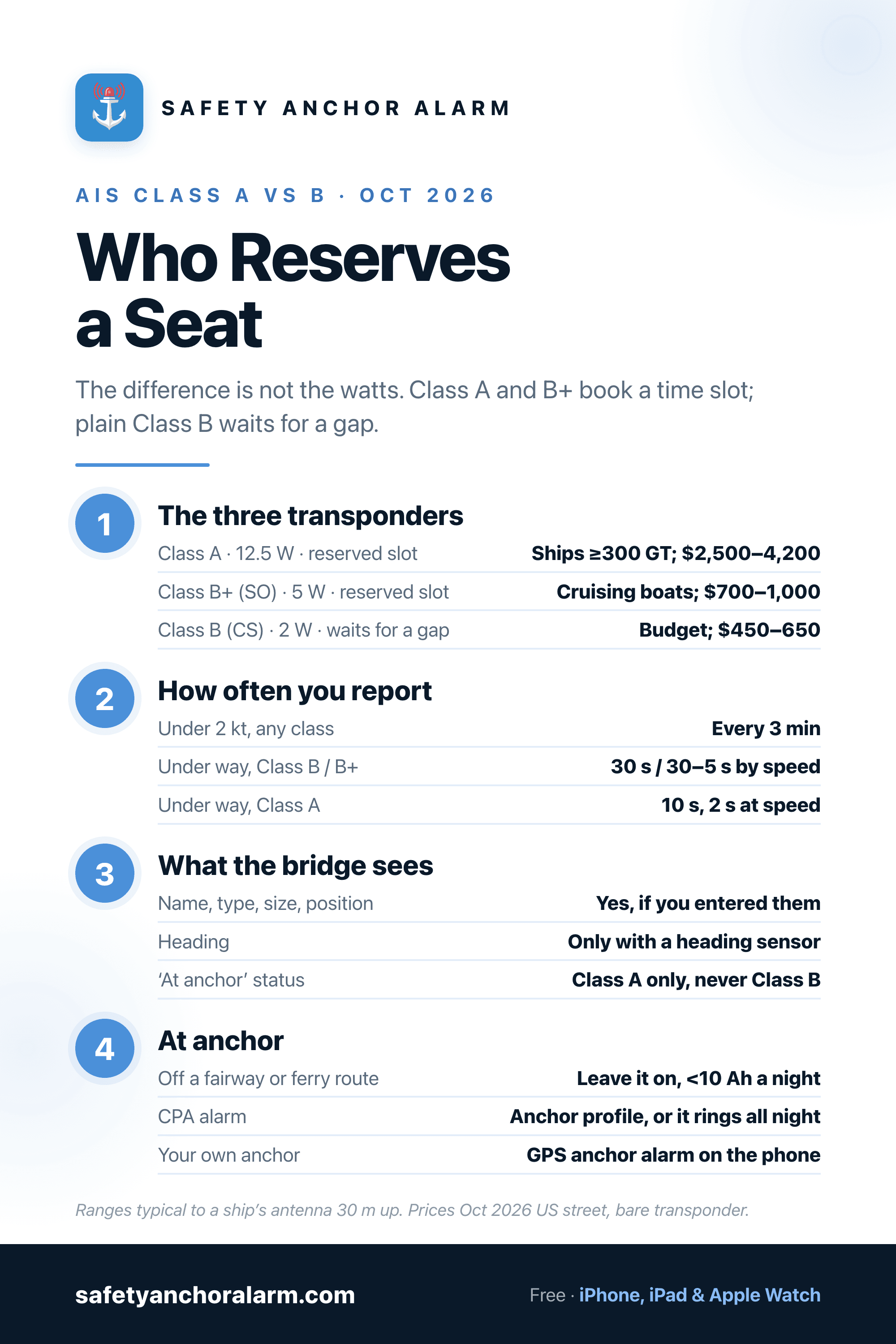
AIS is a VHF data broadcast: each vessel sends its name, MMSI, position, course and speed, and everyone in line of sight plots it. Class A is the ship's system (12.5 W, a reserved time slot, a report every 2–10 s, full data including destination and navigation status, mandatory on ships over 300 GT, $2,500–4,200). Class B is the small-craft system, and it comes in two kinds: Class B+ / SO (5 W, a reserved slot like a ship, 30 s reports that speed up to 5 s on a fast boat, $700–1,000) and Class B CS (2 W, waits for a free slot, 30 s at any speed, $450–650). Both Class B kinds send no navigation status or destination, and both slow to a report every 3 minutes below 2 knots. A receiver ($150–300) shows you the ships and shows them nothing. For a cruising boat in 2026 the answer is a Class B+ transponder; the slot, not the watts, is what you are paying for. At anchor it keeps you on the bridge display of the ship coming in at 03:00; the GPS anchor alarm beside it is what tells you whether your own boat has moved.
Class A, Class B+, Class B and the Receiver
Four boxes, one broadcast. Ranges are typical for a sailboat antenna on a rail or masthead to a ship's antenna 30 m up; prices are October 2026 US street prices for a bare transponder with its GPS antenna, before the VHF splitter or a second antenna.
| Class A | Class B+ (SO) | Class B (CS) | Receiver | |
|---|---|---|---|---|
| Transmit power | 12.5 W | 5 W | 2 W | None |
| How it gets a slot | Reserves one (SOTDMA) | Reserves one (SOTDMA) | Waits for a free one (carrier sense) | Listens only |
| Position report under way | Every 2–10 s by speed and turn | Every 30 s; 15 s over 14 kt; 5 s over 23 kt | Every 30 s at any speed | — |
| Position report under 2–3 kt / at anchor | Every 3 min | Every 3 min | Every 3 min | — |
| Data sent | Name, MMSI, type, size, position, COG, SOG, heading, rate of turn, nav status, draught, destination, ETA | Name, MMSI, type, size, position, COG, SOG, heading | Name, MMSI, type, size, position, COG, SOG, heading | — |
| Seen by a ship's bridge at | 20–30 nm | 10–15 nm | 5–10 nm | — |
| Seen by satellite AIS | Reliably | Usually | Rarely | — |
| Who must carry it | Ships ≥300 GT international, ≥500 GT domestic cargo, all passenger ships (SOLAS) | Some commercial categories where allowed in place of A | Nobody by rule, except visiting yachts in Thailand (B or B+) | Nobody |
| 2026 US street price | $2,500–4,200 | $700–1,000 (splitter models ~$900–1,000) | $450–650 | $150–300, or built into a VHF |
What the AIS Signal Actually Is
AIS is not a separate radio system; it is a pair of data channels inside the marine VHF band, 161.975 and 162.025 MHz, the channels your VHF guide lists as 87B and 88B. On those two channels every fitted vessel sends short digital packets. Some carry dynamic data (position, course over ground, speed over ground, heading, and on ships rate of turn and navigation status) and go out every few seconds to every few minutes. Others carry static data (name, MMSI, call sign, vessel type, length and beam, and on ships draught, destination and ETA) and go out every six minutes. The receiving end, which can be a plotter, a dedicated display, a VHF with a built-in receiver or a phone app on the boat's Wi-Fi, plots each sender as a target on the chart and works out the closest point of approach and the time to it.
Because it is VHF, AIS is line of sight, and everything in the VHF range guide applies: height beats watts, the cable eats power, and the ship's antenna 30 m up does most of the work on the ship-to-yacht leg. Because it is a broadcast, every packet needs a moment of silence on the channel to be heard, and the whole Class A versus Class B story is about how a transponder gets that moment.
Class A: the Ship Reserves a Seat
The channel is divided into 2,250 time slots a minute. A Class A transponder uses self-organised time division (SOTDMA): it listens to the slot map, picks free slots, and announces in each transmission which slot it will use next, so every other Class A in range leaves that slot alone. It is a booking system, and it is why a hundred ships in the approaches to Rotterdam can all report every few seconds without talking over each other. Class A transmits at 12.5 W, sends a position every 10 seconds at cruising speed, every 2 seconds at speed or when turning, and every 3 minutes at anchor, and carries the full data set: navigation status (under way using engine, at anchor, moored, under way sailing, not under command), rate of turn, draught, destination and ETA. It has a pilot plug, a minimum keyboard and display, and inputs for the ship's gyro.
It is mandatory under SOLAS on ships of 300 GT and over on international voyages, 500 GT and over on domestic cargo voyages, and all passenger ships regardless of size, and national rules extend it: the US requires it on most commercial self-propelled vessels of 65 ft and over, on towing vessels over 26 ft and on vessels carrying more than a handful of passengers, and the EU on fishing vessels over 15 m. It costs $2,500 to $4,200 in 2026 (an em-trak A200 or AMEC A750 at the bottom of that, a Furuno FA170 at the top), draws several amps when transmitting, and nothing stops a yacht fitting one. Almost none do, because the fields that justify the price (destination, draught, rate of turn) describe a ship, and because the one thing a yacht does want from Class A, the reserved slot, is now available in a smaller box.
Class B CS: the Boat Waits for a Gap
The original Class B, defined in the mid-2000s to put AIS on small craft cheaply, uses carrier-sense time division (CSTDMA). It does not book slots. Before each transmission it listens for a slot nobody is using, and if it finds one, transmits; if the slots it looked at are busy, it waits and tries again. By design it yields to Class A every time. In open water with a few ships about this is invisible: the channel is mostly empty and the Class B gets its slot on the first try. In a crowded harbour, a busy strait or a regatta start with three hundred transponders inside 5 nm, the map fills, and the polite guest can wait several cycles for a turn. It is the irony of the design that the place the Class B CS is most likely to drop reports is the place with the most traffic.
It transmits at 2 W, sends a position every 30 seconds under way at any speed and every 3 minutes below 2 knots, and sends static data in a slimmer message that has no field for navigation status, destination, draught or rate of turn. From a rail-mounted antenna a 2 W Class B is typically received on a ship's bridge at 5 to 10 nm; from a masthead, further. A new CS unit costs $450 to $650 in 2026 (an AMEC Camino-108 or an em-trak B921), and most are now sold on price to buyers who have not been told what the next paragraph says.
Class B+ (SO): the Boat Reserves a Seat Too
Around 2015 the standard added a second Class B, called Class B SO by the regulators and Class B+ by the shops. It is a Class B data set with a Class A slot method: SOTDMA, a reserved slot, 5 W instead of 2, and a reporting rate that speeds up with the boat: every 30 seconds up to 14 knots, every 15 seconds from 14 to 23, every 5 seconds above 23, and the same 3 minutes below 2 knots. It still sends no navigation status or destination, so it is not a cheap Class A, but it fixes the two things that matter on a small boat: it keeps transmitting when the channel is crowded, and it is heard further. The satellites that feed the ship-tracking websites, which were built to hear 12.5 W Class A slots, pick up a 5 W SOTDMA Class B+ far more often than a 2 W CS unit, which is why a boat that wants family ashore to follow it online wants B+.
In 2026 nearly every mainstream Class B transponder is B+: the em-trak B951 (about $720), the Garmin AIS 800 and Raymarine AIS700 with built-in VHF splitters ($900 to $1,000), the Digital Yacht AIT5000 ($1,100 with Wi-Fi), the Vesper Cortex that folds the VHF into the same box ($2,000). The gap to a CS unit is a couple of hundred dollars. On a fast powerboat the 5 second update rate alone closes the argument; on a sailboat the reserved slot does. Buy B+.
Reporting intervals, all classes
| Speed | Class A | Class B+ (SO) | Class B (CS) |
|---|---|---|---|
| Anchored / moored, under 2–3 kt | 3 min | 3 min | 3 min |
| Under 14 kt | 10 s (3⅓ s if turning) | 30 s | 30 s |
| 14–23 kt | 6 s (2 s if turning) | 15 s | 30 s |
| Over 23 kt | 2 s | 5 s | 30 s |
| Static data (name, type, size) | Every 6 min | Every 6 min | Every 6 min |
The 30 second interval is worth picturing from the other end. A ship closing at 20 knots covers 300 m between two of your reports, so on the bridge your symbol jumps rather than slides, and a sailboat tacking shows a course that is 30 seconds stale. That is the reason Class B targets are read with more caution than Class A ones, and the reason the CPA a ship computes for you is a rougher number than the one you compute for the ship.
Receiver or Transponder
A receive-only AIS ($150 to $300 as a box, or free inside a VHF such as the Standard Horizon GX2400 or Icom M510 that already has one) gives you the ships: name, CPA, the call on 16 by name. It gives the ships nothing. The question is which half you are buying AIS for, and the honest answer is the half you cannot see. A ship's officer at night in rain, with the radar on sea-clutter suppression, may not pick a 10 m sailboat out of the return at all; the same boat as a Class B target has a name and a CPA and trips the bridge alarm. The radar guide covers why the two sensors cover each other's blind spots; the point here is that a receiver only covers yours. If the budget stops at a receiver, make it the one inside the VHF, so that the money next season goes on a transponder rather than a second box.
What the Bridge Sees of You
Fit the transponder, enter the static data, and this is what a ship's officer has on the display when your target wakes up. The gaps are the ones that matter.
| Field | Seen | Note |
|---|---|---|
| Name, MMSI, call sign | Yes | Only if you entered them. A transponder with no static data shows as a bare MMSI. |
| Vessel type (sailing, pleasure craft) | Yes | Set it. 'Sailing' changes how a watchkeeper reads your CPA. |
| Length and beam | Yes | From the antenna-offset fields you fill in at installation. |
| Position, COG, SOG | Every 30 s | On a bridge display at 20 kt closing, a 30 s update is a jump of 200 m. |
| Heading | If connected | Needs a heading sensor on the NMEA network; otherwise the symbol points along COG, which under sail can be 15° off. |
| Navigation status (at anchor, under way sailing) | No | Class B messages have no status field. At anchor you are 'under way, 0 kt' on every bridge. |
| Destination, ETA, rate of turn, draught | No | Class A only. |
Two of those rows are the usual installation mistakes. A transponder that was never given a name and type shows on every bridge as a nine-digit number of unknown kind, which is the target an officer is most likely to dismiss; enter the name, set the type to sailing or pleasure craft, and enter the antenna offsets so the length is right. And a transponder with no heading sensor on the network sends a symbol that points along the course over ground, which on a sailboat with leeway or a boat ferry-gliding across a tide can be well off the bow; a ship reading that symbol reads your intentions wrong. The heading sensor that the radar overlay needs fixes the AIS at the same time.
Ships can filter Class B targets, by range, by CPA and by sleeping status, and on a bridge display in the Dover Strait they do. A transponder makes you visible; it does not make anyone look. A target inside the ship's CPA alarm threshold is looked at, which is one more reason to want the B+ that keeps transmitting, and a call on 16 by the ship's name, early, is still the surest way to be seen. The same signal carries the AIS MOB beacon on a lifejacket and the AIS SART in a liferaft, which the MOB guide and the beacon guide cover: a receiver on your own boat is what lets you see your own crew in the water.
Antenna, GPS and the Splitter
A transponder needs two antennas: a GPS antenna of its own (in the box; mount it with sky above it) and a VHF antenna. The VHF antenna is either shared with the voice radio through an active splitter, built into several B+ units, or a second whip on the stern rail. The VHF range guide settles that choice; the short version is that a dedicated antenna avoids the splitter loss, survives a dismasting, and still hears ships at 15 nm from rail height because their antennas are high. What it does not do is make a 2 W CS unit into a 5 W one. Height and cable fix the leg where your signal is weak, which is the one towards the ship.
The MMSI: Where It Comes From
Nothing transmits until the transponder has a Maritime Mobile Service Identity, the nine-digit number that identifies the vessel in AIS and in the DSC on the VHF, and both must carry the same one. In the US a recreational boat under 65 ft that stays in US waters can get a free MMSI from BoatUS or the US Power Squadrons in minutes (Sea Tow has withdrawn); it is not entered in the international ITU database, so a boat that will visit any foreign port, Canada, Mexico and the Bahamas included, needs an FCC Ship Station Licence ($220 for ten years), which issues an internationally valid MMSI. In the UK the MMSI arrives with the free Ofcom Ship Radio Licence; in most other countries it comes with the national ship radio licence. Program it once and carefully: US-market units lock the MMSI after the first entry and need a dealer reset to change it, which is a known trap when a boat is sold. Register the EPIRB and the AIS MOB beacons against the same MMSI. The MMSI guide covers the digits, the country routes, the one-entry rule and what to do when the boat is sold.
Who Has to Carry AIS
Ships, as above. Yachts, almost nowhere: the US rule is commercial, the EU rule is fishing vessels over 15 m, and SOLAS stops at 300 GT. The exception a cruising boat meets is Thailand, which has required every visiting foreign yacht to carry a Class B transponder and keep it switched on in Thai waters since October 2015; yachts without one are not cleared out. Where AIS is required, it is required at anchor as well as under way, and may only be switched off where keeping it on would compromise the vessel's security, which is the clause that covers a yacht transiting a piracy area on receive-only. For a boat that is not required to carry it the choice is yours, and the next section is where the choice is usually made.
The AIS at Anchor
Below 2 knots every class slows to a position report every 3 minutes, and a Class B at anchor is drawing a few tenths of an amp, well under 10 Ah a night, which the solar guide puts alongside the fridge and the anchor light. In a quiet bay with nothing larger than a dinghy moving after dark, switching it off costs nothing. In an anchorage off a fairway, outside a ferry port, in a bay that fishing boats leave at 04:00 or anywhere fog can close in overnight, leave it on: a sleeping target named Aurora, sailing vessel, 0 knots, is on the bridge display of the ship coming in long before its lookout picks out one anchor light among the shore lights. Three things to know about what it is doing there.
It does not say you are anchored. Class B messages have no navigation status, so a Class B at anchor appears on every receiver as a vessel under way making no way. A ship's CPA calculation copes (a stationary target is the easy case), but a watchkeeper looking for the anchored fleet sees it only by context. Class A declares at anchor; you cannot. If a ship calls you on 16 to ask your intentions, that is why.
It will alarm all night unless you tell it not to. The CPA alarm that is worth having at sea is worthless in an anchorage, where every neighbour swinging on their chain crosses your CPA threshold every ten minutes. Most units and plotters have an anchored or harbour profile that silences CPA alarms for targets under a knot or two; set it before the first night rather than after. The AIS collision alarm cannot be your anchor watch for the same reason: it is tuned to the boats around you, not to you.
It does not watch your anchor. Several transponders and most plotters offer an anchor watch fed by the AIS's own GPS, and it is a good GPS: an external antenna with clear sky, better placed than a phone in a bunk. Use it if you have it. But it alarms at the plotter, on the same power bus as everything else, and it knows nothing about your scope or the margin the fix needs. The instrument this site is built around is the GPS anchor alarm on the phone, on its own battery, centred on the anchor with a radius from your scope, waking you where you sleep. The dragging guide covers what to do when it goes off. The two instruments divide the night cleanly: the transponder is for the ship that does not know you are there, the alarm is for the anchor that has stopped holding, and neither does the other's job.
The Bottom Line
AIS is a VHF broadcast of who you are and where you are going, and the classes differ in how they get a turn to speak. Class A reserves a slot, reports every few seconds with the full ship's data, and is mandatory on ships. Class B+ reserves a slot too, at 5 W, with the small-craft data set, for $700 to $1,000; Class B CS waits for a gap, at 2 W, and in the crowded water where you most need it may not get one. A receiver shows you the ships and shows them nothing. For a cruising boat in 2026, buy a Class B+ transponder, give it a name, a type and a heading, get the right MMSI for the waters you will visit, leave it on at anchor wherever a ship might come in, silence its CPA alarm there, and let the anchor alarm on the phone do the one job the AIS was never built for.

Safety Anchor Alarm
The transponder tells the ship you are there. The anchor alarm on your phone tells you the boat is no longer where you anchored it. Different jobs, same cockpit table, both on.
Download Free