VHF Radio Range and Antennas: How Far It Reaches, and Why Height Beats Watts
Every VHF radio on the shelf says 25 watts on the box, and almost nobody asks the question that decides whether the coastguard hears you: how high is the antenna, and how much of those 25 watts survives the cable on the way up to it. Marine VHF is line of sight. The radio can only talk to a set whose antenna it can, in effect, see over the curve of the earth, and the watts only decide how clear the voice is inside that circle. This guide puts numbers on the circle, explains what the gain on an antenna box actually buys and why a sailboat wants the small one, shows how much signal a cheap cable throws away, settles the AIS splitter question, and ends where the radio spends most of its nights: on the cockpit table, at anchor, next to the other instrument that is listening.
The short answer
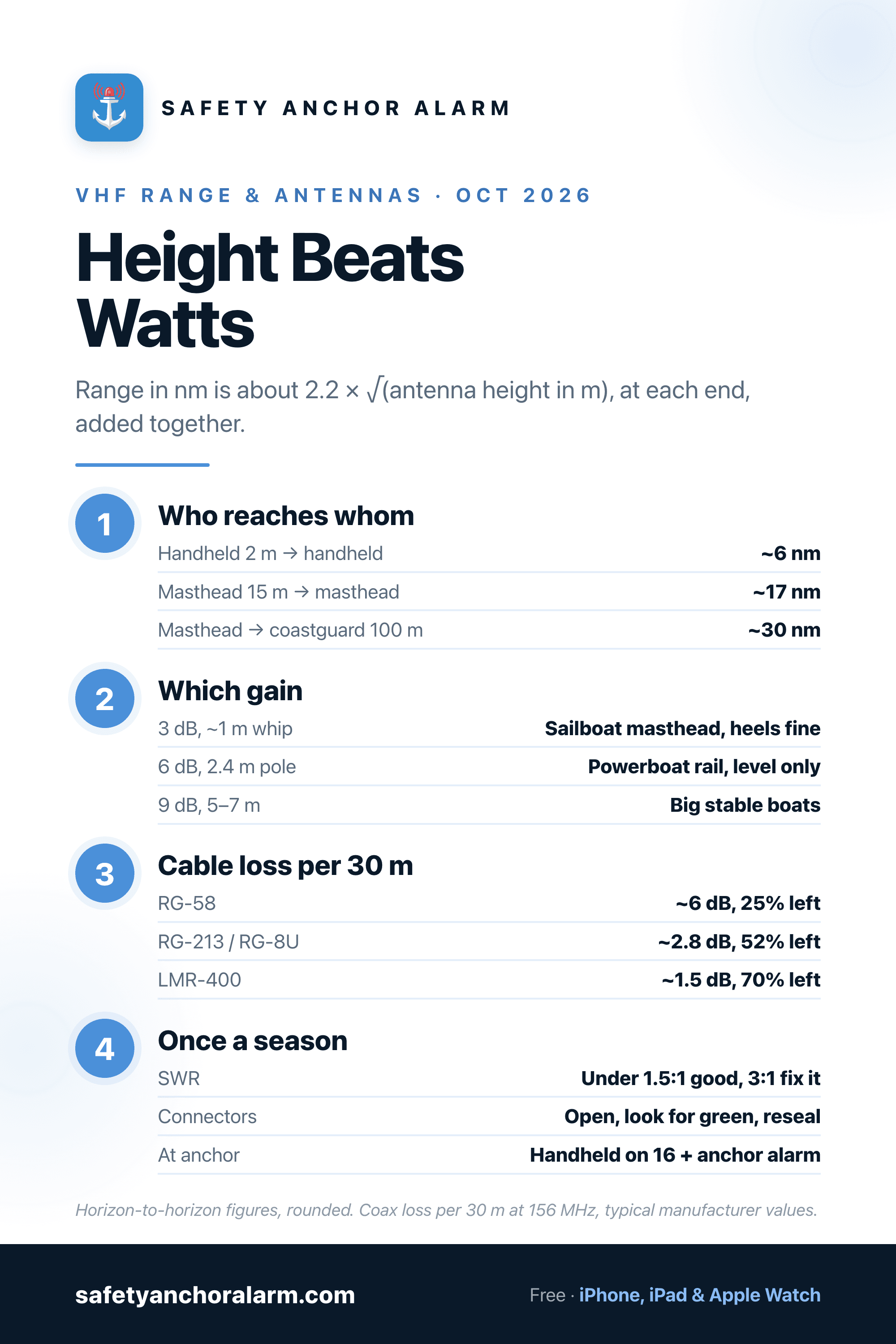
Marine VHF range is line of sight: the radio horizon in nautical miles is about 2.2 × √(antenna height in metres), and the two ends add. A 15 m masthead reaches about 8.5 nm of horizon on its own, so masthead to masthead is about 17 nm, masthead to a coastguard aerial on a 100 m hill about 30 nm, and handheld to handheld at 2 m about 6 nm. Watts do not move the horizon; height does. Antenna gain (3, 6, 9 dB) flattens the signal into a disc that reaches further on a level boat and tips off target on a heeled one, so sailboats use 3 dB at the masthead and powerboats 6 dB on a rail. Thin RG-58 coax loses about three quarters of the power over 30 m; use RG-213 or LMR-400 up a mast, check the connectors, and test SWR once a season. AIS can share the antenna through an active splitter or have its own on the stern rail. At anchor the handheld lives in the cockpit on 16, and the anchor alarm beside it does the watching.
The Range Table
Horizon-to-horizon ranges, rounded, from 2.2 × √h at each end. Real range on a given day is a little more (VHF bends slightly over the horizon) or less (a heeling 6 dB antenna, a corroded connector, a headland in the way). Every row assumes a decent installation.
| Your antenna | Own horizon | to Handheld 2 m | to Rail 4 m | to Masthead 15 m | to Coastguard 100 m |
|---|---|---|---|---|---|
| Handheld, 2 m (cockpit) | 3 nm | 6 nm | 8 nm | 12 nm | 25 nm |
| Rail / hardtop, 4 m (powerboat) | 4.5 nm | 8 nm | 9 nm | 13 nm | 27 nm |
| Masthead, 15 m (35–40 ft sailboat) | 8.5 nm | 12 nm | 13 nm | 17 nm | 31 nm |
| Masthead, 20 m (45–50 ft sailboat) | 10 nm | 13 nm | 14.5 nm | 18.5 nm | 32 nm |
Why Range Is a Height Problem
Marine VHF lives at about 156 to 162 MHz, and at those frequencies a radio wave travels in very nearly a straight line. It does not follow the curve of the earth the way long-wave broadcasts do, and it does not bounce off the ionosphere the way short-wave does. It goes to the horizon and, give or take a few percent of atmospheric bending, carries on into space. So the question of how far a VHF reaches is the question of how far away the horizon is, and the horizon is a function of how high you are standing.
The formula used in the VHF radio guide is the whole story: radio horizon in nautical miles is about 2.2 times the square root of the antenna height in metres, and because both antennas have a horizon, you add them. The square root is the part that matters. Doubling the height does not double the range; it adds about 40 percent. Going from a 2 m handheld to a 15 m masthead, nearly eight times the height, buys under three times the horizon. That is why the table above is flatter than people expect, and why the coastguard's 100 m hilltop aerial does more for your range than anything you can bolt to the boat.
Watts work inside that circle, not beyond it. A 25 W fixed set and a 5 W handheld with their antennas at the same height reach the same horizon; the 25 W set is simply louder and clearer at the far edge, and gets through a little more weather and a little more noise. The legal maximum on marine VHF is 25 W everywhere, and the set spends most of its life on 1 W in harbour. The upgrade that moves the edge is never a bigger radio; it is a higher antenna, a better cable, or a clean connector.
Antenna Gain: Which Number for Which Boat
Antenna boxes advertise gain in decibels, and the instinct is that more is better. It is better for some boats and worse for others, because gain is not amplification; an antenna has no power of its own. Gain is shape. A plain quarter-wave whip radiates in a fat doughnut round itself, with a good deal of the energy going up into the sky and down into the water where nobody is listening. A higher-gain antenna squashes that doughnut into a flatter disc along the horizon, so more of the same 25 W goes where the other boats and the coastguard are. On a level platform that is pure benefit.
| Gain | Typical length | Pattern | Where it belongs |
|---|---|---|---|
| 3 dB | ~1 m whip | Fat doughnut, tolerates 30° of heel | Sailboat masthead; any boat that rolls |
| 6 dB | ~2.4 m (8 ft) fibreglass | Flat disc, loses signal past ~15° of heel | Powerboat rail or hardtop; level platforms |
| 9 dB | ~5.5–7 m (18–23 ft) | Very flat; needs a stable, high mount | Large sportfishers and commercial boats |
The problem is that the disc is attached to the boat, and when the boat heels the disc heels with it. A 6 dB antenna leaned over 20 degrees is pointing its best signal into the sky on the windward side and into the sea to leeward, which is exactly when a sailboat most wants to be heard. The 3 dB whip loses a little reach on a flat sea and keeps most of its signal on the horizon at any angle the boat is likely to sail. That, and the fact that a metre-long whip survives at the masthead where a 2.4 m pole would not, is why every sailboat antenna at the top of the mast is 3 dB and why the height, not the gain, does its work. Powerboats, which sit level and usually have nowhere higher than a hardtop to mount anything, buy the 6 dB and get their range from the shape instead. 9 dB antennas belong on big, stable boats with tall mounts and are a liability on anything that rolls.
Mount matters almost as much as gain. An antenna wants clear sky round it: a whip beside a metal radar arch, a backstay, or a second antenna within a metre has its pattern bent and its SWR disturbed. A rail mount at the stern is fine if nothing taller is within arm's reach of it; an emergency antenna lashed to the pushpit after a dismasting works for the same reason.
The Cable Is Where the Watts Go
Between the set and the antenna is a run of coaxial cable, and at 156 MHz coax is not a wire; it is a resistor that gets worse with length and with thinness. Loss is quoted in decibels per 100 ft or per 30 m, and the arithmetic is unforgiving: 3 dB is half the power gone.
| Coax | Loss per 30 m at VHF | Power left after 30 m | Use it for |
|---|---|---|---|
| RG-58 | ~6 dB | ~25% | Short runs only (handheld-length); never up a mast |
| RG-8X (mini-8) | ~4.5 dB | ~35% | Runs under 10 m; rail-mounted antennas |
| RG-213 / RG-8U | ~2.8 dB | ~52% | Mast runs; the usual sailboat choice |
| LMR-400 | ~1.5 dB | ~70% | Long mast runs where the extra stiffness can be routed |
A 12 m mast with the cable routed through the deck, along the bilge and up to the nav station is easily 20 m of coax. In RG-58, which is what a surprising number of production boats left the yard with, that run eats about 4 dB: a 25 W set is delivering roughly 10 W to the antenna, and the received signal coming the other way is cut by the same amount. The same run in RG-213 loses under 2 dB and keeps about 16 W. The cable is the cheapest range upgrade on the boat and the one almost nobody makes, because it is hidden and because pulling a new one up a mast is a job. Do it when the mast is down for anything else.
Connectors are the other half. Every PL-259 in the run is a place for salt water to creep in and for a joint to corrode, and a corroded connector can lose more than the whole cable. The symptoms are a set that receives fine but is not heard, or that works in dry weather and fades in rain. Unscrew, look for green, and reseal with self-amalgamating tape; a deck gland with a connector just below it is the usual culprit.
SWR: the One Test Worth Doing
Standing wave ratio is the measure of how much of the transmitter's power the antenna system sends back down the cable instead of radiating. A perfect match is 1:1; 1.5:1 or better is a good installation; 2:1 says something is slightly wrong; 3:1 and above means a damaged antenna, water in the coax or a bad connector, and running a set into that for long will damage its output stage. An inline SWR meter for VHF costs less than a dinner ashore, goes between the set and the cable, and reads while you key the mic on low power on a working channel such as 72. Test on installation and once a season. A rising SWR year on year is the cable corroding from the inside, which is the fault no visual inspection catches.
AIS: Splitter or Second Antenna
AIS transmits and receives on two channels just above the voice band, so it can use a VHF antenna. A transponder, which transmits, needs an active splitter that gives the antenna to the VHF whenever you key the mic and to the AIS the rest of the time; the better ones lose under a decibel and fail safe to the VHF if their power goes. A receive-only AIS can use a simpler passive splitter. The alternative is a dedicated AIS antenna, usually a short whip on the stern rail or the pushpit, and on a boat with the space it is the better answer: no splitter loss, no single point of failure, and a working AIS and VHF after a dismasting takes the masthead with it. Rail height limits what the AIS sees less than you would think, because the ships it most needs to see have their antennas 30 m up; a 4 m AIS antenna still hears them at 15 nm or more. The radar guide covers what AIS does and does not tell you about the traffic around you.
The Handheld's Honest Range
A 5 or 6 W handheld with its rubber antenna held at head height in the cockpit has a horizon of about 3 nm, and reaches another handheld at about 6 nm, a masthead boat at about 12 nm, and a coastguard hilltop at 25 nm or so, in good conditions. That last figure surprises people; it is the coastguard's height doing the work, which is why a handheld is a real distress radio near a coast and a toy in mid-ocean. Hold it high, stand up, and get out of the companionway; below decks the hull and the rig halve the range. A handheld with DSC and its own GPS sends a position with the distress call, which the beacon guide puts in its place among the other ways of calling for help.
The Radio at Anchor
At anchor the fixed set and its masthead antenna are, most nights, switched off to save the battery that also runs the fridge and the anchor light, and the radio that matters is the handheld on the cockpit table. Its 3 nm horizon covers the whole anchorage, and the anchorage is where it earns its keep.
The neighbour conversation. The boat that came in at dusk and dropped too close, the charter catamaran swinging on a different arc, the boat upwind whose anchor light is moving: all of them are reached on 16 and moved to a working channel, and a calm call at 21:00 beats a shouted one at 03:00. The anchoring distance guide covers what to ask for.
The dragging call, both ways. If a boat is dragging down on you, the radio is faster than the dinghy and louder than your voice across 100 m of wind. If the dragging boat is yours, the first thing to do after starting the engine is tell the boat downwind, on 16, in one sentence. The dragging guide covers the rest of the drill.
What the radio cannot do is tell you that the boat has moved. It is a mouth and an ear, not a watch. The instrument that knows whether you are still where you anchored is the GPS anchor alarm on the phone next to the handheld, centred on the anchor, with a radius set from your scope and a margin for the phone's fix. The two make a pair: the alarm wakes you, the handheld tells the boat astern. Keep the handheld charged on the same USB as the phone, and keep both on the cockpit table rather than below, because at anchor the range you need is 300 m and the time you have is a minute.
The Bottom Line
VHF range is 2.2 times the square root of the height, at each end, added together. Height moves the horizon; watts only make the voice clearer inside it. Sailboats put a 3 dB whip at the masthead and let the height work; powerboats put a 6 dB pole on the rail and let the shape work. Run RG-213 or better up the mast, inspect the connectors, and test the SWR once a season, because the cable is where the watts go. Give the AIS its own antenna if you can. At anchor, the handheld in the cockpit is how you talk to the anchorage, and the anchor alarm beside it is how you know when there is something to say.

Safety Anchor Alarm
The handheld reaches every boat in the anchorage. The anchor alarm on your phone tells you when yours has started to move. Keep both on the cockpit table, both charged, both on.
Download Free