Satellite Messenger vs PLB vs EPIRB: Which Calls for Help, and Which Talks Back
Twenty miles off the coast the VHF goes quiet and the phone shows no bars. From there, four things can still get a message off the boat: an EPIRB in a bracket by the companionway, a PLB in a lifejacket pocket, a satellite messenger on the chart table and, in some countries, the phone itself. They look similar in the chandlery and they are not the same thing at all. Two of them shout once, to the rescue system, and cannot hear the answer. Two of them hold a conversation, but only while someone is paying and the battery is charged. This guide sets out who hears each signal, how long it lasts, what it costs in 2026 and which two belong on a cruising boat.
The short answer
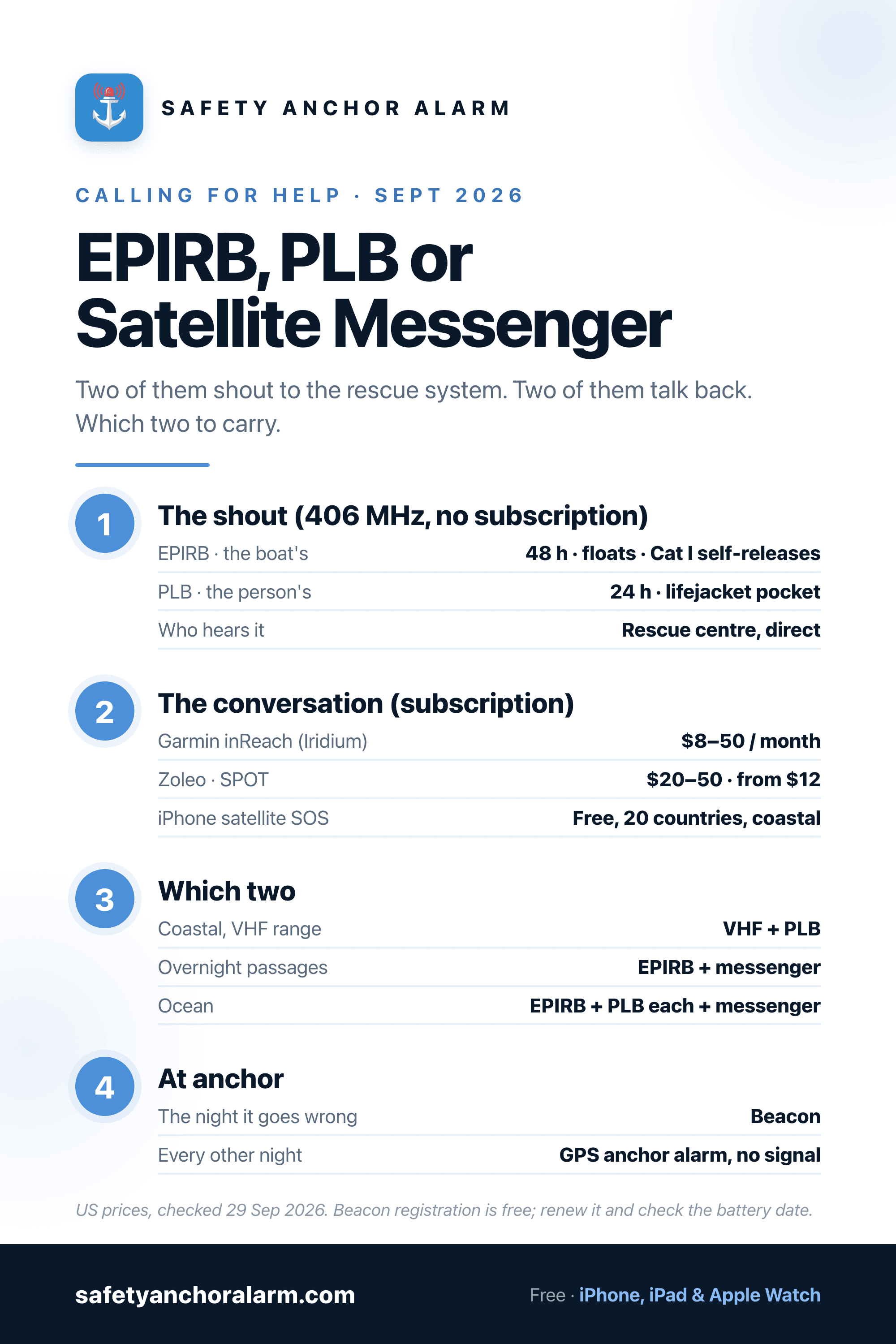
An EPIRB and a PLB are beacons: one press sends your identity and position on 406 MHz straight into the international rescue system, with no subscription, and they cannot talk back. The EPIRB belongs to the boat (48 h, floats, self-releases in Category I); the PLB belongs to a person (24 h, in the lifejacket). A satellite messenger such as a Garmin inReach is a two-way text device on a subscription ($8–50 a month): its SOS goes to a commercial centre first, and it does everything a beacon cannot, from “rudder gone, not sinking” to the forecast. The phone's satellite SOS is a free coastal extra in 20 countries and not an offshore plan. A cruising boat carries an EPIRB for the boat, a PLB per person on deck at night, and a messenger for everything that is not a Mayday.
The Four Ways to Call for Help, Side by Side
US prices and plans as checked on 29 September 2026. Device prices are street prices; subscriptions change often and differ by country.
| Device | Who hears it | Talks back? | Battery | Cost | Registered to | Best for |
|---|---|---|---|---|---|---|
| EPIRB | Rescue coordination centre, via Cospas-Sarsat (406 MHz) | No (RLS models show a blue light when the alert is received) | 48 h+ once on; 5–10 yr sealed | $400–900, no subscription; free registration | The boat | Boat's primary beacon offshore; Cat I self-releases if the boat sinks |
| PLB | Same rescue centres, same 406 MHz system | No (RLS on newer models) | 24 h+ once on; 5–7 yr sealed | $250–450, no subscription; free registration | A person | Lifejacket pocket; the person, not the boat |
| Satellite messenger | Commercial response centre (e.g. Garmin Response), then rescue | Yes: text, position, weather, check-ins | Rechargeable, days to weeks depending on tracking | $150–500 + $8–50 a month | Account holder | Everything that is not a Mayday: broken gear, a message home, a tracking page |
| Phone satellite SOS | Emergency services via Apple's relay centre (Globalstar) | Yes, short texts | The phone's | Free for 2 years on iPhone 14 and later | Nobody | A coastal extra in the 20 supported countries; not waterproof, not offshore |
A Shout and a Conversation
The clearest way to sort these devices is not by size or price but by who is on the other end.
An EPIRB or a PLB transmits on 406 MHz, a frequency reserved worldwide for distress beacons and nothing else. The signal is picked up by the Cospas-Sarsat satellites, a system run by governments since 1982, and passed to the rescue coordination centre responsible for that patch of sea. There is no company in the chain, no subscription and no account that can lapse. The beacon says three things: this is who I am, this is where I am, and I am in grave and imminent danger. It then says them again every fifty seconds until the battery dies or someone switches it off. It is a shout, and the only shout the international rescue system is built to hear.
A satellite messenger is a different animal. It sends short texts over a commercial satellite network, Iridium for Garmin and Zoleo, Globalstar for SPOT, to whoever you like: a phone number, an email address, a tracking page, and, when you lift the cover and press SOS, a private response centre that talks to you and then calls the coastguard on your behalf. It is a conversation. That is its whole value and its whole weakness. Rescuers can ask “how many aboard, is anyone hurt, are you taking water” and you can answer; and none of it works unless the subscription is paid and the battery is charged.
The phone's satellite SOS is the messenger's little cousin, and the VHF is the older sibling both of them forgot: within twenty miles of a coast, the VHF with DSC is still the first call, because every boat around you hears it at the same time as the coastguard.
EPIRB: the Boat's Beacon
The EPIRB is registered to the vessel. When it goes off, the rescue centre pulls up the registration and sees the boat's name, type, colour, MMSI, the owner's phone and a shore contact who knows the passage plan, all before a helicopter has been asked for. Modern units carry a GPS, so the first position arrives within about a hundred metres rather than the several kilometres of the satellite-only fix, and a 121.5 MHz homing signal lets the helicopter find the raft in the last mile.
- Category I lives in a bracket with a hydrostatic release. If the boat goes down, the release fires at a metre or two of depth, the beacon floats free and switches itself on in the water. It is the one for a boat that could sink with nobody able to reach the bracket.
- Category II is the same beacon in a manual bracket: someone has to take it and switch it on, or drop it in the water. Cheaper, and fine if the bracket is by the companionway and the crew knows it is there.
- Battery. Sealed, five to ten years in the bracket depending on the model, with the expiry printed on the case; once activated it must run at least 48 hours. The hydrostatic release has its own expiry, usually two years, and it is the part people forget.
- Two newer options. Return Link Service (RLS) beacons flash a blue light when the rescue system has logged the alert, which is the only reply a beacon can give and worth a great deal at three in the morning. AIS EPIRBs add a local AIS transmission, so the boats within a few miles see the beacon on their plotters as well.
PLB: the Person's Beacon
A PLB is the same 406 MHz shout in a package the size of a small torch, registered to a person rather than a boat. It rides in the lifejacket pocket or on a lanyard, is switched on by hand, and must transmit for at least 24 hours. Most float, but not upright with the antenna clear, so the person has to hold it up; some have a strobe. Battery life in the pocket is five to seven years.
The distinction matters at the moment that matters. If the boat sinks, the EPIRB goes with the raft and the rescue centre looks for a boat. If a crew member goes over the side at night, the boat is fine and the EPIRB is useless; what the rescue centre needs is the position of one person in the water, and that is what a PLB in the lifejacket gives. The man overboard procedure on this site puts an AIS MOB beacon or a PLB on every lifejacket for the same reason: the boat has to be able to find you first, and if it cannot, someone else has to.
For a coastal or weekend boat that never leaves VHF range, a PLB is often the only beacon aboard, and that is a reasonable choice. It costs less than an EPIRB, it works from a kayak or a tender as well as from the yacht, and it goes home with you. What it does not do is release itself, float upright or run for two days.
Satellite Messenger: the Conversation
The messenger is the device that changed offshore sailing more than any beacon. Its SOS is real, and it has been used to coordinate real rescues, but that is the rare use. On a cruising boat it earns its place on the ninety-nine passages where nothing goes badly wrong: the daily position to the family, the forecast request that comes back as a text, the “we lost the engine, arriving Tuesday not Sunday, not an emergency” that a beacon has no way to say. It is also the one device that works after the boat's electrics are gone: a handheld with its own battery, in the grab bag, that can tell the world where the raft is and how everyone is.
Three networks, three families. Garmin inReach on Iridium is the cruising standard, because Iridium covers the whole planet including the poles and the mid-ocean gaps. Zoleo, also on Iridium, pairs with the phone and is cheaper to buy; its plans run from about $20 a month for 25 messages to $50 unlimited and can be suspended free between seasons. SPOT on Globalstar is the cheapest to run, from about $12 a month for tracking and $30 for two-way, with the trade-off that Globalstar's coverage has holes in the far ocean and high latitudes.
What a Garmin inReach costs in 2026
| Plan | Per month | Messages | Tracking | Who it suits |
|---|---|---|---|---|
| Enabled | $7.99 | Pay as you go ($0.50 each) | Pay as you go | SOS only. Replaces the old suspend fee; keeps the device live in the bracket. |
| Essential | $14.99 | 50 | Pay as you go | Coastal boat that wants messages home and the odd forecast. |
| Standard | $29.99 | 150 | Unlimited | The cruising plan: a tracking page for the family and weather every day. |
| Premium | $49.99 | Unlimited | Unlimited | Ocean crossing month, then drop back down. |
All four are month to month with SOS included, plus a one-off $39.99 activation per device and $0.50 for every text over the allowance; the annual contracts and the old suspend fee are gone, and a subscription can be paused free for up to 12 months. The cruising pattern is Standard for the season, Premium for the crossing month, Enabled through the winter so the device in the bracket still has a live SOS.
The catches are the ones that come with any subscription. Confirm the plan is active before a passage, not after. Charge it. Set the tracking interval to something the battery can sustain; a ten-minute track drains a small unit in a few days. And remember that the SOS goes to a company first: a good one, with a 24-hour centre, but a company, and the chain to the coastguard is one link longer than the beacon's.
The Phone in Your Pocket
Since the iPhone 14, Apple's Emergency SOS via satellite sends short texts to emergency services over Globalstar with no cellular signal at all, free for two years after the phone is activated. By September 2026 it works in 20 countries, including the US, Canada, Mexico, the UK, Ireland, France, Spain, Portugal, Italy, Germany, the Netherlands, Belgium, Switzerland, Austria, Iceland, Australia, New Zealand and Japan, and it works in those countries' waters as long as the phone can see the sky. Android phones on the newer flagships have equivalents, and T-Mobile's T-Satellite service on Starlink's direct-to-cell satellites adds ordinary texting, including to emergency numbers, up to 12 nautical miles off the US coast.
Treat it as a bonus, not a plan. The phone is rated for a swim in the pool, not an hour in the sea; it does not float; the battery is the battery you have been using all day; and the list of countries is a list of countries. The Caribbean, the Bahamas, Greece, Croatia and Turkey are not on it. For a day sailor in the Solent or Long Island Sound it is a genuine extra layer. For a boat on passage it is the thing you try after the beacon is on.
Registration: Free, and the Whole Point
A 406 MHz beacon carries a 15-character identity. Registration is what attaches a boat, a description, a phone number and a shore contact to it, and it is the difference between a rescue centre that can ring your partner and confirm you left Bermuda on Tuesday and a rescue centre staring at a code. It is free everywhere. In the US, register with NOAA and renew every two years; NOAA emails a reminder two months ahead. In the UK, on the UK Beacon Registry, and add the beacon to the Ship Radio Licence; the 2026 amendment to the Merchant Shipping Regulations makes registration a legal requirement for beacons on UK vessels. Other flags have their own registry, and a beacon bought abroad is coded to the country it was sold in, so register it there.
Two housekeeping rules. Update the registration when the boat changes hands, changes name or changes its shore contact. And do the self-test the manual describes, monthly or before a passage; it checks the battery and the transmitter without sending a live alert. Setting one off by accident is not a crime, but the first thing to do is switch it off and ring the coastguard to cancel.
Which Two to Carry
- Day and coastal sailing, within VHF range: the VHF with DSC is the distress call. Add a PLB on the lifejacket of whoever goes forward at night. The phone's SOS is a free extra in the supported countries.
- Overnight passages, out of VHF range: an EPIRB for the boat, Category I if the boat could sink fast. A messenger becomes worth its subscription the first time the arrival date slips and someone ashore is waiting.
- Ocean and remote cruising: EPIRB, one PLB per person on watch, a messenger on Iridium for the conversation and the forecast, and all of it listed on the safety equipment checklist with the battery and subscription dates next to each item.
- Starlink does not replace any of them. It needs the boat's power, a mount and a dry router, and it does not send a distress alert; the Starlink guide sets out what it is for.
Beacons at Anchor
None of these devices has anything to do with whether the anchor is holding, and that is the point worth making plainly, because the chandlery puts them on the same shelf. A beacon is for the night it all goes wrong. An anchor alarm is for the two hundred nights before it: it takes the phone's GPS, which is free and needs no signal and no subscription, and wakes you when the boat leaves the circle you drew around the anchor, so that the beacon stays in its bracket. It runs in a bay with no bars and no satellite plan, which is most of the bays worth anchoring in.
Where the beacons do come into the anchoring routine is on deck. The most dangerous minutes of a night at anchor are the ones after the alarm goes off, when someone is on the foredeck in a rising wind resetting the anchor or veering more chain, often alone while the rest of the crew sleeps. That is a PLB moment: the lifejacket goes on with the beacon in the pocket before the hatch is opened, exactly as the solo sailor's anchor routine has it. And the messenger has a quiet job in a remote anchorage: the check-in that tells the person ashore which bay you are in tonight, so that if the beacon ever does go off they already know where to point the search.
The Bottom Line
Sort them by who hears them. The EPIRB and the PLB shout to the rescue system with no subscription, one for the boat and one for the person, and the only question is which category and how many. The messenger holds a conversation, for a monthly fee, and earns its keep on the passages where nothing goes wrong. The phone is a bonus in twenty countries. A cruising boat carries a beacon and a messenger, registers the beacon, pays the subscription, and lets the anchor alarm on the phone handle the nights in between.

Safety Anchor Alarm
The beacon is for the night it all goes wrong. The anchor alarm is for every other night: GPS only, no signal, no subscription, and it wakes you before the boat is in trouble.
Download FreeFrequently Asked Questions
What is the difference between an EPIRB and a PLB?
Is a satellite messenger like a Garmin inReach a replacement for an EPIRB?
How much does a satellite messenger subscription cost in 2026?
Can I use my iPhone's Emergency SOS via satellite at sea?
Do I have to register an EPIRB or PLB?
How long does an EPIRB battery last?
Which one do I need for coastal sailing?
Related Articles
How to Use a VHF Radio
Still the first distress call within twenty miles: Channel 16, DSC and the Mayday format.
SafetyMan Overboard Procedure
Why the AIS MOB beacon or PLB goes on the lifejacket, and the lift that fails.
SafetyBoat Safety Equipment Checklist
Everything aboard with an expiry date, from flares to the EPIRB battery.
ElectronicsStarlink on a Boat
Internet at anchor and on passage, and why it is not a safety device.