Life Jacket Types Explained: Type I to V, the New Level Labels, and What the Coast Guard Actually Requires
Everyone searches for a Type II or a Type III. The jacket on the shelf says Level 70, carries a row of icons and has no Type on it at all, and the jacket in your locker from 2015 still says Type II and is still perfectly legal. Both are true because the Coast Guard spent a decade replacing the Type system with one shared with Canada, and did it without making anybody throw anything away. This guide translates the old Types into the new Levels, explains how to read the new label, sets out what the federal rules actually require, covers the inflatable rules that changed in 2025, says which jacket suits which boat, and ends with the three moments at anchor when the jacket matters most.
The short answer
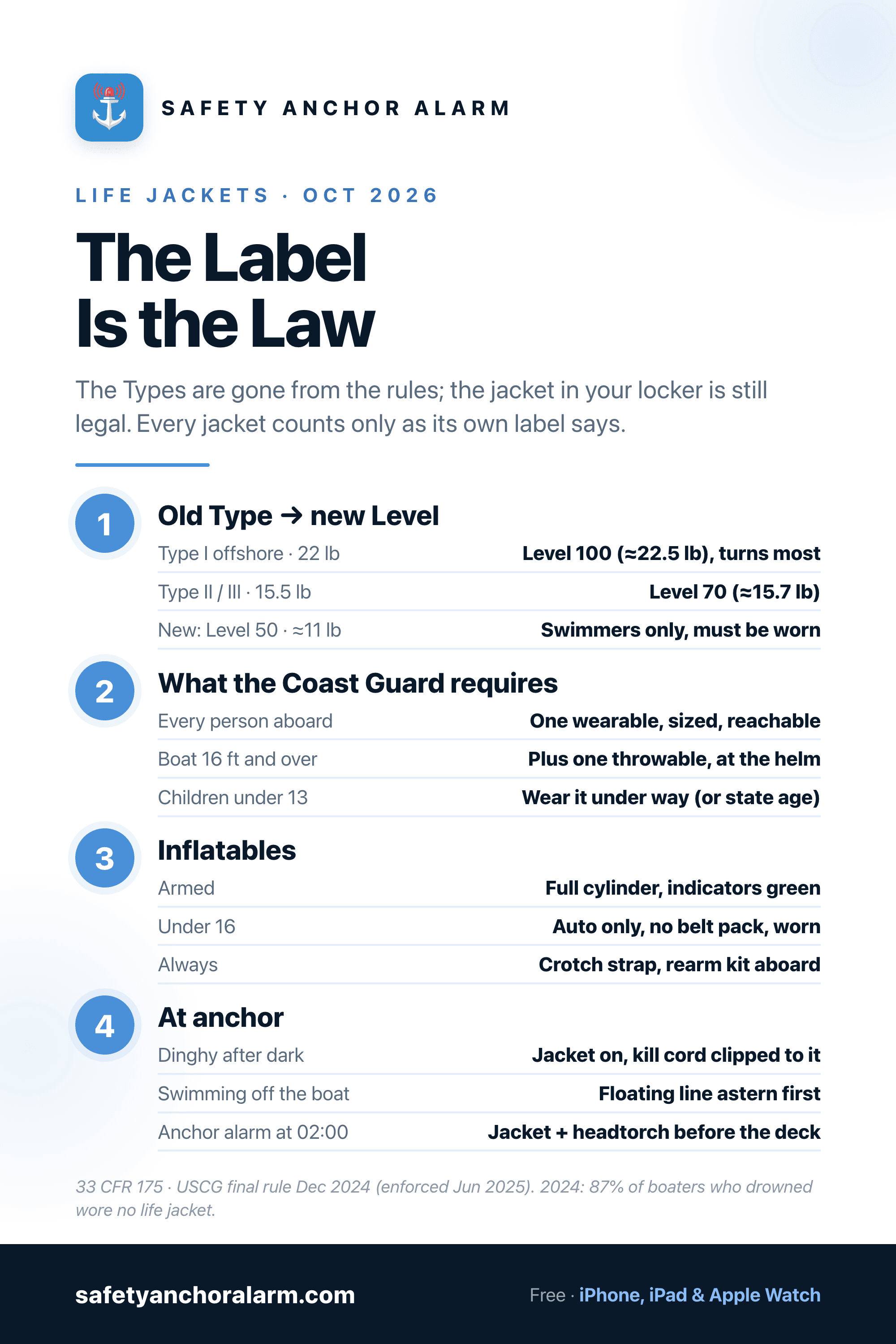
The old US system had five types: Type I offshore (22 lb, turns most unconscious wearers face up), Type II near-shore vest (15.5 lb, turns some), Type III flotation aid (15.5 lb, does not turn you), Type IV throwable, and Type V special use, which counts only under the conditions on its label. The Coast Guard took the Type codes out of its rules in 2014, and since 2025 new jackets are approved and labelled by buoyancy in newtons: Level 50 (about 11 lb, swimmers only, must be worn), Level 70 (about 15.7 lb, the new Type II/III) and Level 100 (about 22.5 lb, the new Type I). Old-label jackets remain legal while serviceable. The federal rule is one approved wearable per person, the right size and readily accessible; a throwable on boats 16 ft and over; and children under 13 wearing one while under way unless below decks. The rule also says every jacket must be used as its label says, which makes the label part of the law: an inflatable marked “must be worn” counts for nothing in a locker.
The Old Types, Translated into the New Levels
Buoyancy is the minimum for an adult jacket. The new levels are newtons of buoyancy; one pound of buoyancy is about 4.45 N, which is why the new numbers land almost exactly on the old ones.
| Old label | Buoyancy | New equivalent | Made for | Turns you face up? |
|---|---|---|---|---|
| Type I · Offshore life jacket | 22 lb foam · 33 lb inflatable | Level 100 (≈22.5 lb); Level 150 (≈33.7 lb) for the offshore inflatables | Open, rough or remote water where rescue may be slow | Most wearers |
| Type II · Near-shore buoyant vest | 15.5 lb foam | Level 70 (≈15.7 lb) | Calm inland or near-shore water, quick rescue likely | Some wearers |
| Type III · Flotation aid | 15.5 lb foam | Level 70 | Conscious wearers near help: fishing, watersports, day boating | No: the wearer keeps their own face up |
| Type IV · Throwable | 16.5 lb ring · 18 lb cushion | Still a throwable (separate standards) | Thrown to someone in the water; never counts as a wearable | Not worn |
| Type V · Special use | 15.5 to 22 lb, by design | Whatever level the new label states | Work vests, deck suits, hybrids, many inflatables and belt packs | As the label says, and only counts under its conditions |
| (new) Level 50 | ≈11.2 lb | Level 50, approved in the US from 2025 | Swimmers with help or rescue nearby: paddling, waterskiing, racing | No; marked 'Not recommended for weak or non-swimmers' |
What Each Type Was For
The Type system sorted jackets by the water they were meant for, and the names still describe the jackets you meet on docks and in charter lockers.
Type I, the offshore life jacket, is the bulky orange jacket with foam front and back that ships and charter boats carry by the dozen. Twenty-two pounds of foam, more in the inflatable versions, and a shape designed to roll an unconscious person onto their back. Nobody wears one for fun, which is the whole problem with it. Type II is the horse-collar vest: cheap, less buoyant, and it turns some wearers but not reliably. Type III is the jacket most people actually wear, the cut-away vest of the angler, the waterskier and the paddler: the same 15.5 lb as a Type II, but shaped for movement, and it does not turn you at all; a conscious wearer has to tilt their head back.
Type IV is the throwable: a ring buoy, a horseshoe or a square seat cushion with straps. It counts as the extra device on boats 16 ft and longer and never as anyone's wearable, and the cushion, which has been sat on for ten summers, is the item an inspector most often finds squashed flat. Type V, special use, was the bucket for everything that did not fit: work vests, float coats, deck suits, hybrids, and many of the inflatables and belt packs sailors wear today. A Type V counts only when used under the conditions on its label, which is often “when worn”.
Why the Types Disappeared
The trouble with the Types was that they described the water, not the jacket. A Type III and a Type II had the same buoyancy; the difference that mattered, whether the jacket turns an unconscious person over, was buried in the pamphlet. The Coast Guard ran focus groups on the labels and found what anyone who has watched a crew pick jackets from a locker could have told it: people choose by look and comfort, and read nothing.
The fix came in three steps. In September 2014 the Coast Guard removed the Type codes from its carriage regulations, so that the law would say “wearable” and “throwable” and leave the classification to a standard. In 2019 it began accepting Level 70 jackets built to the new North American standard, ANSI/CAN/UL 12402-5, written jointly with Transport Canada, so one jacket could be approved for both countries. And in a final rule published on 6 December 2024, effective 6 January 2025 and enforced from 4 June 2025, it incorporated the rest of the suite: Level 50 and Level 70 under 12402-5, Level 100 under 12402-4, with pictorial labels and a point-of-sale placard replacing the pamphlet.
Two sentences in that rule matter to every owner. Jackets that met the carriage requirements before it continue to meet them; nobody has to buy anything if their jackets are in good and serviceable condition. And manufacturers may keep producing models approved under the old series, while all new designs go through the new standards. That is why a chandlery in 2026 sells Type III vests and Level 70 vests side by side, and why both are right.
How to Read the New Label
The new label is built to be read in a shop, by someone who will not read a pamphlet, in any language. Its parts:
| On the label | What it tells you |
|---|---|
| The level number | 50, 70 or 100 in a coloured shape: the buoyancy in newtons. Higher floats you higher and, from 100 up, starts to turn you. |
| Turning icon | Shows whether the jacket is designed to turn an unconscious wearer face up. Level 50 and 70 are not; that is the honest answer the old Type II blurred. |
| Warning and activity icons | Activities the jacket is not suited to, crossed out: typically towed sports, personal watercraft or white water for inflatables. |
| Conditions in words | 'Must be worn to be counted', 'Not recommended for weak or non-swimmers', adult supervision for a child's inflatable. These are legal conditions, not advice. |
| Size | Chest size and, for children, weight range. Under federal rules a jacket that does not fit its wearer does not count for that wearer. |
| Approval number | The Coast Guard approval number (160.xxx/…). It must be legible; a jacket whose label has washed off is, on paper, not approved. |
The Level 50 is the genuinely new thing. The Coast Guard had never approved a jacket that light before 2025; the racing vests waterskiers and dinghy sailors wore were legal to wear but did not count. Now they can, with two conditions printed on them: it must be worn to be counted, and it is not recommended for weak or non-swimmers. The Coast Guard's reasoning is worth repeating: a light jacket someone wears saves more lives than a heavy one in a locker, because in its own study 86% of the people who drowned in boating accidents were not wearing one.
Level 150 and Level 275, the offshore and commercial levels familiar from Europe, are not part of the US recreational rule. In practice the US offshore inflatables still carry an old-style approval with 33 lb or more of buoyancy, which is the same thing a European label calls 150 N.
The Label Is the Law
Here is the sentence that most guides leave out. The federal carriage rule, 33 CFR 175.15, says that no one may use a recreational boat unless there is a wearable for each person aboard and each one is used in accordance with any requirements on its approval label, and with its owner's manual if the label points to one. The next section adds that each must be of the size and fit for its wearer as marked on the label, and legibly marked with its approval number.
So the conditions on the label are not advice. A jacket marked “must be worn to be counted” in a cockpit locker is legally no jacket. An adult jacket on a 40 lb child is no jacket for that child. A belt pack worn by someone the label excludes, or an inflatable whose label has faded to blank, does not count. When an inspector, or an insurer after an accident, asks whether the boat carried a life jacket for each person, the question is really whether it carried one that met its own label for each person. Read the label once for each jacket aboard, and the rule reads itself.
What the Coast Guard Requires
The federal minimum for recreational boats, which the safety equipment checklist sets alongside the extinguishers, flares and lights:
- One approved wearable per person aboard, the right size for that person, and readily accessible: out and reachable, not sealed in plastic under the forepeak cushions.
- One throwable in addition on any boat 16 ft or longer, immediately available, which in practice means at the helm or on the pushpit. Canoes and kayaks of any length are exempt from the throwable.
- Children under 13 wear one while the boat is under way, unless they are below decks or in an enclosed cabin. Where a state has its own child-wear age, the state rule applies on its waters instead, so check the state you are in, not the one the boat is registered in.
- Serviceable condition: no broken or corroded buckles, no torn or detached straps, no rips that let foam escape, no foam that is hard, compressed, waterlogged, oily or mildewed. For an inflatable, a full cylinder, every status indicator green, an unblocked oral tube and a pull tab that is there.
- Racing shells, rowing sculls, racing canoes and kayaks, and sailboards are exempt from carriage altogether.
None of this requires adults to wear a jacket on a recreational boat. The law asks you to carry one; the statistics ask you to put it on.
Inflatables: The Rules That Changed
Inflatable jackets are what most sailors wear, because they are the only kind comfortable enough to wear all day. There are two kinds of firing head. A manual one inflates only when you pull the tab. An automatic one also fires on immersion, either through a water-soluble bobbin or pill, which can be set off by heavy spray or a wet locker, or through a hydrostatic head that fires only under water pressure and ignores rain. Either way the jacket is only a jacket while it is armed: a full cylinder screwed home, the indicators green, and the service date on the head, which is printed there, not exceeded. Carry a rearming kit for each model aboard; a jacket that has done its job once is a bag until it is rearmed.
The age rule is the change people missed. The old inflatable standard approved inflatables only for wearers 16 and over, and many labels still say so. The new standard allows an inflatable for a younger wearer only if it inflates automatically, does not need to be pulled over the head after it inflates (which rules out belt packs), is worn, and carries a warning about adult supervision. That is a narrow door, and for a child the foam jacket remains the better answer: nothing to arm, nothing to pull, and it floats whether or not the child is conscious enough to help.
Whatever the type, use the crotch or thigh straps. An inflated jacket without them rides up over the face of a person in the water, which is why the jacklines guide insists on them for anyone clipped on, and why the man overboard procedure is so much easier with someone floating high and face up.
Which Jacket for Which Boat
The best jacket is the one that will be worn, and that depends on the boat and the activity more than on the level:
| Who / where | Pick | Why |
|---|---|---|
| Coastal day sailing and cruising | Level 70 automatic inflatable with crotch strap; integral harness if you sail at night or alone | Comfortable enough to wear all day, which is the only jacket that works. |
| Offshore and night watches | 33 lb / 150 N automatic inflatable: harness, crotch strap, spray hood, light and whistle | Turns you, keeps spray off your face, and is the European standard for open water. |
| Fishing and inshore powerboats | Level 70 foam vest or a fishing-style inflatable | Foam for rough handling and hooks; an inflatable if heat means the foam stays in the locker. |
| Jet ski, waterski, wakeboard, tubing | Foam Level 50 or 70 rated for the activity; never an inflatable | Repeated impacts and high-speed entries; the label crosses inflatables out for these. |
| Kayak and paddleboard | Foam Level 50 or 70 paddling vest; adult swimmers on a SUP may use a belt pack if the label allows | Lets you swim and climb back on; the belt pack needs a hand and a head to work. |
| Children and weak swimmers | Foam, sized by weight (infant under 30 lb, child 30 to 50, youth 50 to 90), crotch strap; head support and grab handle for infants | Nothing to arm, nothing to pull, and it floats whether the wearer helps or not. |
For paddle craft and personal watercraft the small-craft safety guide goes further, and the clothing guide covers the one fitting rule everyone breaks: the jacket goes on over the outer layer, never under it, or it cannot inflate. Try every new jacket in the water once, in a pool or off the swim platform on a calm day; the new placard says so, and five minutes of floating teaches more than the label.
Outside the US
Europe and the UK use the international ISO 12402 levels: 50 N buoyancy aids, 100 N, 150 N and 275 N lifejackets, with 150 N the norm for coastal and offshore sailing. Level 70 is a North American level and Canada accepts the same harmonised labels as the US. A jacket counts toward a country's carriage rules only if it carries that country's approval, so a European-bought 150 N jacket on a US-registered boat needs a Coast Guard approval number of its own to count, however good it is.
The Life Jacket at Anchor
The Coast Guard's 2024 boating statistics recorded 556 deaths, the fewest in more than fifty years. Three quarters of them drowned, and 87% of those who drowned were not wearing a life jacket. Four of every five who drowned were on boats under 21 ft. On a cruising boat, the boat under 21 ft is the dinghy, and most of the moments a life jacket matters at anchor happen in it or on the way to it.
The dinghy run back at night. The beach bar, a drink or two, a laden tender, a chop that got up after dark, and a boat you have to find among thirty anchor lights. Wear the jacket in the dinghy, every trip after sunset; clip the kill cord to it; carry a light. The dinghy guide has the rest of the kit.
Swimming off the boat. In an anchorage with current, the boat is not the edge of the swimming pool, it is moving water going past a fixed point. Stream a floating line with a fender astern before anyone goes in, and put a jacket or a throwable within reach of whoever stays aboard.
The deck at 02:00. When the anchor alarm goes off, you go from asleep to the foredeck in under a minute, in the dark, on a pitching boat, often barefoot and alone. It is the one time on a cruise that a sailor reliably does not wear a jacket, and the time the night anchoring checklist asks you to. Keep an inflatable on the hook by the companionway with a headtorch clipped to it, put both on before you step out, and clip on if the drag is real and you are going forward in a blow. For a solo sailor, nobody aboard will see you go over.
The division of labour is honest. The jacket cannot tell you the boat is moving, and the alarm cannot keep you afloat. What the alarm decides is the time you have: a wake-up when the boat has left its circle by a few metres means walking forward with the jacket on and the engine running; a wake-up from the bang of the hull on rock means doing everything at once. The jacket on the hook and the alarm on the phone belong to the same five seconds.
The Bottom Line
The five Types described the water a jacket was meant for. The new Levels describe the jacket: its buoyancy in newtons (50, 70, 100), whether it turns you, and what it is not for, in icons. A Type II or III is a Level 70, a Type I is a Level 100 or more, and every serviceable Type-labelled jacket you own is still legal. The federal rule is short: one approved wearable per person, sized and reachable; a throwable from 16 ft; children under 13 wearing theirs under way. The part people miss is that every jacket counts only as its label says, so read the label of every jacket aboard once, arm the inflatables, and put one on before the dinghy, the swim and the 02:00 foredeck.

Safety Anchor Alarm
The life jacket is for the minute you are in the water. The anchor alarm on your phone is for the hours before it, so that the minute never comes. Keep one on the hook by the companionway; run the other every night.
Download Free