Boat Maintenance Checklist
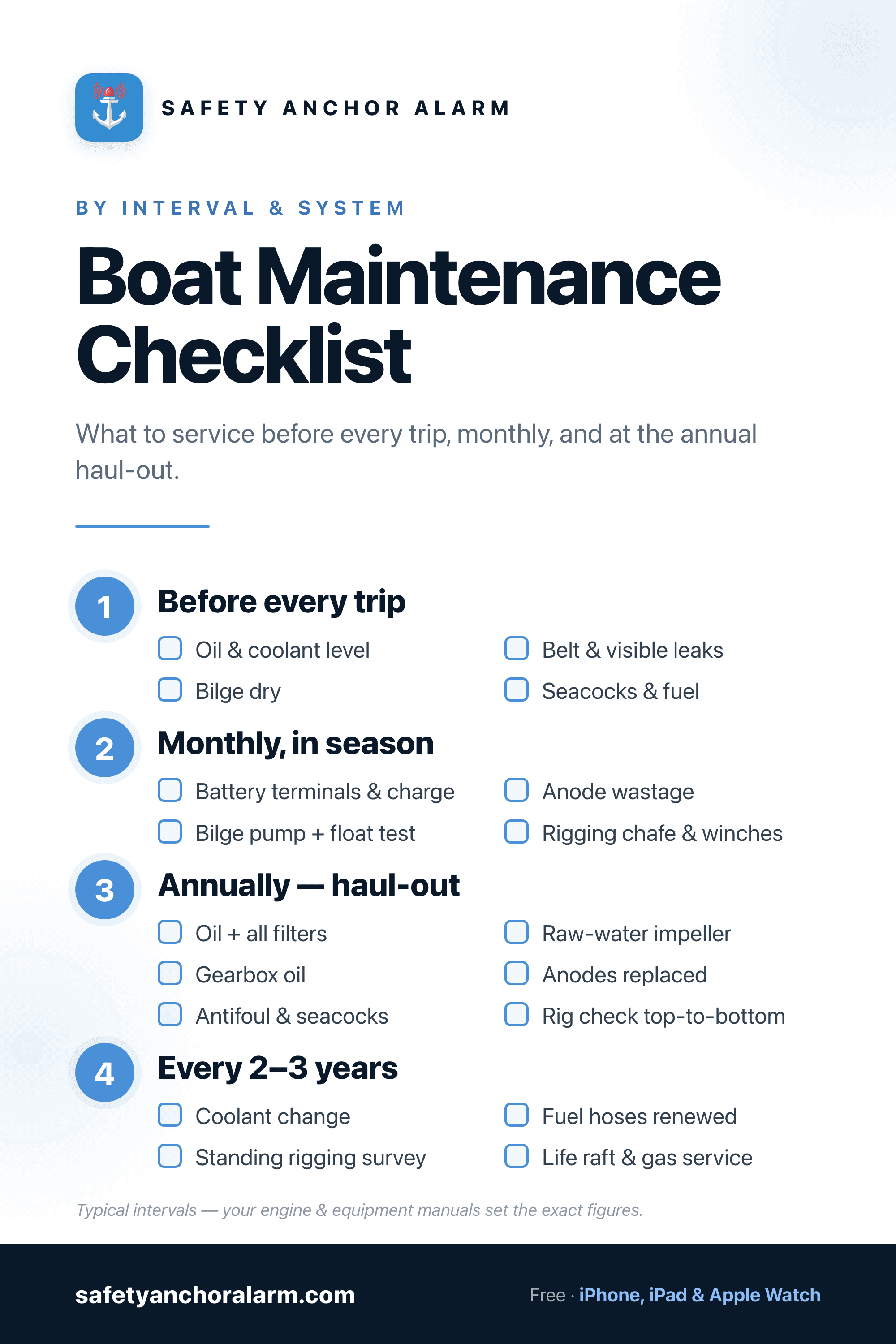
A boat maintenance checklist works when it is a schedule, not a wish list: check oil, coolant, belts, bilge and seacocks before every trip; anodes, batteries and the bilge pump monthly; oil, all filters, the raw-water impeller, anodes and antifoul at the annual haul-out; and coolant, fuel hoses, standing rigging and the life raft every few years. The catch nobody puts on the printable list is that these jobs run on three different clocks — the calendar, the engine hours, and plain condition — and getting them mixed up is how a boat with a perfect-looking service record still fails at sea.
The Checklist, by Interval
Print a flat list of every job on a boat and you will do the easy ones twice and the buried ones never. The fix is to sort by when, not by what. The table below reads top-to-bottom as jobs come due less and less often, and left-to-right by system so nothing falls into the gap between “engine” and “boat”. Intervals are typical for a cruising sailboat or small motor cruiser — your engine and equipment manuals set the exact numbers, and they always win over a generic figure.
| Interval | Engine & drivetrain | Hull & below waterline | Deck, rig & safety |
|---|---|---|---|
| Before every trip | Oil & coolant level, belt tension, visible leaks, fuel level | Bilge dry, seacocks operate, no water ingress | Nav lights, VHF check, ground tackle & shackle pins secure |
| Monthly (in season) | Battery terminals & charge, drive belt wear, raw-water strainer | Anode wastage where reachable, bilge pump & float switch test | Running rigging chafe, winch operation, extinguisher gauges |
| Annually / at haul-out | Oil + oil filter, both fuel filters, raw-water impeller, gearbox oil | Antifoul, replace anodes, service seacocks, inspect cutless bearing & prop | Rig check top to bottom, service winches, grease steering, sail inspection |
| Every 2–3 years | Coolant change, inspect/renew fuel hoses & clips, check heat exchanger | Re-bed leaking fittings, check keel bolts, moisture survey if any doubt | Gas system test, life raft service, standing rigging professional check |
| Long cycle (7–15 yr) | Injector service, exhaust elbow renewal (raw-water cooled) | Osmosis survey, through-hull & seacock renewal | Standing rigging replacement, running rigging replacement |
The Three Clocks That Decide When a Job Is Due
This is the part the printable checklist leaves out, and it is the part that matters most. Every maintenance job is governed by one of three clocks, and reading the wrong one is how boats fail with a full logbook and a clean bilge.
Clock one — the calendar. Rubber and elastomers age whether the boat moves or not. A raw-water impeller, fuel and coolant hoses, drive belts, and the life raft all degrade sitting on a cradle all winter. A boat that did twenty hours last season still needs a fresh impeller this spring. Do these on the date, never on the hour meter.
Clock two — engine hours. Wear-based jobs run on how hard the engine has actually worked: oil and oil filter, valve clearances, coolant on its longer cycle. A charter boat that racks up 400 hours a season hits these far sooner than a weekend cruiser on 40. Fit an hour meter if you don't have one — you cannot schedule what you cannot count.
Clock three — condition. A few things are replaced when they are worn, not when a date or an hour count says so. Sacrificial anodes come off at about half wasted, whenever that happens; standing rigging is condemned on inspection — cracked swage, broken strand, corroded terminal — not at a fixed age; antifoul goes on when the old coat stops working. Judge these by looking, and inspect them often enough that the look is honest.
Most jobs actually answer to two clocks at once, and the rule is simple: whichever limit arrives first wins. Oil is “100 hours or annually” — the low-hours boat changes it on the calendar, the busy one on the meter.
Engine & Drivetrain: The Jobs That Run on Hours
The engine is where the two faster clocks collide, so it earns its own table. Below are the jobs that a marine diesel needs on an hours-or-calendar basis; the figures are typical, and the number in your engine manual replaces any of them.
| Job | Typical interval |
|---|---|
| Engine oil & oil filter | ~100–250 h or annually |
| Primary & secondary fuel filters | Annually or by hours |
| Raw-water impeller | Annually (rubber ages regardless of hours) |
| Coolant / antifreeze | ~1,000 h or every 2 years |
| Drive belt | Inspect annually, renew by maker's hours |
| Valve clearances | Major hour milestone in the manual |
| Gearbox / saildrive oil | Annually or by hours |
| Saildrive diaphragm | ~7 years, calendar-driven |
Two things worth saying out loud. First, the raw-water impeller is the single most common cause of an overheating alarm mid-passage, and it is a fifteen-minute job — carry a spare and the cover gasket, and know where the strainer is before you need it. Second, keep the old but intact impeller and a spare fuel filter aboard: the whole point of servicing to a schedule is that the failures happen in the yard, not at sea, but the sea still gets a vote.
Hull & Below the Waterline: The Annual Haul-Out
Almost everything under the waterline is done once a year while the boat is out of the water, because that is the only time you can reach it. This is the haul-out list:
- Antifoul. Wash off, scrape, and re-coat before growth costs you a knot and a chunk of fuel. Match the paint to your water and how fast you move.
- Anodes. Replace anything past roughly half gone. Under-protected metal pits; over-painted anodes protect nothing. This is a condition call, not a date.
- Seacocks and through-hulls. Work every one open and shut, grease the ball valves, and check the hull fitting and hose clips. A seized seacock you cannot close is a sinking you cannot stop.
- Cutless bearing, prop and shaft. Check for play in the bearing, clean and inspect the prop, and look at the anode on the shaft or saildrive leg.
- Hull moisture. If you have any doubt about blistering or a soft patch, get a moisture survey while it is accessible.
Rig, Sails & Deck Gear
The rig fails rarely and expensively, so it rewards a slow, methodical look rather than a quick glance. Once a year, go up the mast or have it dropped and check every swage, terminal, split pin, sheave and tang for cracks, corrosion and broken strands. Standing rigging is a condition item until it becomes a calendar one — most insurers and riggers want wire replaced at around ten to fifteen years regardless of how good it looks. Between those, service the winches (strip, clean, re-grease, new pawls and springs as needed), inspect running rigging for chafe and renew before it lets go, and check the furling gear.
Electrical, Batteries & Bilge
The electrical system is a monthly job in season and the source of most no-start mornings. Keep terminals clean and tight, check the state of charge, top up flooded cells with distilled water, and make sure the charging system actually puts current back. Test the bilge pump and its float switch by hand — a pump that has never run is not a pump you can trust — and keep a manual backup that works when the battery is flat. Nav lights, the VHF and the instruments all belong on the same monthly sweep.
Ground Tackle & Safety Gear
The gear that holds you off the rocks needs the same discipline as the engine. Check the anchor, chain and shackles for wear and make sure the pins are seized; run the windlass; and confirm the bitter end is actually made fast inside the locker — plenty of anchors have gone over the bow with nothing to stop them. Re-mark your chain so you still know how much you have veered in the dark, and while you are there, check the gypsy pockets and the clutch cone: windlasses die of neglect far more often than of use. On the safety side, the dated items — flares, extinguishers, life raft — sit alongside the maintenance calendar; our boat safety equipment checklist covers what the law requires and when each item expires. And for the hours you spend asleep on that ground tackle, an anchor alarm is the watch-keeper the maintenance list forgets — worth knowing how to tell if the anchor is dragging before you have to.
The Real Job Isn't Doing It — It's Remembering
Read back over this checklist and notice how little of the difficulty is in the wrenching. The impeller is fifteen minutes; the anodes are four bolts. The hard part is that the impeller is on the calendar, the oil is on the hours, and the anodes are on condition — three clocks, none of which tells you it is overdue until something stops working. That is why the boat with a shoebox of receipts still gets caught out: a receipt records that a job was done, not when the next one is due.
The fix costs nothing and takes a minute: write down each job as you do it — date, engine hours, what you fitted, which part number. That single record turns a pile of one-off tasks into a schedule you can read at a glance, tells you the impeller is on its second season before it tells you the hard way, and becomes a service history that adds real money when you sell the boat. Keep it in a notebook by the engine, a spreadsheet, or a dedicated logbook app that stamps the hours and reminds you when each item comes round — the format matters far less than the habit.
The Bottom Line
Stop thinking of boat maintenance as a list and start thinking of it as a schedule on three clocks. Do the quick checks before every trip, the monthly sweep on batteries, anodes and the bilge pump, and the big jobs — oil, filters, impeller, anodes, antifoul, seacocks and the rig — once a year at haul-out, with coolant, hoses and rigging on their longer cycles. Run the calendar jobs on the date, the wear jobs on the hours, and the condition jobs on what your eyes tell you. Then write down every one as you go, because the schedule only works if you can see when each job was last done — which is exactly what a marine logbook is for. The one job that is not on this schedule at all is the end of the season — laying the boat up is its own list, and it is in our boat winterization checklist. What all of it costs over a year — and why the big jobs wreck budgets that look fine month to month — is in our guide to the cost of living on a sailboat. And because no service interval covers the night you spend asleep at anchor, add the one watch the list never mentions: an anchor alarm set to your own swing circle.

Safety Anchor Alarm
GPS-powered anchor monitoring for iPhone, iPad and Apple Watch. The watch no maintenance schedule lists — set the alarm to your own swing circle and it monitors your position while you sleep, waking you the moment the anchor starts to drag.
Download FreeFrequently Asked Questions
What should be on a boat maintenance checklist?
How often should you service a boat engine?
How often should you replace a raw-water impeller?
How often should sacrificial anodes be replaced?
Why keep a boat maintenance log?
Related Articles
Boat Safety Equipment Checklist
What the Coast Guard requires by boat length, and the dated items that quietly expire in a locker.
Tools10 Best Sailing Apps for 2026
The apps that earn their place aboard — navigation, weather, logbook and anchor watch.
GuideHow to Tell If Your Anchor Is Dragging
The signs, the transit trick, and why a GPS alarm catches it first.
ToolAnchor Scope Calculator
How much rode to carry and what alarm radius to set for your depth and boat size.