How to Winterize a Boat: the Checklist, and Why Warm Climates Need It Too
Almost everything written about winterizing a boat is written for a boat that will freeze, which is why so many owners in the Mediterranean, the Canaries or the Caribbean skim it and decide it does not apply to them. It mostly does. Winterizing is not really about cold — it is about water that has nowhere to go, and only one of the three ways water damages a laid-up boat has anything to do with frost. Sort the list that way and two useful things happen: the jobs stop being arbitrary, and you can see exactly which ones you can skip in a mild winter and which ones you cannot.
The short answer
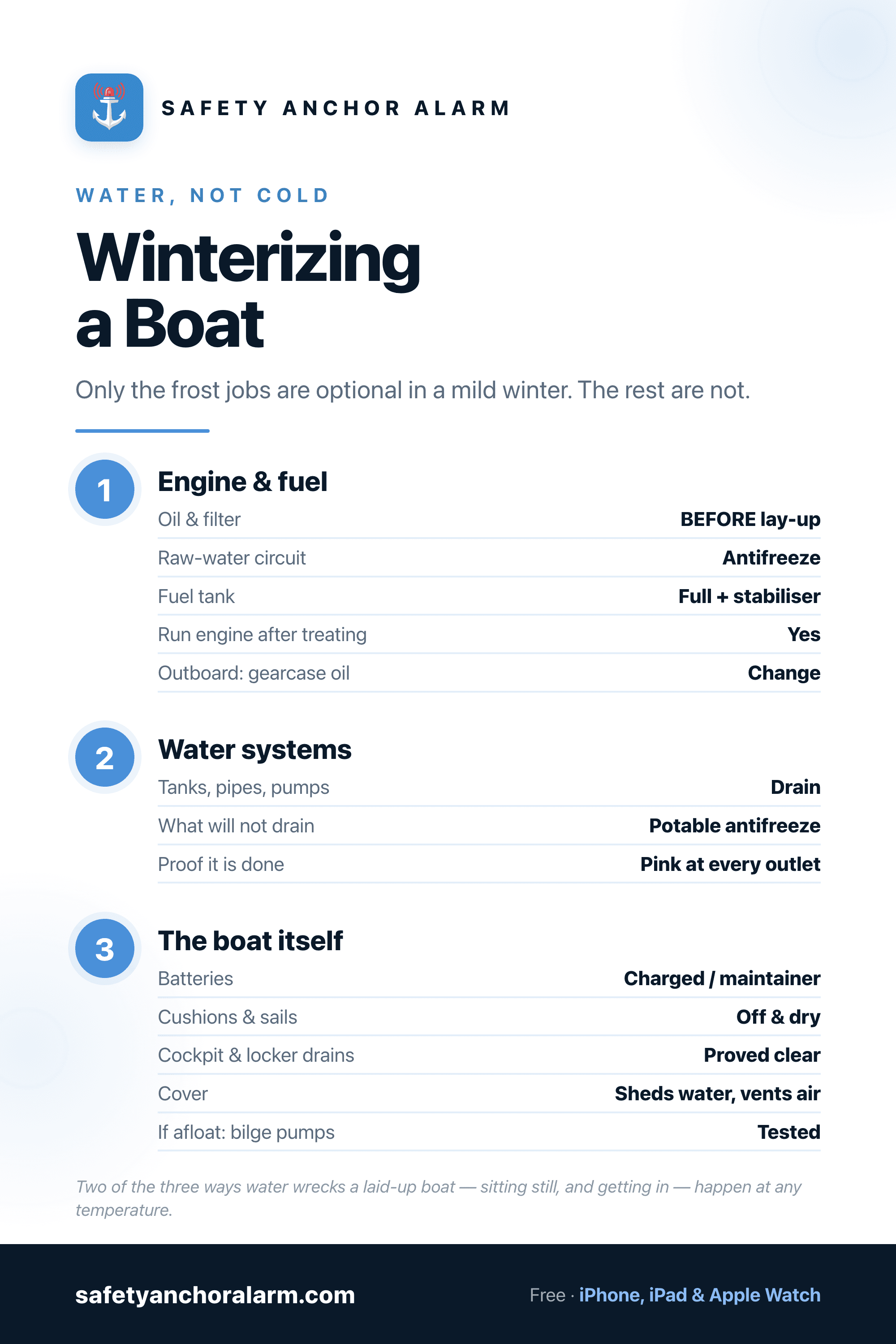
Four systems, in order. Engine: oil and filter changed before storage, antifreeze through the raw-water circuit, coolant checked. Fuel: tank full, stabiliser added, engine run long enough to carry treated fuel through the filters and injectors. Water: every tank, pipe, pump and head drained or filled with non-toxic antifreeze. Boat: batteries charged and on a maintainer, bilges dry, soft furnishings off, drains proved clear, and a cover that sheds water while still letting air move. In a frost-free climate you skip the antifreeze and keep everything else.
The Three Ways Water Damages a Laid-Up Boat
Every job on every winterization list is defending against one of these three. Learn the three and the list stops being something you copy and becomes something you can reason about for your own boat, in your own harbour.
| Failure mode | What it does | What it damages | The job that stops it | Applies |
|---|---|---|---|---|
| 1. Water that freezes | Expands by about a tenth as it turns to ice, with enough force to split cast iron | Engine block, raw-water circuit, calorifier, pipework, tanks, heads, pumps | Drain it, or replace it with antifreeze | Frost climates only |
| 2. Water that sits still | Feeds biology — diesel bug in the tank, mould on every soft surface, corrosion in every damp locker | Fuel and filters, upholstery, sails, headlining, electrical connections, a flat battery | Dry it, fill it, treat it, and keep air moving | Every climate |
| 3. Water that gets in | Arrives through the parts you did not check and then becomes number 2 — or, afloat, becomes a sinking | Deck leaks, blocked cockpit and locker drains, ponding covers, tired hoses and seacocks | Clear the drains, shed the water, check every through-hull | Every climate |
Two of the three apply everywhere. That is the whole argument for why a boat wintering in Greece still needs a lay-up routine — and why the owner who only does the antifreeze in Maine has done about a third of the job.
The List, Split by Climate
Here is the same checklist arranged so you can see what your winter actually requires. The left column is every boat everywhere. The right column is what frost adds on top.
| System | Every boat, every climate | What frost adds |
|---|---|---|
| Engine | Oil and filter changed BEFORE storage; fuel tank full and stabilised; run the engine so treated fuel reaches the filters and injectors; belts eased; check the raw-water impeller. | Antifreeze pulled through the raw-water circuit until it runs coloured from the exhaust; coolant strength tested on the freshwater side; block and heat-exchanger drained if that is your manual's method. |
| Water systems | Tanks emptied and left dry rather than part-full; heads flushed clean; the calorifier drained if it will sit for months. | Every pipe, pump, shower, sink, calorifier and head either fully drained or filled with non-toxic (potable-system) antifreeze. This is the job that most often gets missed one pipe at a time. |
| Batteries | Fully charged, terminals cleaned and greased, and either removed to a dry place or left on a maintainer. Never left flat. | A discharged lead-acid battery freezes at close to the temperature of water; a fully charged one does not. In frost, charge is what stops the case splitting. |
| Inside the boat | Cushions on edge or ashore, lockers emptied of food, bilges dry, hatches and lockers left open, and ventilation everywhere. Damp plus still air equals mould in any climate. | — |
| Outside the boat | Sails off, dried and bagged; running rigging eased or stowed; cockpit and locker drains proved clear; a cover that sheds water rather than collecting it; ground tackle rinsed. | Snow load on the cover becomes a structural question — a frame that ponds water will collapse under wet snow. |
| If she stays afloat | Bilge pumps and float switches tested, power source confirmed, mooring lines doubled and chafe-protected, hoses and seacocks checked, and somebody local who will look at her after a gale. | Ice can chafe through lines and damage topsides; many yards will not leave boats afloat where the harbour freezes. |
The Engine: Change the Oil Before, Not After
This is the one job whose order matters more than its content, and it is routinely done the wrong way round.
Used engine oil carries combustion by-products, including acidic compounds and water. Leave it in the sump for five months and it sits against bearings and cylinder walls doing quiet corrosive damage all winter. Change it in spring and you have thrown away the oil after it did the harm. So: oil and filter out before lay-up, fresh oil in, and run the engine briefly to circulate it. The spring service is then just a check.
After that, the raw-water side. Salt water sitting in a heat exchanger, exhaust elbow and hoses all winter is corrosion in slow motion even where it never freezes, and in frost it is a cracked block waiting to happen. The standard method is to run the engine with the raw-water intake fed from a bucket of antifreeze until it comes out of the exhaust coloured. Check the freshwater side's coolant strength while you are there, and follow your manual on fogging — modern engines and older ones disagree, and the manual wins.
Outboards want the same logic in a smaller package, and enough of the detail differs that they get their own guide: flush with fresh water, drain the gearcase and check the oil for the milky look that means water is getting in, replace the gear oil, fog the cylinders per the manual, grease the linkages, and store it upright so the water drains out rather than sitting in the leg.
Fuel: Full, Treated, and Circulated
A part-empty tank is mostly air, and air carries moisture. Every temperature swing condenses some of it onto the tank walls, where it runs down and collects under the fuel — which is exactly the interface where diesel bug lives. Over one winter that turns into blocked filters in spring; over several it turns into a tank that needs cleaning.
So fill it, add the appropriate stabiliser or biocide, and then — the step people miss — run the engine long enough for the treated fuel to reach the filters, the injectors and the return line. Treated fuel that never left the tank has only protected the tank.
Water Systems: the Job That Fails One Pipe at a Time
Freshwater systems are where winterization most often goes slightly wrong, because the failure is not forgetting the job — it is forgetting one branch of it. The tank drains, the taps run dry, and then in April you find the shower mixer, or the deck wash, or the calorifier, or the low point in a pipe run under a bunk, has split.
Two approaches, and the second is more reliable: drain everything, or drain what you can and push non-toxic potable-system antifreeze through the rest until it appears at every outlet. Work through them systematically — cold taps, hot taps, shower, transom shower, galley, heads inlet and outlet, holding tank, calorifier, deck wash, watermaker per its own instructions — and treat “I have seen pink at this outlet” as the only proof that counts. Never use engine antifreeze in a drinking-water system.
The Ventilation Mistake
The single most common way to do everything right and still open the boat in spring to a disaster is to seal her up too well.
A boat is full of moisture: in the bilges, in cushions, in lockers, in the fabric of the thing. Wrap her tightly, take away all airflow, and that moisture spends the winter condensing on the coldest surfaces and growing mould on everything soft. A shrink wrap or a winter cover with no vents is a very expensive way to ruin your upholstery and headlining.
So: cover to shed water, not to seal. Vents in the cover, hatches and locker lids propped open inside the cover, cushions on edge or taken home, lockers emptied of anything organic, and a dehumidifier or moisture absorbers if you have power. The aim is a boat that breathes and stays dry, not a boat that is hermetically damp.
Ashore or Afloat
The decision changes the list, so make it deliberately.
Ashore takes the boat out of the water, the ice and the winter surge, lets you antifoul and inspect the underwater gear, and removes any possibility of her sinking on her lines. In exchange the cover becomes the entire defence and she must be chocked and supported properly — a badly supported hull over a long winter is its own kind of damage.
Afloat is cheaper, keeps the hull wet, and suits plenty of boats in mild harbours. But it leaves a vessel that depends on things continuing to work while nobody is aboard: bilge pumps and their power source, hoses and seacocks, and mooring lines that will be worked by every gale for four months. Doubled lines, chafe protection at every fairlead, and a relationship with somebody local who will walk the pontoon after a blow are not optional extras — they are the plan.
What a Winter Alarm Is Actually For
One last item, and it belongs to the boats left afloat.
Everything else on this page defends the boat against water. The thing none of it addresses is that from November to March nobody is looking at her. A mooring can drag in a winter gale, a line can chafe through, a berth neighbour can come adrift and take you with them — and the difference between an inconvenience and a total loss is usually how many hours pass before somebody notices.
That is a different job from the one an anchor alarm does in an anchorage. In summer it wakes you. Over the winter it is a position watch on an asset you are not standing next to: leave the phone or an old device aboard on power with the alarm set on her berth or mooring, and a boat that starts moving in February becomes something you find out about the same day rather than at Easter. The wider argument for treating the boat as an asset with an annual cost rather than a hobby with a monthly one is in our guide to the cost of living on a sailboat.
The Spring Half of the Job
Write down what you did. Not as bookkeeping, but because recommissioning is the reverse of a list you will not remember in April: which pipes have antifreeze in them and need flushing, which seacocks you closed, where the battery went, what you noticed and meant to fix. Every winterization is also next spring's instructions, and the boats that come out well are the ones whose owners wrote them down — in a marine logbook if you want to be able to find it again. The same principle runs through our maintenance checklist: the schedule only works if you can see when each job was last done.
The Bottom Line
Winterizing is water management. Water that freezes gets drained or replaced with antifreeze — and that is the only part of the job the Mediterranean gets to skip. Water that sits still gets dried, filled, treated and ventilated, in every climate there is. Water that gets in is kept out with clear drains, a cover that sheds and through-hulls you have actually looked at.
Do those three and the boat comes out in spring as the same boat you put away. Skip the second one because your harbour never freezes, and you will spend April dealing with mould, a flat battery and a filter full of diesel bug — none of which needed winter to happen.

Safety Anchor Alarm
GPS-powered anchor monitoring for iPhone, iPad and Apple Watch. In summer it wakes you. Over the winter it watches a boat you are not standing next to.
Download FreeFrequently Asked Questions
How do you winterize a boat?
Do you need to winterize a boat in a warm climate?
Should you leave a fuel tank full or empty over winter?
How much does it cost to winterize a boat?
Is it better to store a boat ashore or in the water?
Related Articles
Boat Maintenance Checklist
The year-round schedule on three clocks — calendar, engine hours and condition.
Cruising LifeThe Cost of Living on a Sailboat
Where the haul-out and the lay-up sit in the annual sinking fund.
SafetyBoat Safety Equipment Checklist
The dated gear — flares, extinguishers, liferaft — that lay-up is a good time to check.
SeamanshipBoat Pre-Departure Checklist
The five-minute check for the first trip after recommissioning.