How to Winterize an Outboard Motor: the Two Things That Actually Kill It
An outboard is not a small inboard. It hangs outside in the weather, it is full of passages that fill with water every time you run it, and on many boats it is the only engine — so the list is short, but the two failure modes behind almost all winter damage are unforgiving: water that cannot drain out, and fuel that degrades where it sits. Everything below is one of those two, plus the annual health check that is hiding inside a job most people rush.
The short answer
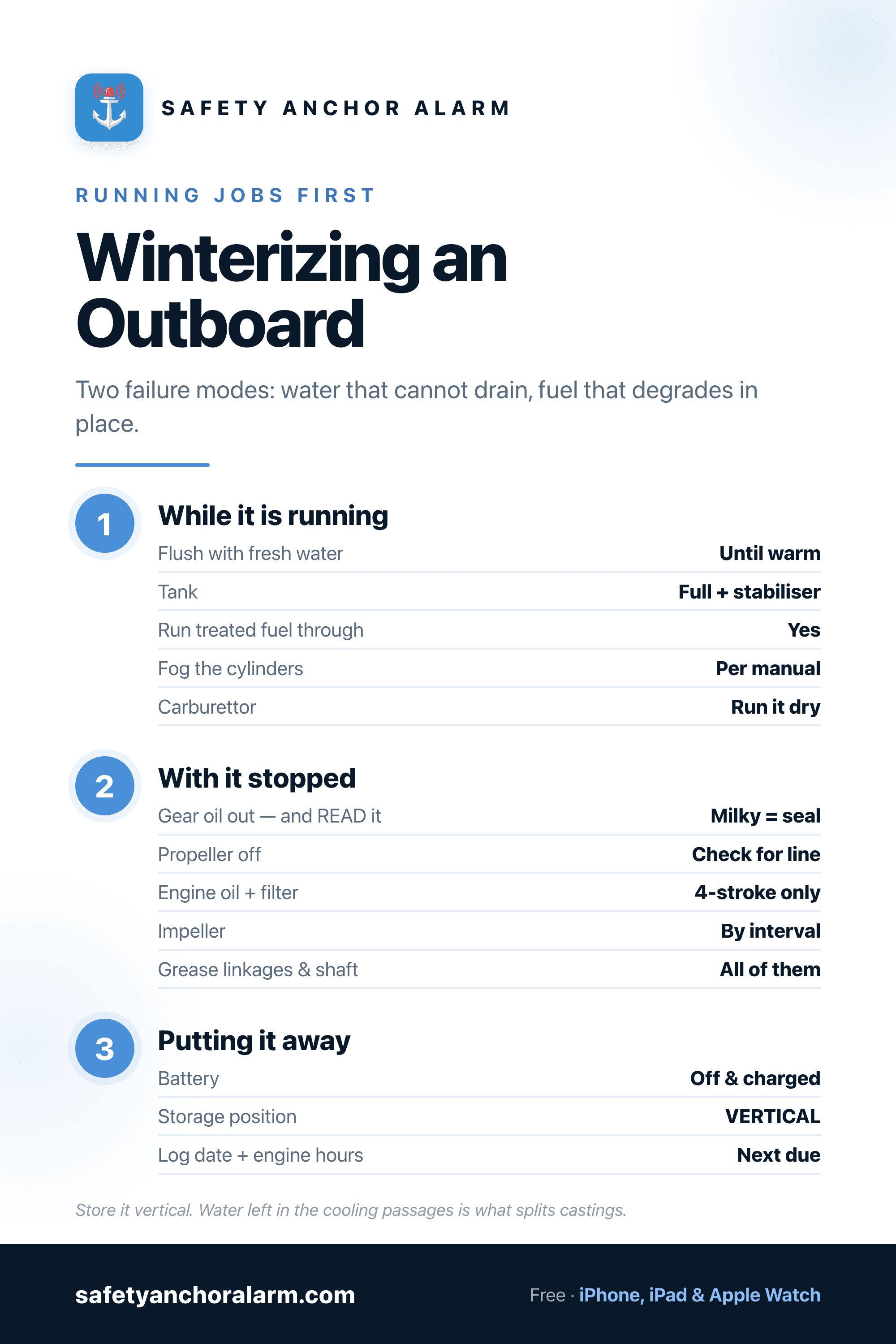
Flush with fresh water while it runs. Fill and stabilise the tank, run the treated fuel through, then run the carburettor dry. Fog the cylinders if your manual says to. Change the gear oil and look at what comes out. Four-stroke? Engine oil and filter too. Grease the linkages and propshaft, take the battery off and charge it, and store the motor vertical so the cooling passages drain. The running jobs come first, because anything that stops the engine running ends the session.
What the Gear Oil Is Telling You
Changing the lower-unit oil is on every winterization list as a chore. It is really the one diagnostic you get all year: the only look inside the gearcase without opening it. Drain it into something clean and pale, and read it before you throw it away.
| What comes out | What it means | What to do about it now |
|---|---|---|
| Clear amber, or dark but translucent | Normal. Dark just means it has done its job. | Refill with fresh oil and carry on. |
| Milky, creamy, coffee-with-milk | Water in the gearcase — a seal has failed. | Do not leave it over winter. Pressure-test and reseal the lower unit; check behind the propeller for fishing line. |
| Glittery, or gritty between your fingers | Metal from the gears. Something is wearing or has chipped. | Get the lower unit opened before spring, not after. |
| Barely any oil comes out | It has been leaking, so it has probably been running low. | Find the leak. Low oil damages gears faster than dirty oil. |
And the chain almost nobody joins up: fishing line wrapped around the propshaft is the usual reason that oil is milky. A few turns of monofilament behind the propeller works like a cutting tool against the seal until it lets go, and then the gearcase takes on water every time you use it. Which is why the propeller comes off as part of this job rather than as a separate one — you are not just greasing the shaft, you are looking for the thing that killed the seal.
Finding it in autumn is the good outcome. Water left in a gearcase over a cold winter freezes, corrodes the gear teeth and turns a seal-and-oil job into a rebuild.
Do It in This Order
The sequence is not arbitrary. Three of these jobs need the engine running, so they come before anything that stops it running.
- Flush with fresh water, on muffs or in a tank, with the engine running until it is warm. Salt left in the cooling passages corrodes all winter, and warm salt is worse than cold salt.
- Fill and stabilise the tank, then keep running so treated fuel reaches the lines, the filter and the carburettor. Treated fuel that never left the tank has only protected the tank.
- Fog, if your manual says to — while it is still running and warm.
- Run the carburettor dry. Shut off the fuel supply and let the engine stop on its own. What is left in a carburettor bowl evaporates over the winter and leaves varnish in jets the width of a hair.
- Gear oil out, and read it (above). Propeller off, check for fishing line, fresh oil in.
- Engine oil and filter if it is a four-stroke — before storage, not in spring.
- Grease the propshaft, tilt tube, steering and throttle linkages.
- Battery off, charged, and stored somewhere dry on a maintainer.
- Store it vertical. The next section is only about this, because it is the one that cracks castings.
Store It Down, Not Up
This is the cheapest job on the page and the most expensive to get wrong.
An outboard's cooling passages fill with water every time it runs, and they drain by gravity — which only works in one position. Leave the leg tilted up, or lie the motor on its side in the back of a car, and water stays in the block and the pump housing. Water that cannot escape expands as it freezes, and it expands with enough force to split an aluminium casting.
So: store it in the vertical running position, leave it there long enough to drain properly after the flush, and keep it that way until spring. If it lives on a bracket ashore, the same rule applies. This is also the job the mild-climate crowd can genuinely skip — but only the freezing part of it. Salt and damp do not care what the temperature is, which is the wider argument in our boat winterization checklist.
The Fuel Problem Got Worse
Petrol with ethanol in it — E10 and its relatives — behaves differently from the fuel outboards were designed around. It draws water out of humid air, and over months that water can separate out and sit at the bottom of the tank, which is exactly where the pickup is. Ethanol is also a solvent, so in older engines it loosens decades of deposits and carries them into the filter.
Two habits solve most of it:
- Store the tank full and treated. A full tank has almost no air in it to condense, and stabiliser keeps the fuel usable over the layup.
- Store the carburettor empty. This is the opposite instruction and both are right: fuel sitting in a vented carburettor bowl evaporates and leaves gum behind, and a blocked pilot jet is the classic reason a small outboard will not idle in April.
Portable tanks make this easier — take the tank home, and the boat is left with nothing to go stale.
Two-Stroke or Four-Stroke
Most of the list is identical. These are the parts that are not.
| Job | Two-stroke | Four-stroke |
|---|---|---|
| Engine oil & filter | None to change — the oil goes through with the fuel or is injected. | Change both, before storage rather than after. Old oil is acidic and sits on the bearings all winter. |
| Fogging | Standard on older carburetted engines. Direct-injection models have their own procedure. | Follow the manual — several makers do not want fogging oil through the intake. |
| Oil injection tank | Top it up, so it does not sit part-empty and condense. | Not applicable. |
| Carburettor | Run it dry after the treated fuel has been through. | Same, if it is carburetted. Injected engines differ. |
| Gear oil, flush, grease, storage | Identical. | Identical. |
The Impeller Question
The water pump impeller is rubber, and rubber takes a set and cracks with age whether or not the engine ran much. Most makers want it changed on a fixed interval — commonly every year or two, sooner if the motor has ever run dry or overheated — and layup is the convenient moment, because the lower unit is already off for the gear oil.
It is also the part with the worst failure consequence relative to its price: an impeller that shreds in June cooks an engine that costs a hundred times more.
Write Down What You Did
Outboards make this harder than inboards, because the jobs run on different clocks: the impeller on a calendar, the gear oil annually, the engine oil on hours, the anodes on condition. A motor that did fifteen hours last season still needs most of the list.
So log it as you go — the date, the hours on the engine, what you changed, what the gear oil looked like. That last one matters more than it sounds: “slightly cloudy” means nothing on its own and means a great deal if you wrote the same thing last autumn. A marine logbook keeps each job with its next-due date and next-due engine hours, which is the only way a three-clock schedule stays honest. The wider version is in our boat maintenance checklist.
The Bottom Line
Two failure modes, one storage rule. Get the water out — flush the salt, drain the gearcase, and stand the motor vertical so the cooling passages empty themselves. Get the fuel right — tank full and treated, carburettor run dry. Do the running jobs before the ones that stop it running, and read the gear oil instead of pouring it away.
Do that and the outboard comes out in spring as the same motor you put away, which is more than most of the ones in the yard will manage.

Safety Anchor Alarm
GPS-powered anchor monitoring for iPhone, iPad and Apple Watch. For the months the engine is off and the boat is still on a mooring somebody should be watching.
Download FreeFrequently Asked Questions
How do you winterize an outboard motor?
Should you store an outboard up or down?
What does milky gear oil mean on an outboard?
Do you need to fog a modern outboard?
Should you leave fuel in an outboard over winter?
Related Articles
How to Winterize a Boat
The whole-boat list — and why only one of the three failure modes involves frost.
MaintenanceBoat Maintenance Checklist
The schedule on three clocks — calendar, engine hours and condition.
AppMarine Logbook
Keep the service history with next-due dates and engine hours, and find it again.
SeamanshipBoat Pre-Departure Checklist
The five-minute check for the first trip after recommissioning.