The Cost of Living on a Sailboat: The Three Budgets Nobody Separates
Every answer to this question is a monthly figure, and the monthly figure is the wrong number. Not because people are lying — most liveaboard budgets you read are honest — but because they are an average of a year in which nothing big broke, and because they quietly bundle three completely different kinds of cost into one line. Separate those three and the question becomes answerable, the number becomes yours rather than somebody else's, and one decision turns out to matter more than all the rest put together.
The short answer
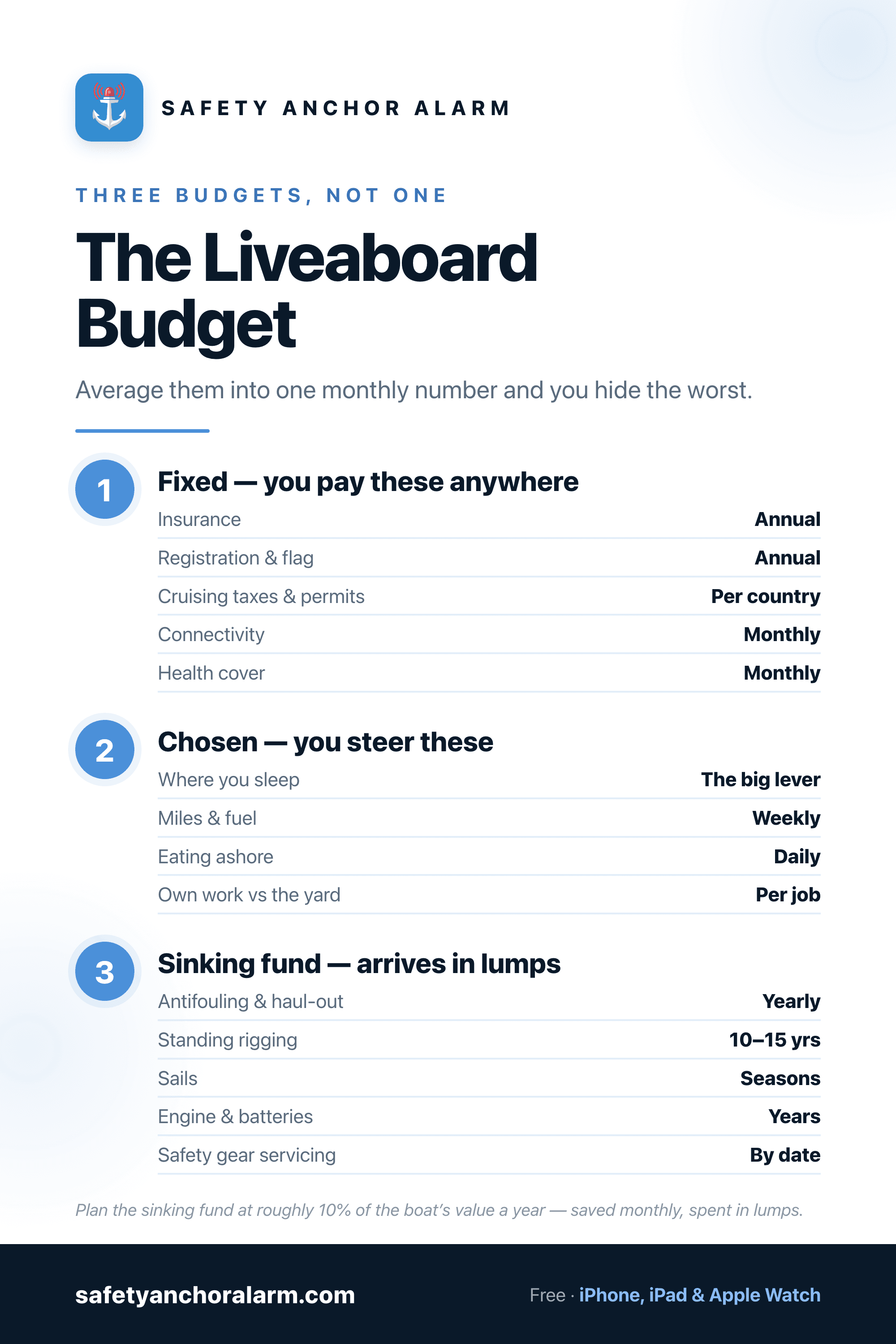
A liveaboard budget has three buckets, not one. Fixed costs (insurance, registration, cruising taxes, connectivity) are predictable and comparatively small. Chosen costs are dominated by a single decision — marina, mooring or anchor — which can swing the annual total by a factor of two or three. The sinking fund for the boat itself runs, by a common rule of thumb, at around 10% of the vessel's value a year, and arrives in lumps. Budget the third one monthly and spend it annually, or it will find you.
The Three Buckets
These behave so differently that adding them together and dividing by twelve destroys the information you need. Each has its own rhythm, its own amount of control, and its own characteristic way of going wrong.
| Bucket | What's in it | How much you control it | How it arrives | The trap |
|---|---|---|---|---|
| 1. Fixed | Insurance, registration and flag, cruising taxes and permits, connectivity, health cover | Almost none, once you have chosen boat and cruising ground | Monthly or annually, on a schedule you can diary | Underinsuring to make the number work, then discovering the policy required rigging under ten years old. |
| 2. Chosen | Where you sleep, how far you move, how often you eat ashore, whether you do your own work | Almost total — this is the bucket you actually steer | Daily and weekly, in small decisions | Treating the marina line as fixed. It is the single biggest variable in the whole budget. |
| 3. Sinking fund | Rigging, sails, engine, batteries, antifouling, safety gear servicing, the unexpected | You choose when, rarely whether | In lumps, years apart, always at the worst moment | Averaging it away. A month with nothing broken is not a cheap month, it is a month you were saving. |
Bucket 1: The Fixed Costs
These are the ones you can actually write down in advance, which makes them the least interesting part of the budget and the part people spend the most time on.
- Insurance. Priced on the boat's value, your cruising area and your experience — and increasingly on the age of the standing rigging, which is why the sinking fund and the insurance line are connected. Cruising outside a declared area, or through a named storm season, changes the premium or voids the cover.
- Registration, flag and paperwork. Small, and non-negotiable.
- Cruising taxes and permits. Charged for being in the country at all, not for using a marina — Greece's TEPAI, Croatia's vignette, Turkey's transit log and the various marine-park permits are all payable whether you spend the night on a berth or on your own anchor. The country-by-country picture is in our guide to anchoring rules in the Mediterranean.
- Connectivity and health cover. Data is the utility bill of the modern liveaboard (the Starlink guide prices the maritime plans), and health insurance is the line people postpone until the first time they need a doctor in a country they are not resident in.
Fixed costs are real, but they rarely decide whether the plan works. The other two buckets do.
Bucket 2: The Chosen Costs — and the One Lever
This is the bucket you steer, and almost all of the steering is one decision: where you sleep.
A marina berth is the largest single controllable line in liveaboard life, and in a popular cruising ground in season it can exceed everything else on the page combined. A mooring buoy is cheaper. An anchor is free. Nothing else in the budget offers that kind of range, which is why two crews on identical boats in the same country in the same year can report annual totals that differ by a factor of two or three and both be telling the truth.
| Pattern | Where you sleep | Annual index | What it really means |
|---|---|---|---|
| Marina-based | Berth all year, contract rate | 100 | Shore power, shore water, a walk to the shops, and the highest number on this page. Winter contracts cost far less per night than summer transient rates, which is why so many liveaboards are in a marina from November and gone by May. |
| Mixed | Cruising season at anchor, winter in a berth | ≈ 55–70 | The most common pattern in the Mediterranean and the one most budgets are built on. You pay for the berth when the weather is worst and the days are shortest, which is also when you most want to be able to leave the boat and go home for a fortnight. |
| Anchor-out | At anchor almost all year, occasional berth for weather and work | ≈ 30–45 | The cheapest way to live aboard and the most demanding. The saving is real, but part of it converts into gear — solar, batteries, watermaker, dinghy and outboard, ground tackle — and part of it into the willingness to move the boat when the wind goes round at two in the morning. |
The other chosen costs are smaller but move the same way. Miles cost fuel, and a crew that motors whenever the wind drops below eight knots spends a great deal more than one that waits. Eating ashore is the line that quietly doubles in a pretty anchorage with a good taverna. Doing your own work is the difference between a yard bill and a weekend, and it is the skill that most changes what a given budget can buy — our maintenance checklist is a reasonable map of what you would be taking on.
Bucket 3: The Sinking Fund, and the 10% Rule
Here is the number that dominates every honest liveaboard budget: plan on roughly 10% of the boat's value a year for the boat itself. It is a rule of thumb rather than a law, it runs higher on older and more complex boats and lower on simple, well-sorted ones, and it is the single best predictor of whether a cruising plan survives contact with a haul-out.
Applied, it is startling. A boat you would sell for eighty thousand implies a planning figure around eight thousand a year — call it six hundred and change every month — before anybody on board has eaten anything. That figure does not arrive in monthly instalments. It arrives like this:
- Antifouling and a haul-out: annually, or close to it. Predictable, and the one everybody remembers — and the moment the lay-up list lands too.
- Standing rigging: commonly replaced on a ten- to fifteen-year cycle, and increasingly demanded by insurers. One bill, one decade, large.
- Sails: a cruising wardrobe worn by UV and use, replaced a panel of the budget at a time if you are lucky and all at once if you are not.
- Engine and batteries: services are cheap, injectors and heat exchangers are not, and a battery bank is a consumable with a life measured in years.
- Safety gear servicing: liferaft, flares, extinguishers, EPIRB batteries — all dated, all due on a schedule that has nothing to do with how much you used them. The full inventory is in our safety equipment checklist.
- The unexpected. A furler, a saildrive seal, a laptop that meets a wave. There is always one a year.
This is why published monthly budgets are so often unrepeatable. A crew who spent a year with no haul-out and a healthy engine can write down a wonderfully low number in complete good faith; the rigging they will replace next spring simply is not in it. When you read someone's liveaboard budget, the useful question is not “what did you spend” but “what did the boat cost you over five years” — which is only answerable if somebody logged it as it happened, ideally in a marine logbook rather than a shoebox.
What the Budget Leaves Out
Five things that are absent from almost every published figure and present in almost every real year.
- The boat you bought sets the budget. Age, length and systems decide most of your annual cost before you have made a single lifestyle choice. A simple, sorted thirty-eight-footer is cheaper to live on than a tired forty-five-footer with a generator, air conditioning and a watermaker that all want attention.
- Getting home. Flights, and the marina berth you pay for while you are on them, because you will not leave the boat at anchor for a fortnight.
- The second boat. A dinghy and outboard are your car, and they are maintained, insured, stolen and replaced like one.
- Currency and season. Earning in one currency and spending in another adds a variable you do not control, and every cost in this article roughly doubles in July.
- The exit. Boats depreciate, sales take months, and a boat you must sell quickly sells for less. The cost of living aboard properly includes what the boat will be worth when you stop.
The Anchoring Economy
Follow the logic of the three buckets and it lands somewhere specific: the cheapest way to live aboard is to sleep at anchor, and the money you save moves into two places. Some of it becomes independence — solar, batteries, water, a dinghy you can rely on in a chop. The rest becomes ground tackle and the confidence to use it, which is worth being precise about, because it is where the saving is actually earned.
A holidaymaker who drags at three in the morning has a bad night and a story. A liveaboard who drags at three in the morning is watching their house go onto rocks with everything they own in it, uninsured for the parts of “everything they own” that a yacht policy does not count. The stakes are not the same, and neither is the arithmetic: for a full-time cruiser, the anchor is not a convenience, it is the thing standing between the cheapest line in the budget and the most expensive night of your life.
That is the honest case for the gear. Oversized ground tackle costs once. A GPS anchor alarm costs nothing, watches the position against the anchor rather than the boat, and wakes you while the problem is still a winch job. Neither of them is a budget line worth trimming, and both of them are what make the anchor-out column on that table survivable rather than merely cheap. The method is in our complete guide to anchoring; the radius comes out of the scope calculator.
The Bottom Line
Stop looking for a monthly figure. Build three: a fixed list you can diary, a chosen list you steer — starting with where you sleep, because nothing else in the budget moves like it — and a sinking fund at roughly a tenth of the boat's value a year, saved monthly and spent in lumps. Do that and you will have a number that is actually yours, and you will be able to see, in advance, which of the three is about to break.
And the arithmetic points the same way the rest of this site does. The single largest saving available to anyone living aboard is to sleep on their own anchor, which is only a saving if you sleep.

Safety Anchor Alarm
GPS-powered anchor monitoring for iPhone, iPad and Apple Watch. The cheapest line in a liveaboard budget is the one you have to sleep through.
Download FreeFrequently Asked Questions
How much does it cost to live on a sailboat?
Is living on a boat cheaper than renting a flat?
What is the biggest hidden cost of living aboard?
Can you live on a boat at anchor for free?
What size boat is cheapest to live on?
Related Articles
Boat Maintenance Checklist
What the sinking fund is actually buying — by interval, engine hour and condition.
RegulationsAnchoring Rules in the Mediterranean
Cruising taxes, permits and the places you may no longer anchor for free.
GuideHow to Anchor a Boat
The complete method — spot, scope, lay, set, watch — with a pass/fail test at every step.
SafetyAnchor Safety for Solo Sailors
When there is nobody on the other watch, the alarm is the other watch.