Essential Sailing Knots: The Six That Matter — and the Knots for Anchoring
Every knot in every knot book holds. That is not the hard part. On a boat the useful question is the other one: can you get it off again — after twelve hours of load, in the dark, one-handed, while the bow is snatching and the line is bar-taut and wet? Choose knots that way and the list gets short, the reasoning gets obvious, and the ones you keep are the ones that will not let you down at three in the morning. Here is the working set, organised by the job rather than by the tying — with the anchoring knots covered properly, because those are the ones nobody practises until the night they need them.
The short answer
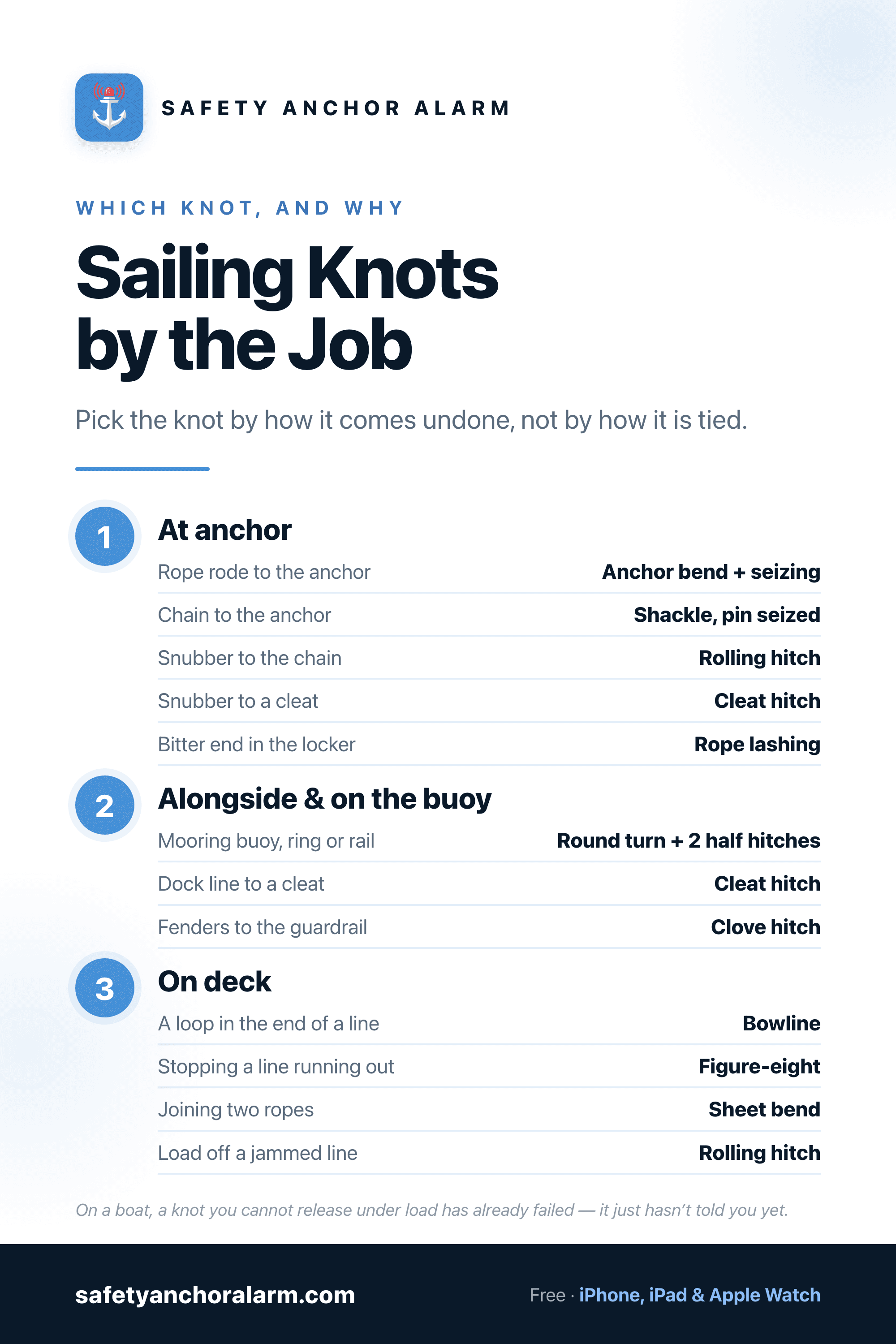
Six knots cover almost everything on a cruising boat: bowline for a fixed loop, cleat hitch for making fast, round turn and two half hitches for a ring or a mooring buoy, clove hitch for fenders, figure-eight as a stopper, and rolling hitch for gripping a loaded line or chain. For anchoring specifically, add the anchor bend to join a rope rode to the anchor — and remember that on an all-chain rode the critical connection is a seized shackle, not a knot at all.
The Job, the Knot, and How It Comes Undone
This is the table to learn from, because the last column is the one that decides which knot goes where. Most knot guides stop at “it holds”. On a boat, holding is the entry requirement.
| The job | The knot | Why this one | How it comes off |
|---|---|---|---|
| Rope rode to the anchor | Anchor bend (fisherman's bend) | Two round turns spread the load and stop the knot strangling itself in the ring. | It does not. This one is meant to be permanent — seize the tail and leave it. |
| Snubber to the chain | Rolling hitch | Grips lengthwise along chain or a loaded rope, which no loop knot will do. | Slides off the instant the load comes off. That is the whole point of it. |
| Snubber or rode to a cleat | Cleat hitch | The initial round turn lets you hold and ease several tonnes with your hands. | Under full load, one horn at a time — the only fastening on the boat you can reliably slip while it is loaded. |
| A loop in the end of a line | Bowline | Fixed loop that will not slip or tighten on whatever is inside it. | Break the neck with a thumb after the load comes off, even after a hard night. |
| Mooring buoy, ring or post | Round turn and two half hitches | The round turn holds the boat while you tie the rest one-handed. | Easily, and it can be eased under tension before you finish it — the reason it beats a bowline off the bow. |
| Fenders to the guardrail | Clove hitch | Fast, adjustable for height, tied with one hand while the other holds on. | Instantly at fender loads. Never use it where the load is heavy or varying — it slips, then jams. |
| Joining two ropes | Sheet bend (double, if the sizes differ) | Works between different diameters and materials, where a reef knot capsizes. | Easily, provided it was loaded steadily rather than shock-loaded. |
| Stopping a line running out | Figure-eight | Bulkier than an overhand and, unlike one, it comes undone afterwards. | Push the loop back through; it does not weld itself shut. |
| Taking load off a jammed winch or line | Rolling hitch onto the loaded line | Transfers the load to a second line so you can free the first. | Falls apart once the original line takes the strain back. |
| Reefing, and tying bundles | Reef knot | Flat, neat, and easy to spill deliberately when you shake the reef out. | Too easily to be trusted anywhere else — it is not a bend, and it capsizes if you join two ropes with it. |
The Six, and What Each One Is Actually For
1. The bowline — the loop that unties
A bowline puts a fixed loop in the end of a line: it will not slip, it will not tighten on whatever is inside it, and after a night of load you can break its neck with a thumb and it falls apart. That last property is why it is the first knot every sailor learns and the one that gets used for everything from a jib sheet to a halyard to a line ashore.
Two cautions. It works loose when it is loaded and unloaded repeatedly while slack — a flogging jib sheet is the classic — so leave a tail of at least ten rope diameters and add a stopper where it matters. And it is a poor choice in slippery high-modulus line, which is covered further down.
2. The cleat hitch — the only thing you can release under load
The cleat hitch is not really a knot, and it is the most important fastening on the boat. A full turn round the base of the cleat first, then two figure-eights across the horns, then a locking hitch if the line will not need slipping in a hurry.
The full turn is the part beginners skip and the part that earns the knot its place: with one turn on the cleat you can hold, surge and ease a line carrying several tonnes using nothing but the friction of the metal, and you can let it out under control instead of losing it. Everything else on the cleat is just tidiness. Two figure-eights are enough — a cleat buried under six of them is a cleat nobody can free in the dark, which is when it will be needed.
3. Round turn and two half hitches — for rings and buoys
The knot for tying to something you cannot pass a loop over: a mooring buoy ring, a rail, a bollard, a dinghy painter. The round turn takes the load first, which means you can hold the boat one-handed against wind and tide while you tie the two half hitches with the other. It is also easy to ease under tension before you commit — a bowline dropped over a buoy ring gives you none of that.
4. The clove hitch — fast, adjustable, and limited
Two crossing turns, tied in seconds with one hand, adjustable for height. That is exactly what fenders need and it is why the clove hitch is worth knowing. It is also worth knowing its limits: it slips under a varying load, and having slipped and tightened, it jams. Fenders yes; anything structural, no.
5. The figure-eight — the stopper that comes out again
A stopper knot in the end of every sheet and every halyard so the line cannot run out through a block or up the mast. It matters that this is a figure-eight and not an overhand knot: both stop the line, but only one of them can still be untied after it has been slammed hard into a block.
6. The rolling hitch — the problem-solver
The knot that grips along another rope or a chain instead of round something. Two turns on the loaded side, then a half hitch on the other, and it will not slide towards the load. It is the knot for taking the strain off a riding turn on a winch, for rigging a temporary snubber onto chain, and for a hundred other jobs where you need to grab something already under tension. It is also the knot that separates people who can solve a problem on the foredeck from people who have to go and find a knife.
Knots for Anchoring: the Set That Holds You Overnight
This is where the stakes change. Everything else on this page is convenience; the anchoring set is what stands between the boat and the rocks while you are asleep. And the first thing to say about it is a correction, because it catches people every season: the most important connection in an anchoring system is usually not a knot at all.
On an all-chain rode the anchor joins the chain with a shackle, and that shackle's pin has to be seized — stainless seizing wire through the hole in the pin, or at minimum a cable tie — because a pin that is merely done up finger-tight will slowly unscrew itself over a season of the boat swinging back and forth. No knot in this article will save you from a shackle that undid itself.
| Connection | What belongs there | Why |
|---|---|---|
| Anchor to rode | Shackle, pin seized — or an anchor bend on rope rode | The most important connection in the system is not a knot. A shackle pin that backs itself out over a season of swinging loses you the whole anchor. |
| Chain to rope (a mixed rode) | Chain splice, or a shackle through a spliced thimble | Anything knotted here has to pass through the bow roller and, on many boats, over the gypsy. A knot will not. |
| Snubber to chain | Chain hook, or a rolling hitch | The hook is quicker; the rolling hitch is what you use when the hook is over the side or the wrong size for the chain. |
| Snubber to the boat | Cleat hitch, or a spliced eye dropped over the cleat | Whichever you use, protect it from chafe where it crosses the bow roller — this is the single most common overnight failure. |
| Bitter end to the boat | A rope lashing to a strong point in the chain locker | Rope, not a shackle. If the whole rode runs out, or you need to slip it and go, you can cut rope with a knife. |
| Trip line to the crown | Bowline through the crown eye, buoy on the other end | Rigged before you drop, in anchorages known for old moorings and cables. It turns a fouled anchor into a two-minute job. |
The anchor bend, for a rope rode
If your rode is rope — a kedge, a stern anchor, a small boat's main rode — the traditional connection to the anchor is the anchor bend, also called the fisherman's bend:
- Two round turns through the anchor ring or shackle, kept loose enough to work with.
- A half hitch passed under both turns, round the standing part — this is the bit that makes it an anchor bend rather than a round turn and two half hitches.
- A second half hitch above it, round the standing part in the same direction.
- Seize the tail to the standing part with whipping twine or a cable tie. This connection is meant to live there for the season; the seizing is what stops it working loose when the rode goes slack and snatches, over and over, all night.
Better still, where you can: a spliced eye round a thimble, shackled to the anchor. A splice keeps almost all of the line's strength where a knot gives away a large slice of it, and the thimble stops the eye chafing through on the shackle.
The rolling hitch, for the snubber
A snubber is a few metres of stretchy nylon that takes the load off the chain and the windlass and absorbs the shock of every gust. Most boats attach it with a chain hook. The knot to know for when the hook is the wrong size, over the side, or was never bought is the rolling hitch, tied round the chain itself: two turns first, working towards the load, then a half hitch on the far side. Under tension it grips; slack, it slides off in your hand.
What the snubber must never be tied with is a bowline round the chain. A loop cannot grip chain lengthwise — it slides down to the nearest link and loads a single point sideways — and after a night of shock loading, nylon that has been repeatedly stretched and released turns a bowline into something you will be cutting off with a knife. The full picture of why the load has to leave the windlass at all is in anchoring with a windlass.
The bitter end, and the knife argument
The bitter end of the rode should be made fast inside the chain locker with a rope lashing, long enough to reach the deck, and never with a shackle. Two scenarios, both real: the whole rode runs out by accident, and you would rather lose the anchor than have the chain rip the locker apart; or you need to leave in a hurry — a dragging neighbour, a shifting wind on a lee shore — and buoying the rode and cutting it is faster than recovering it. You can cut rope. You cannot cut a shackle.
What Every Knot Costs You
A knot is a tight bend in a rope, and the fibres on the inside of that bend carry far less load than the ones on the outside. The working rule: tying a knot costs somewhere between a quarter and a half of the line's breaking strength, depending on the knot, the rope and who is measuring. A well-made splice costs very little.
That single fact explains most of the rigging choices on a well-found boat: why dock lines and anchor rodes come with spliced eyes rather than knotted loops, why a permanent connection is spliced and a temporary one is tied, and why the number printed on the reel is not the number you should be designing around. It is not an argument against knots — it is an argument for sizing the line as though it will always be knotted, because sooner or later it will be.
Modern line changes the answers
High-modulus fibres — Dyneema, Spectra and their relatives — are extraordinarily strong and extraordinarily slippery, and most traditional knots either slip in them outright or give away far more strength than they would in polyester. The rule with these lines is simple: splice, do not knot. If you must tie one, use a knot known to work in high-modulus line and treat its strength as a fraction of the printed figure. Nylon has the opposite personality: it stretches, which is exactly why it makes the best snubbers and the worst knots to untie after a gale.
The Failure Modes
Almost every knot that lets go on a boat fails in one of these five ways, and none of them is exotic.
- Not enough tail. The single most common failure. Ten rope diameters is the old rule and it is a good one. A bowline with a two-centimetre tail is a bowline waiting for a reason.
- Cyclic loading. Loaded, slack, loaded, slack — thousands of times overnight. This is the anchoring load case precisely, and it is what shakes knots out that would hold a steady pull for a week.
- The wrong knot for the direction of pull. A clove hitch pulled along the rail instead of across it; a loop where the load runs lengthwise. Rolling hitches exist for that second case and nothing else does.
- Chafe, which is not a knot failure at all. The knot is fine; the rope has sawn through 30 cm away where it crosses the bow roller. Anywhere a loaded line crosses an edge gets protection, every time, and on a snubber it gets checked before you go below.
- A knot nobody else can undo. If you are the only person aboard who can free your lines, you have built a single point of failure into the crew as well as the rigging.
How to Actually Learn Them
Knots are muscle memory, not knowledge, and the gap between “I know that knot” and “I can tie that knot at night with cold hands” is where the trouble lives. Three things that work:
- Practise the release, not the tying. Tie it, load it hard, then undo it. That is the half everyone skips and the half that decides whether the knot belongs on your boat.
- Learn them in the dark, with your eyes shut. Six knots, a metre of line, ten minutes at anchor with a drink in the other hand. You are training your hands, not your eyes.
- Teach one to the crew. The cleat hitch, if you only teach one — it is the one that gets used most and done worst, and it is the one somebody else will need to undo while you are on the bow.
The Bottom Line
Six knots run a cruising boat: bowline, cleat hitch, round turn and two half hitches, clove hitch, figure-eight, rolling hitch. Add the anchor bend if you have rope rode, seize the shackle if you have chain, and choose every one of them by how it releases rather than by how it holds — because on a boat the knot you cannot undo is a knot that has failed, it just has not told you yet.
The anchoring set is the part that works while you are asleep, and it is the part you cannot check by looking at it from the cockpit. That is the gap an anchor alarm fills: whatever is holding the snubber to the chain and the chain to the seabed, the alarm watches the one thing that proves it is all still working — that the boat has not moved. Set the centre on the anchor, the radius from your scope, and let the knots get on with their night. The complete method is in our guide to anchoring a boat.

Safety Anchor Alarm
GPS-powered anchor monitoring for iPhone, iPad and Apple Watch. Your knots hold the boat to the chain — this tells you the chain is still holding the boat.
Download FreeFrequently Asked Questions
What knot do you use to tie a rope to an anchor?
What are the best knots for anchoring?
How much strength does a knot take out of a rope?
Why does my bowline come undone?
How do you tie a cleat hitch correctly?
Related Articles
Anchoring With a Windlass
Why the load has to come off the windlass and onto a chain stopper and snubber.
ReferenceSailing Terms Glossary
200 nautical words A–Z, including rope, line, rode and warp — and why they differ.
GuideHow to Anchor a Boat
The complete method — spot, scope, lay, set, watch — with a pass/fail test at every step.
SeamanshipBoat Pre-Departure Checklist
The five-minute routine before you leave the dock, lines and ground tackle included.