Navigation Rules Explained: COLREGs, Right of Way, Sound Signals and What Changes at Anchor
The rules of the road do not give anyone the right of way. They name one boat the give-way vessel and the other the stand-on vessel, and they give both a job. This guide sets out the two rulebooks a US boater lives under and the magenta line that divides them, who keeps clear of whom, the five situations in which two boats meet, what the whistle and the bell mean on each side of that line, and what the Coast Guard's 2024 figures say about how often the rules are broken. It ends with the part most guides skip: the rules for a boat at anchor, and why a boat that is dragging has, by the rules' own definition, stopped being one.
The short answer
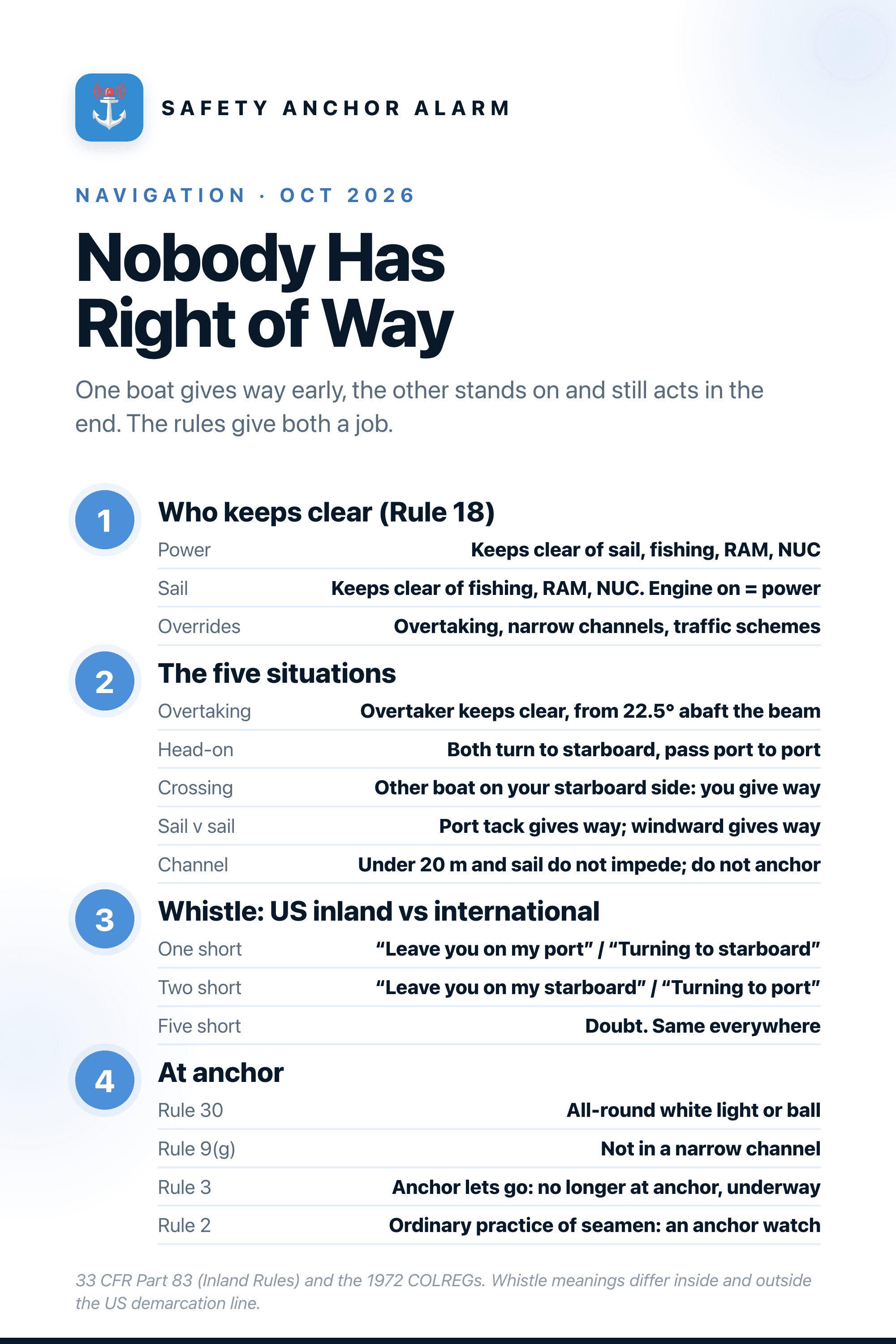
The COLREGs are the International Regulations for Preventing Collisions at Sea, 1972: 41 rules that apply to every vessel at sea. Inside the US demarcation lines the Inland Navigation Rules apply instead, with the same numbering and a few differences, mainly in whistle signals. Between two boats one is the give-way vessel, which must act early and substantially, and one the stand-on vessel, which holds course and speed but must act if the other does not. Power gives way to sail, sail to fishing, everyone to a vessel that cannot manoeuvre; an overtaking vessel always keeps clear; in a crossing the boat with the other on her starboard side gives way; port tack gives way to starboard. One short blast means “I intend to leave you on my port side” on US inland waters and “I am turning to starboard” everywhere else; five short blasts mean doubt. A boat at anchor shows an all-round white light, rings a bell in fog and stays out of narrow channels. A boat whose anchor has let go is no longer at anchor.
The Five Situations
Almost every meeting between two boats in sight of each other is one of these. Who keeps clear, how the rules say you tell, and the mistake behind each:
| Situation | Who keeps clear | How you tell | The trap |
|---|---|---|---|
| Overtaking (Rule 13) | The overtaking vessel keeps clear, whatever she is: power, sail or fishing | Coming up from more than 22.5° abaft the other's beam: at night you would see only her sternlight | A later change of bearing does not turn it into a crossing; in doubt, assume you are overtaking |
| Head-on, two power-driven vessels (Rule 14) | Both alter course to starboard and pass port to port | Ahead or nearly ahead; at night both sidelights, or masthead lights in a line | In doubt, assume it is head-on. Inland: a downbound vessel with a following current on the Great Lakes and Western Rivers has right of way and proposes the passing |
| Crossing, two power-driven vessels (Rule 15) | The vessel that has the other on her starboard side keeps out of the way | Not overtaking and not head-on; the other's bearing is steady and the range closing | Avoid crossing ahead. Inland: a vessel crossing a river keeps out of the way of one going up or down it |
| Two sailing vessels (Rule 12) | Port tack keeps clear of starboard tack; same tack, windward keeps clear of leeward | Windward is the side opposite the mainsail | Port-tack boat unsure of the other's tack keeps clear. Engine on means power-driven, and Rule 18 applies instead |
| Narrow channel (Rule 9) | Keep to the starboard side; under 20 m, sailing and fishing vessels must not impede a vessel that can only navigate in the channel | Do not cross if it impedes such a vessel; do not anchor in the channel if you can avoid it | Impede is not the same as give way: the small boat must keep out of the big one's road early, not wait for a situation to develop |
Two Rulebooks and a Magenta Line
The COLREGs are the International Regulations for Preventing Collisions at Sea, adopted by the International Maritime Organization on 20 October 1972 and in force since 15 July 1977. The IMO counts 41 rules in six parts: general (Rules 1 to 3), steering and sailing (4 to 19), lights and shapes (20 to 31), sound and light signals (32 to 37), exemptions (38) and, added in 2013, verification of compliance (39 to 41). Their first innovation was Rule 10 on traffic separation schemes. They apply to all vessels on the high seas and on all waters connected to them that seagoing vessels can navigate, and each country applies them in its own law: in the United Kingdom through the Merchant Shipping regulations, in most of the world directly.
The United States adds a second book. The Inland Navigation Rules, codified in 33 CFR Part 83 since 2014, govern the inland waters of the United States and US vessels on the Canadian waters of the Great Lakes. They are written as “special rules made by an appropriate authority” under COLREG Rule 1(b), keep the same rule numbers, and differ from the international text in a handful of places, which this guide marks as it goes. The boundary between the two is the set of COLREGS demarcation lines in 33 CFR Part 80: “the waters inside of the lines are Inland Rules waters. The waters outside the lines are COLREGS waters.” We counted them in the eCFR of 28 October 2026: 105 sections of lines, from Calais, Maine to Alaska and the Pacific island possessions, each a chain of headlands, breakwaters and buoys. On a NOAA chart they appear as a magenta dashed line labelled COLREGS DEMARCATION LINE, usually drawn across a harbour entrance or between two headlands. Cross it outbound and the whistle signals change meaning; most of the rest does not.
The Inland Rules also carry a paper requirement: the operator of a self-propelled vessel of 12 metres or more must carry a copy of the rules on board for ready reference. The Coast Guard publishes both texts side by side in its Navigation Rules and Regulations Handbook, and the Inland text is free in the eCFR.
The Rules Are Not About Right of Way
The phrase “right of way” appears in the Inland Rules exactly once, for a vessel going downstream with the current on the Great Lakes and Western Rivers, and in the international rules not at all. What the rules do is name a give-way vessel and a stand-on vessel and give each a duty:
- Give-way (Rule 16): “take early and substantial action to keep well clear.” Early, so the other boat sees it; substantial, so she cannot mistake it.
- Stand-on (Rule 17): keep course and speed, so the give-way vessel can plan around something that does not move. But a stand-on vessel is not a passenger: she may act as soon as it is apparent the other is not acting, and she must act when collision can no longer be avoided by the give-way vessel alone. A power-driven vessel acting in a crossing should not turn to port for a vessel on her own port side.
Three rules sit over all of this. Rule 2 says nothing in the rules excuses a vessel from “the consequences of any neglect to comply with these Rules or of the neglect of any precaution which may be required by the ordinary practice of seamen,” and allows a departure from the rules to avoid immediate danger. Rule 5 requires every vessel, at all times, to “maintain a proper look-out by sight and hearing as well as by all available means.” Rule 6 requires a safe speed, judged by visibility, traffic, stopping distance, background lights at night, wind, sea, current and depth, and for a boat with radar, by what the radar can and cannot show. Being the stand-on vessel is a defence against none of them.
Who Keeps Clear: The Order of Responsibility
When two vessels of different kinds meet, Rule 18 decides before any of the situation rules do. Read it from the top: each vessel keeps out of the way of every one below it.
| Vessel | Duty | Note |
|---|---|---|
| Power-driven vessel | Keeps clear of all below | Includes any sailing vessel with her engine in gear |
| Sailing vessel | Keeps clear of all below | Under sail alone |
| Vessel engaged in fishing | Keeps clear of all below | Nets, lines or trawls that restrict manoeuvrability: not trolling |
| Vessel restricted in her ability to manoeuvre | Keeps clear of the one below | Dredging, cable laying, towing that cannot deviate, and the rest of Rule 3(g) |
| Vessel not under command | Everyone keeps clear | Unable to manoeuvre through some exceptional circumstance |
Three things about that list catch people out. First, the definitions are strict. A sailing vessel is one “under sail provided that propelling machinery, if fitted, is not being used”: a yacht motor-sailing is a power-driven vessel and gives way to one that is not. A vessel engaged in fishing is one working nets, lines or trawls that restrict her manoeuvrability; a boat trolling a couple of lines is not, and takes no priority from them. Second, Rule 18 opens with “except where Rules 9, 10 and 13 otherwise require”: in a narrow channel, in a traffic separation scheme, and when overtaking, the order above is suspended. A sailing vessel does not stand on against a ship confined to a channel, and an overtaking sailing boat keeps clear of the motorboat she is passing. Third, a vessel at anchor is not in the list, because the whole of Rule 18 is addressed to vessels underway. An anchored boat has her own rules, further down.
The Five Situations, Rule by Rule
The table at the top covers the mechanics. The points the rules themselves make that a summary loses:
- Overtaking beats everything. Rule 13 applies “notwithstanding anything contained in Rules 4 through 18”. The test is the angle: more than 22.5 degrees abaft the beam, the arc of the sternlight. Once you are overtaking you stay the overtaking vessel until “finally past and clear”, however the bearing changes on the way.
- Head-on means both turn to starboard. Rule 14 has no stand-on vessel; each alters course so they pass port to port. The sign at night is both sidelights of the other boat at once, or her masthead lights in line. In doubt, treat it as head-on. The Inland Rules add the one case of right of way: on the Great Lakes, Western Rivers and waters the Coast Guard specifies, a power-driven vessel going downbound with a following current has right of way over an upbound vessel and proposes how they pass.
- Crossing: starboard is the danger side. Under Rule 15 the boat with the other on her starboard side keeps clear and avoids crossing ahead. The practical test is a steady compass bearing with the range closing, which Rule 7 names as the sign that risk of collision exists; a bearing that does not change is a boat that will arrive where you will. Inland, a power-driven vessel crossing a river keeps out of the way of one going up or down it.
- Sail against sail is about tack, then height. Rule 12 is the same on both sides of the line: port tack keeps clear of starboard, windward keeps clear of leeward on the same tack, and a port-tack boat that cannot tell keeps clear anyway. The racing rules add layers on top of this; the COLREGs do not.
- A narrow channel belongs to the vessel that needs it. Rule 9 puts every vessel on the starboard side of the channel, and tells vessels under 20 metres, sailing vessels and fishing vessels not to impede a vessel that can safely navigate only within it. Not impeding is a different and earlier duty than giving way: it means staying out of her road before any situation arises. Rule 9(g) adds the sentence that matters for the rest of this guide: “Every vessel shall, if the circumstances of the case admit, avoid anchoring in a narrow channel.”
Rule 19, for vessels not in sight of one another in fog, throws the whole give-way and stand-on structure out. Every vessel proceeds at a safe speed, with engines ready, and a vessel that detects another by radar alone takes avoiding action early, avoiding an alteration to port for a vessel forward of the beam unless she is overtaking it. In fog there is no stand-on vessel.
Sound Signals: Intent on One Side of the Line, Action on the Other
This is where the two books part. Under the international Rule 34, a whistle signal reports what a vessel is doing: one short blast, “I am altering my course to starboard”; two, “to port”; three, “I am operating astern propulsion”. Nobody answers. Under the Inland Rule 34, the same blasts announce what a vessel intends, and are only used when two power-driven vessels in sight of one another will meet or cross within half a mile: one short blast, “I intend to leave you on my port side”; two, “on my starboard side”. The other vessel, if she agrees, sounds the same signal back; if she doubts it, she sounds the doubt signal and both hold off until they have an agreement. A passing arranged on the VHF counts as the agreement and the whistles can stay silent.
| Signal | US Inland Rules | International COLREGs |
|---|---|---|
| One short blast | "I intend to leave you on my port side"; the other answers one blast if she agrees | "I am altering my course to starboard"; no answer |
| Two short blasts | "I intend to leave you on my starboard side"; answered with two if agreed | "I am altering my course to port"; no answer |
| Three short blasts | "I am operating astern propulsion" | Same |
| Five or more short, rapid blasts | Doubt: I do not understand you, or you are not doing enough | Same |
| One prolonged blast | Nearing a bend or obstruction; also when leaving a dock or berth | Nearing a bend or obstruction |
| Overtaking in a channel | One short: overtake on your starboard side; two short: on your port side; same signal back if agreed | Two prolonged then one short (starboard) or two short (port); agreement is long-short-long-short |
A short blast is about one second, a prolonged blast four to six (Rule 32). The one signal that matters most is the same everywhere: five or more short and rapid blasts when you do not understand the other vessel or doubt she is doing enough. It is not an insult; it is the rule's way of saying “talk to me”, and Rule 34(d) says the vessel in doubt shall immediately sound it. Rule 33 sets the equipment: a vessel of 12 metres or more carries a whistle, 20 metres or more a bell as well, 100 metres or more a gong; a vessel under 12 metres need carry none of them but must have “some other means of making an efficient sound signal”. A canned air horn satisfies that, as long as it is where you can reach it.
In Fog: Who Sounds What
Rule 35 is the same in both books apart from one inland exemption, and it is the rule most small-boat sailors have never read all the way down. In or near restricted visibility, day or night:
| Vessel | Signal, at least every two minutes |
|---|---|
| Power-driven, making way | One prolonged blast |
| Power-driven, underway but stopped | Two prolonged blasts, about two seconds apart |
| Sailing, fishing, towing, not under command, restricted in ability to manoeuvre | One prolonged and two short blasts |
| At anchor | Bell rung rapidly for about five seconds, every minute at most; 100 m and over adds a gong aft. May add short-prolonged-short to warn an approaching vessel |
| Aground | The anchor signal, with three distinct strokes on the bell before and after the ringing |
| 12 to 20 m at anchor or aground | Not obliged to ring the bell, but must make some other efficient sound signal every two minutes |
| Under 12 m | Not obliged to give the signals above, but must make some other efficient sound signal every two minutes |
Two things to notice. A sailing vessel under way in fog sounds the same signal as a vessel not under command or restricted in her ability to manoeuvre: one prolonged and two short. And the anchored vessel's signal is the only one in the rule given on a bell, every minute rather than every two, which is what lets a vessel groping into an anchorage tell a boat at anchor from one moving. The inland exemption is in 35(l): a vessel under 20 metres anchored in a special anchorage area designated by the Coast Guard need not sound it at all. More on those below.
What the 2024 Numbers Say
The Coast Guard's Recreational Boating Statistics for 2024 verified 3,887 incidents, 556 deaths and 2,170 injuries. Its executive summary lists navigation rules violations among the top five primary contributing factors, and adds that where the data was known, a navigation rules violation was a contributing factor, primary or not, in 55% of incidents, 34% of deaths and 63% of injuries. Collisions with another vessel were the second most common incident type, 747 of them, with 43 deaths and 570 injuries. The primary factors, from Table 5, with two rows from lower down the table that belong in an anchoring guide:
| Primary contributing factor | Incidents | Deaths | Injuries |
|---|---|---|---|
| Operator inattention | 551 | 42 | 294 |
| Improper lookout | 464 | 24 | 348 |
| Operator inexperience | 436 | 42 | 213 |
| Machinery failure | 289 | 13 | 94 |
| Navigation rules violation | 288 | 17 | 163 |
| Excessive speed | 279 | 26 | 245 |
| Alcohol use | 244 | 92 | 192 |
| Weather | 188 | 55 | 53 |
| Hazardous waters | 172 | 53 | 69 |
| Force of wave/wake | 122 | 5 | 80 |
| Improper anchoring | 36 | 3 | 8 |
| Inadequate onboard navigation lights | 16 | 7 | 13 |
Read the top three rows against Rule 5. Operator inattention and improper lookout together account for over a thousand incidents, more than any rule about who gives way. Most collisions are not a dispute about Rule 15; they are a boat nobody was looking out of. The same report's table of what vessels were doing at the time records 211 vessels at anchor in incidents, with 16 deaths, against 436 drifting, with 129 deaths, and 2,165 cruising, with 158.
At Anchor: The Fourth State of a Vessel
Rule 3(i) defines underway in one sentence: “a vessel is not at anchor, or made fast to the shore, or aground.” That gives a vessel four states, and the rules owe each a different set of duties:
| State | Meaning | What the rules require |
|---|---|---|
| Underway | Not at anchor, not made fast to the shore, not aground | Steering and sailing rules, navigation lights, fog signal by type |
| At anchor | Held by her anchor | All-round white light or ball (Rule 30), bell in fog (Rule 35), not in a narrow channel (Rule 9) |
| Made fast to the shore | Tied to a dock, quay or mooring | No anchor light at a dock; a moored boat shows what local rules require |
| Aground | Resting on the bottom | Anchor lights plus two all-round red lights or three balls; the bell with three strokes before and after |
For the boat at anchor, four rules apply and the give-way rules do not:
- Rule 30: be seen. An all-round white light where it can best be seen, or a black ball by day; a vessel under 50 metres may show a single light. A vessel under 7 metres anchored away from channels, fairways, anchorages and where other vessels normally navigate is excused, and under the Inland Rules so is a vessel under 20 metres in a special anchorage area. The detail, including the common mistakes, is in our navigation lights guide.
- Rule 35: be heard. The bell, every minute, in fog; or for a boat under 20 metres, some other efficient sound every two minutes. Nobody expects a 10-metre yacht to ring a bell all night in fog, but the rule does expect her to be able to make a noise when she hears an engine closing.
- Rule 9(g): not in the channel. And, because channels are marked for vessels that move, our channel markers guide explains how to tell where that channel actually is.
- Rule 2: the ordinary practice of seamen. The rules never list what a boat at anchor must do about her anchor. They do not need to: Rule 2 makes every precaution “required by the ordinary practice of seamen” a duty, and keeping a watch on the anchor in a rising wind has been ordinary practice for as long as there have been anchors.
The special anchorage areas are worth knowing about if you anchor on US inland waters. Subpart A of 33 CFR Part 110 lists them, each designated for the purposes of Rules 30 and 35 so that vessels under 20 metres need show no anchor light and sound no fog signal there. We counted the eCFR of 28 October 2026: 99 sections, from Penobscot Bay in Maine to Apra Harbor in Guam, many describing several areas, with exact boundaries in each. They are drawn where small boats habitually lie, off yacht clubs and town waterfronts, and they are charted. Outside them, every anchored boat of 7 metres or more owes the light.
Now the sentence the rules leave for you to finish. A boat is at anchor because her anchor holds her. When the anchor lets go, she is no longer at anchor; she is not made fast to the shore and not aground; by Rule 3(i) she is underway, and the standard commentaries on the rules treat a vessel dragging her anchor exactly that way. She is a power-driven vessel under Rule 18 with nobody steering, and under Rule 5 with nobody keeping a look-out. Worse, she is still showing the all-round white light of Rule 30, which tells every other boat in the anchorage that she is stationary. The rules are written for vessels that know their own state, and a dragging boat has changed state without anyone on board noticing.
That is the case for an anchor watch, and for making it one that does not depend on someone staying awake. A GPS anchor alarm centred on the anchor, with a radius covering the full swing plus GPS error, does one thing: it tells you the moment the boat has left the circle in which she can honestly be called at anchor. Take the radius from your scope, know the signs of dragging for the minutes after it sounds, and the rules' assumption about you, that the light means what it says, stays true all night.
The Bottom Line
Two rulebooks, one numbering: the COLREGs outside the magenta line and the Inland Rules inside it, different mostly in what a whistle means. No right of way, only a give-way vessel that must act early and a stand-on vessel that must act in the end. Power keeps clear of sail, sail of fishing, everyone of the vessel that cannot manoeuvre, and overtaking, narrow channels and traffic schemes overrule all of it. In a crossing, starboard is the danger side; under sail, port tack gives way; in fog there is no stand-on vessel at all. Five short blasts are a question, not an insult. The Coast Guard's 2024 figures put a rules violation in more than half of incidents, and inattention and a poor look-out ahead of every rule about who gives way. And a boat at anchor keeps her own four rules: the light, the bell, the channel, and the ordinary practice of seamen, which includes knowing she is still at anchor.

Safety Anchor Alarm
The rules assume a boat at anchor stays at anchor. Centre the alarm on the anchor, set the radius for the swing, and it wakes you the moment that stops being true.
Download Free