Electric Shock Drowning: Why Swimming Near a Dock Can Kill, What an ELCI Does, and How to Test Your Boat for AC Leakage
On the Fourth of July weekend in 2012, a 13-year-old girl and her 8-year-old brother were swimming near a private dock on the Lake of the Ozarks when they started to scream. By the time they were pulled out, both were unresponsive, and both died. They had not drowned in the usual sense. Alternating current leaking from the dock had paralysed them in the water. BoatUS counted seven confirmed deaths like theirs in four months that summer alone. It is called electric shock drowning, and it is hard to count because it leaves no marks: unless someone saw the shock, the record says drowning. This guide explains how the current gets into the water, why fresh water is where it kills, the devices that stop it on the boat and on the dock, how to test your own boat, and what to do if you are ever the one in the water, or the one on the dock.
The short answer
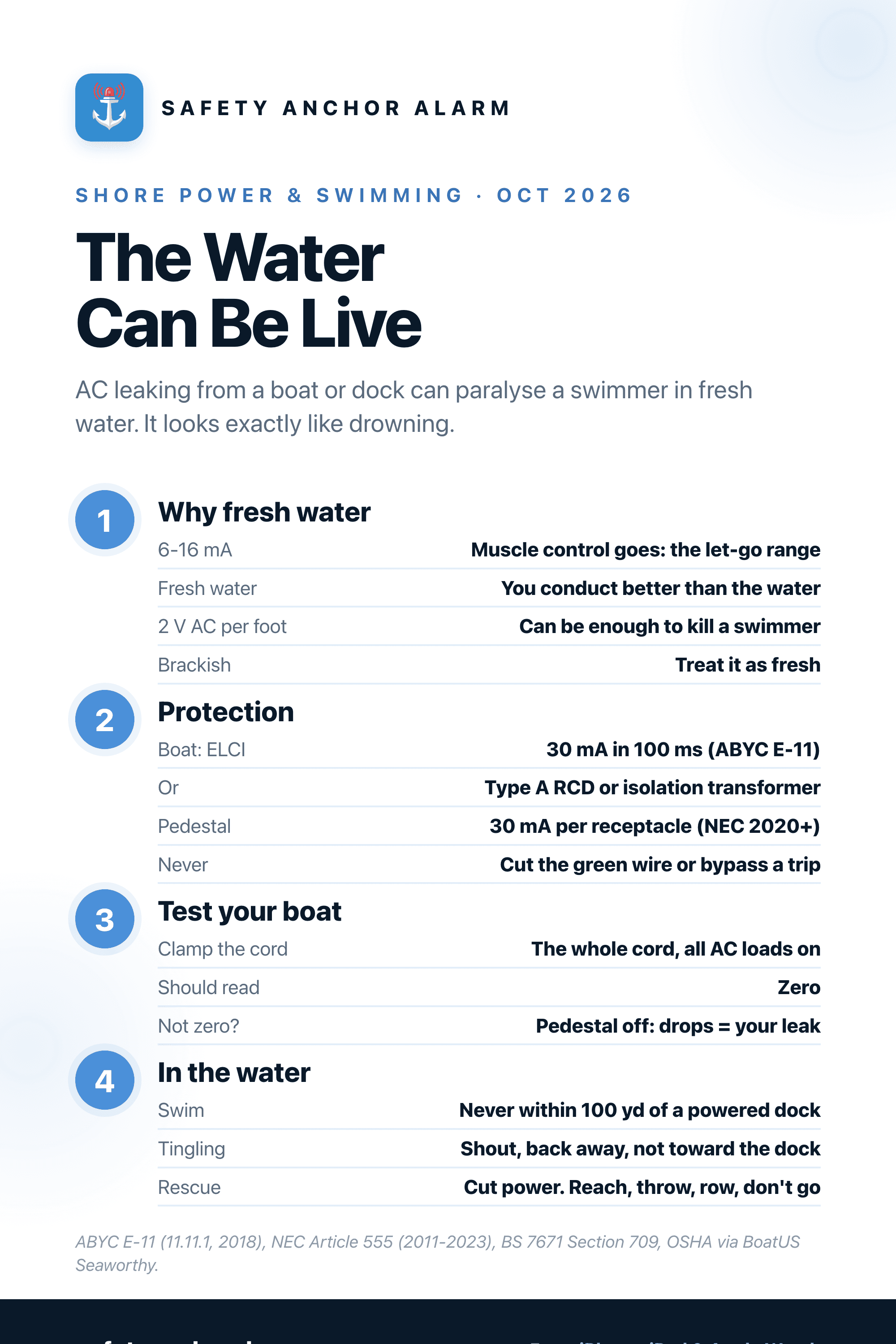
Electric shock drowning is AC current leaking from a boat or dock into fresh water, passing through a swimmer and paralysing their muscles so they drown. It takes milliamps: from about 6 to 16 mA a person loses muscle control. It needs three failures at once: an electrical fault, a broken safety ground and no ground-fault protection. The fix on the boat is an ELCI (ABYC E-11: trips at 30 mA within 100 ms) or an isolation transformer; on the dock, ground-fault protection at every pedestal (NEC 555). Test your boat with a clamp meter around the shore cord: it should read zero. Never swim within 100 yards of a powered freshwater dock. If you feel tingling, shout and move away from the dock. If someone is in trouble, cut the power and reach, throw or row, but do not go.
It Takes Milliamps, Not Amps
A shore power circuit is rated at 30 or 50 amps. The current that kills a swimmer is measured in thousandths of an amp. Nerves and muscles run on tiny electrical signals, and alternating current, cycling 60 times a second, scrambles them. This is the standard table of what AC current through the body does:
| Current | Probable effect |
|---|---|
| 1 mA | Perception: a slight tingle |
| 5 mA | A shock felt, not painful; most people can still let go |
| 6-16 mA | Painful; muscle control starts to go. The “let-go” range |
| 17-99 mA | Extreme pain, respiratory arrest, cannot let go. Death possible |
| 100-2,000 mA | Ventricular fibrillation. Death likely |
The “let-go” range is the one that matters in the water. A swimmer does not need to be electrocuted to die. Once the arms and legs stop answering, a person who was swimming a moment ago cannot stay at the surface. Captain David Rifkin, who ran in-water tests for a 2008 Coast Guard study by exposing himself to low currents in fresh water, told BoatUS that anything above 3 milliamps can be very painful.
Why Fresh Water
Current leaking into the water is trying to get back to its source, the transformer ashore. It takes whatever path offers the least resistance. Salt water conducts electricity 50 to 1,000 times better than fresh water, and a wet human body sits between the two, much closer to salt water. So:
- In the sea, the water is a better conductor than you are. Most of the current flows around a swimmer, and the danger is grabbing something that is itself live, such as a propeller, a swim ladder or a sterndrive.
- In fresh water, you are a better conductor than the water. The current spreads out from the leaking boat or dock as a voltage gradient, and a body that spans the gradient becomes the shortcut. BoatUS puts the danger point at about 2 volts AC per foot: enough to kill a swimmer who bridges it.
Rivers, estuaries and harbour mouths can be salty one week and fresh the next with the rain and the tide. If you boat there, treat the water as fresh. And it is AC that does this, not the boat's 12-volt DC system: Rifkin estimates DC would need 6 to 8 volts per foot, three to four times the AC gradient, and there are no recorded electric shock drowning deaths from 12-volt DC.
How Current Gets Into the Water: Three Failures at Once
In a healthy system, every amp that goes down the shore power cord to the boat comes back up it. For some of it to end up in the lake, three things have to go wrong together:
- An electrical fault. Somewhere, current escapes from the circuit: a chafed wire touching metal, a water heater element breaking down, a wet connection. In the case that started the modern ESD campaign, the 1999 death of 8-year-old Lucas Ritz in a freshwater marina in Oregon, a DC wire on a boat in the marina had melted against an AC wire and fed AC down the shaft into the water.
- A broken safety ground. The green grounding wire is supposed to carry that stray current back to shore and trip the breaker. If it is broken, corroded, missing in a cheap adapter or deliberately cut, the only way home is through the boat's underwater metal and the water. That is why the galvanic corrosion guide says never to cut the green wire to save your anodes.
- No ground-fault protection. Current returning through the water leaves a small imbalance between what went out on the hot wire and what came back on the neutral. A ground-fault device would see that difference and switch off. Without one, the boat stays live and so does the water around it.
The source does not have to be your boat. It can be a neighbour, the dock's own wiring, a pedestal, a boat lift, or a live cord left lying on the dock. That is why the rules below cover both ends of the cable.
The Protection: on the Boat and on the Dock
Ground-fault protection is the layer that turns a dangerous fault into a tripped breaker. It now exists at both ends of the shore power cord, at least on paper:
| Where | Rule | What it requires |
|---|---|---|
| On the boat (US) | ABYC E-11 | ELCI or Type A RCD: trips at 30 mA within 100 ms, within 10 ft of the shore inlet. Or an isolation transformer |
| At each shore power pedestal (US) | NEC 555.35, 2020 and later | Individual ground-fault protection for each shore power receptacle, 30 mA |
| On dock feeders (US) | NEC 555.35 | Ground-fault protection not exceeding 100 mA |
| Around the marina (US) | NEC 555.10, 2017 and later | Permanent signs: “Warning: potential shock hazard, electrical currents may be present in the water” |
| At each marina socket (UK) | BS 7671 Section 709 | Every socket for a boat on its own 30 mA RCD, disconnecting all live conductors including neutral |
The ELCI on the Boat
An Equipment Leakage Circuit Interrupter is a residual current device that watches the current going out to the boat and the current coming back. If more than 30 milliamps is missing, it disconnects the hot and neutral conductors within 100 milliseconds. ABYC E-11 requires it at the main shore power breaker or at the breakers within 10 feet of the shore inlet, whichever is closer to the shore connection, in a readily accessible place. ABYC set the requirement after in-water shock tests funded by a Coast Guard grant, and it has applied to new shore power installations since 31 July 2010. The 2018 edition accepts an ELCI, an IEC Type A RCD rated for 60 Hz, or an isolation transformer within 10 feet of the inlet instead.
Thirty milliamps is a compromise. ABYC notes that lower trip levels and faster times cause nuisance trips on boats, where a little leakage is normal. That is also why an ELCI is not a GFCI: the GFCI outlets in the galley and head trip at about 5 milliamps to protect a person holding a faulty appliance, and an ELCI does not replace them.
Most boats built before 2010 do not have one. You can fit a panel ELCI behind the shore inlet, which is a job for an electrician who works to ABYC standards, or use a shore power cord with an ELCI built in. An isolation transformer, which passes power to the boat with no copper connection to shore ground at all, is the most complete answer: stray current on the boat has nowhere to go but back to the boat's own transformer. It also solves the galvanic problem.
The Dock's Side
The US National Electrical Code (NFPA 70, Article 555) has tightened marina ground-fault rules over five editions. The 2011 code first required 100 mA protection on the marina's main supply; the code panel later accepted that 100 mA would not stop muscle paralysis in children in the water. The 2017 code added the warning signs. The 2020 code required individual 30 mA protection for each shore power receptacle, 100 mA on feeders to the slips, and a leakage measurement device at marinas with more than three shore power receptacles. The 2023 code added rules for when old dock equipment is replaced or modified. In the UK, BS 7671 Section 709 requires every marina socket for a boat to have its own 30 mA RCD.
The catch is the word “new.” Codes apply when docks are built or rewired, and adoption varies by state and town. Plenty of marinas and most private docks were wired long before any of this. Do not assume a sign on the dock means protection at the pedestal, or that a missing sign means a safe dock.
Test Your Boat With a Clamp Meter
You can find out whether your boat is leaking current with two tools: a plug-in circuit tester and an AC clamp meter that reads milliamps. BoatUS put the pair at about $150. A freshwater marina should own both and be using them on the boats on its docks.
- Check the pedestal. Plug the circuit tester into the receptacle you use. If the lights show a wiring fault, tell the marina and do not plug in.
- Clamp the whole cord. Put the clamp meter around the entire shore power cord, not around one wire. If everything that goes out comes back, the currents cancel and the meter reads zero.
- Run every AC load. Air conditioning, refrigeration, water heater, battery charger. Faults in cycling loads only show while they are running.
- Read it. Anything other than zero means current is going somewhere other than back up the cord: your boat is leaking, or current from the dock or another boat is coming back through your boat's metal.
- Switch off at the pedestal to tell which. If the reading stays the same with the pedestal off, the current is coming from elsewhere: tell the marina. If it drops, the leak is yours. Unplug and do not plug in again until an electrician trained to ABYC standards has found and fixed it.
BoatUS recommends testing once a year, and testing the ELCI or GFCI test buttons monthly, or as the maker says.
When the ELCI Trips
An ELCI that trips when you plug in, or when the water heater comes on, is doing its job: the boat is leaking more than 30 milliamps. The wrong answer is to bypass it, or to plug into a household outlet with a household extension cord to get around it. The right answer is to find the fault. A boat that trips the pedestal's ground-fault protection is telling you the same thing from the other end.
If You Feel Tingling in the Water
Instinct says swim to the dock and climb out. That is the wrong way: the current is strongest near its source, and a metal ladder may be live. BoatUS gives this sequence:
- Do not swim toward the dock.
- Shout. A drowning person cannot speak. Shouting tells everyone this is a shock, not a cramp, so they react the right way.
- Stay upright and back out the way you came, warning other swimmers, then head for shore well away from the dock.
- Get the power switched off to the dock until the fault is found.
If Someone Else Is in Trouble
Do not go in. Whatever is paralysing the swimmer will do the same to you the moment you enter the water. Instead:
- Cut the power to the dock and nearby boats if you can: the breaker on the dock, the pedestal, the shore power cords.
- Reach, throw, row, but don't go. A boat hook or pole, a lifebuoy or a line, a dinghy. The same principle as a person-in-the-water recovery, with the added reason that the water itself may be live.
- Call for help and start CPR if the person is not breathing. BoatUS notes that ESD victims are good candidates for successful resuscitation, which is a reason to learn CPR and keep it current.
Rules for Swimming Around Boats and Docks
- Never swim within 100 yards of a freshwater marina, boatyard or any dock with electrical power.
- On a private dock, switch off all shore power to the dock and the boat before anyone swims, and remember the neighbour's dock. Have the dock wiring inspected once a year by a licensed electrician to NEC 555 and NFPA 303.
- Tell children why. Most victims are children swimming or playing around a dock. Tell them what to do if they feel a tingle.
- Never dive on a boat that is plugged in to clean the hull or change an anode, even in salt water. Grabbing live metal is the salt water version of the same danger.
- Use marine shore power cords built to UL standards, never household extension cords or homemade adapters that drop the ground.
At Anchor
Electric shock drowning is a marina and dock problem. It needs a shore power connection and a return path to a transformer ashore. At anchor or on a mooring, far from the dock, with the shore cord coiled in a locker, that connection does not exist. A swim off the stern of a boat at anchor in open water is the kind of swim ESD campaigners would point you to instead of the lake behind the marina.
Two things still need care. A boat at anchor running its own generator or inverter still has 120 or 230 volts AC aboard, so its GFCIs and wiring matter just as much, and the swim ladder is no place to troubleshoot. And the swim has a different risk: the boat has to be there when you turn around. A dragging anchor in a gust takes the boat away faster than anyone swims. That is the job of the anchor alarm: set it before anyone goes in, and it raises the alarm the moment the boat starts to move, at lunch or as part of the night anchoring routine.
The Bottom Line
Electric shock drowning kills with milliamps of AC in fresh water, and it looks like an ordinary drowning. It needs an electrical fault, a broken ground and no ground-fault protection at the same time, so the defence is layered: fit an ELCI or isolation transformer to the boat (ABYC E-11: 30 mA, 100 ms), ask your marina about NEC 555 protection at the pedestals, test the boat with a clamp meter and the test buttons, and never cut the green wire. Do not swim within 100 yards of a powered freshwater dock. If you feel tingling, shout and move away from the dock. If someone else is in trouble, cut the power and reach, throw or row, but do not go.

Safety Anchor Alarm
Swim at anchor, away from powered docks. Then the only thing to watch is the anchor, and the anchor alarm watches it for you, raising the alarm the moment the boat starts to drag.
Download Free