Boat Electrolysis and Galvanic Corrosion: Zinc vs Aluminum vs Magnesium Anodes, Galvanic Isolators, and Why Boats Corrode in the Marina
The moment you plug a boat into shore power, its propeller, shaft, seacocks and anodes are wired to every other boat on the dock. The green grounding wire in the shore power cable is there for safety, and it does its job. But it also connects your underwater metal to the shore ground, the dock's steel and the next boat's bronze, all sitting in the same sea water. Together they make one big battery, and your anodes may now be protecting a stranger's boat. This guide explains what boat owners call electrolysis: the slow kind and the fast kind, which anode suits which water, when to change them, what a galvanic isolator blocks, why aluminum boats suffer most, and how to tell from a reading whether the boat is protected.
The short answer
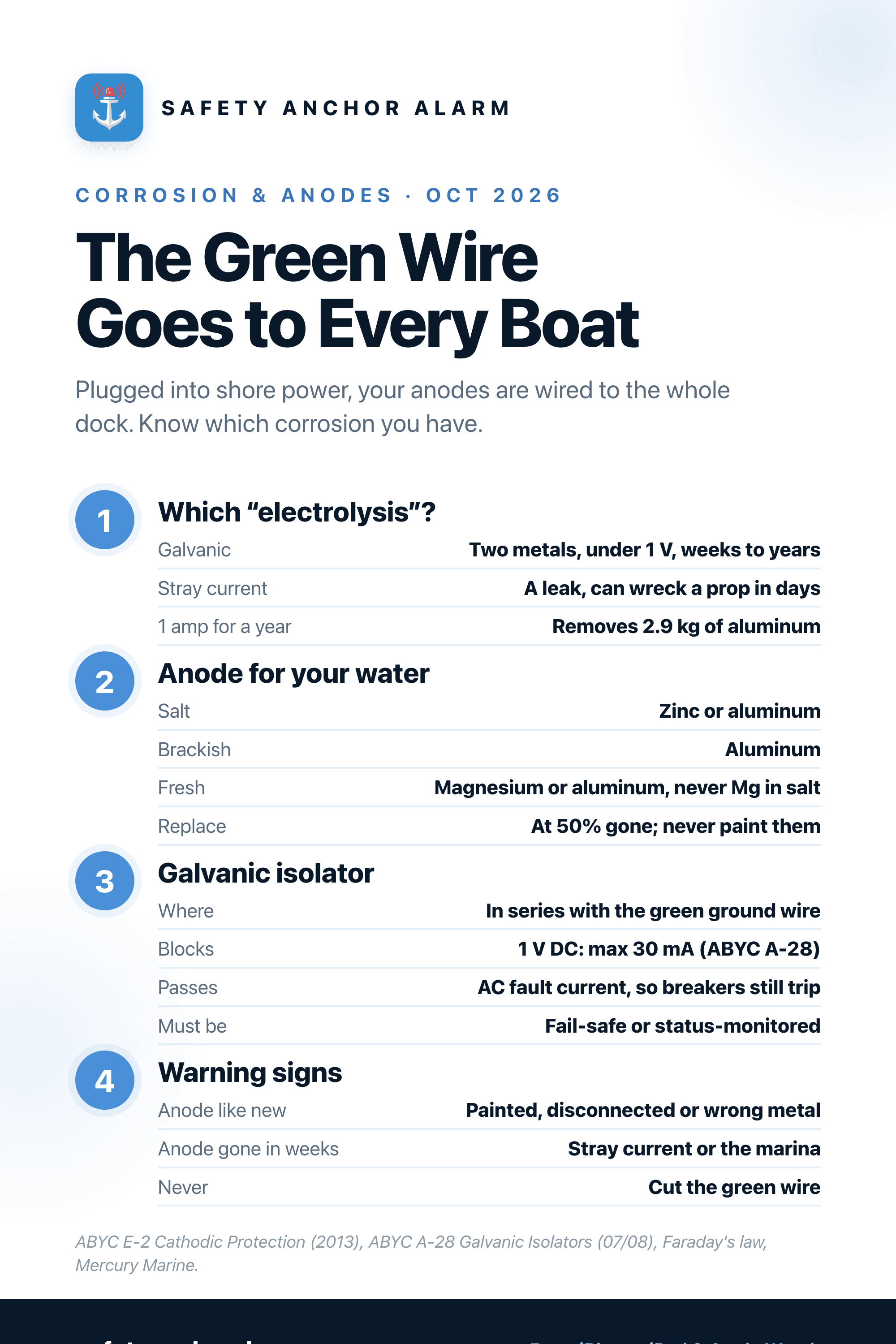
What people call “electrolysis” on a boat is either galvanic corrosion (two different metals connected in water, a slow battery of less than a volt) or stray-current corrosion (a leak from a power source, which can wreck a propeller in days). Fight the first with anodes matched to the water: zinc for salt, aluminum for salt, brackish or fresh, magnesium for fresh only. Replace them at 50% gone. If you plug into shore power, fit a galvanic isolator (or an isolation transformer) in the green grounding wire: it blocks galvanic current from the dock and other boats but keeps the safety ground. Never cut the green wire. Fight stray current by finding the leak.
Electrolysis Is Two Different Problems
Strictly speaking, electrolysis is something done on purpose in a laboratory or a factory. Below a boat's waterline, the word covers two different problems with two different fixes. Get the diagnosis wrong and you will keep fitting new anodes for a problem anodes cannot solve.
| Galvanic corrosion | Stray-current corrosion | |
|---|---|---|
| What drives it | Two different metals connected in water: a battery | An outside power source: a leak, a fault, a bad wire |
| Voltage | Usually well under 1 volt | Up to the full 12 V of the battery, or more |
| Speed | Weeks, months, years | Days |
| What it eats | The least noble metal in the circuit | Whatever metal the current leaves through, even a noble one |
| Fix | Anodes, insulation, galvanic isolation on shore power | Find and fix the leak; anodes cannot keep up |
How Galvanic Corrosion Works
Put two different metals in sea water, connect them by a wire, a bonding strap or simply by touching, and you have a battery. A small current flows. The more active metal, the anode, gives up metal into the water; the more noble one, the cathode, is protected. How much voltage the battery has depends on how far apart the two metals sit in the galvanic series: the list of metals in order of their potential in sea water, measured against a silver/silver chloride reference electrode. This is an excerpt of the table in ABYC E-2, the American Boat & Yacht Council's cathodic protection standard:
| Metal (most active first) | Potential, mV vs Ag/AgCl | On a boat |
|---|---|---|
| Magnesium | -1600 to -1630 | Anode, fresh water only |
| Aluminum alloy anode | down to -1100 | Anode, any water |
| Zinc | -980 to -1030 | Anode, salt water |
| Aluminum alloys | -760 to -1000 | Hulls, outdrives, outboard legs |
| Mild steel, cast iron | -600 to -710 | Steel hulls, keels |
| 316 stainless (active, still water) | -430 to -540 | Stainless starved of oxygen |
| Manganese bronze | -270 to -340 | Older propellers |
| Bronze thru-hull (ASTM B62) | -240 to -310 | Seacocks, thru-hulls |
| 316 stainless (passive) | 0 to -100 | Shafts, fittings with oxygen |
| Titanium | -50 to +60 | |
| Graphite (carbon) | +200 to +300 | Carbon fibre is at the noble end |
Read it like this. A bronze seacock at about -0.27 volts and a zinc anode at about -1.0 volts make a battery of roughly 0.7 volts, and the zinc dissolves. That is the plan: a sacrificial anode is a piece of metal chosen to be the least noble thing in the circuit, so that it corrodes instead of the propeller. An aluminum outdrive at about -0.9 volts next to a stainless shaft at about -0.05 volts is a battery of roughly 0.85 volts, and without an anode the aluminum goes. Two details on the table catch people out. Stainless steel has two entries, because stainless starved of oxygen, inside a stern tube or under barnacles, behaves much more actively than polished stainless in open water. And carbon sits at the far noble end, which is why a carbon fibre part bolted to aluminum needs careful insulation.
Galvanic corrosion is slow because the voltages are small and the currents are measured in milliamps. Its damage builds over a season. The fix is equally undramatic: anodes, insulation between metals that should not touch, and keeping the shore ground out of the circuit.
Stray Current: The Fast One
Stray-current corrosion happens when current from an actual power source finds its way into the water through your metal. On a boat the usual culprit is DC: a chafed or corroded wire in the bilge, often the bilge pump or float switch connection sitting in bilge water, leaking battery current to ground through the water and out through a seacock or the shaft. Professional BoatBuilder's advice is to make bilge pump and float switch connections no less than 18 inches above the base of the pump, protected by waterproof heat-shrink. The other source is outside the boat: a fault on the dock or on a neighbouring boat, with the current looking for a way home.
The speed comes from the size of the current. Faraday's law fixes how much metal a current removes, and the numbers are brutal. One amp leaving through a metal for a year removes about:
- Aluminum: 2.9 kg (6.5 lb), about 56 g (2 oz) a week
- Steel: 9.1 kg (20 lb)
- Copper: 10.4 kg (23 lb)
- Zinc: 10.7 kg (23.6 lb)
A sterndrive leg or an outboard gearcase does not have 56 grams to spare in a thin section. That is how a propeller blade or a lower unit is lost in days. And stray current does not care about the galvanic series: it attacks the metal the current leaves from, noble or not, and it chews through anodes far faster than they were sized for. If a new set of anodes is gone in weeks, stop replacing anodes and start looking for the leak.
Which Anode for Which Water
The anode has to be more active than everything it protects, and it has to keep working in the water the boat lives in. ABYC E-2 gives this table, with the warning that it is no substitute for testing:
| Anode | Water | Why | Watch for |
|---|---|---|---|
| Zinc | Salt only | The traditional choice; reliable in sea water | Coats itself with oxide and stops working in fresh water |
| Aluminum (alloy) | Salt, brackish or fresh | Lasts longer than zinc for the same weight; covers boats that change water | Must be a proper anode alloy, not a lump of aluminum |
| Magnesium | Fresh only | Highest driving voltage, which fresh water needs | About -1.6 V: in salt water it overprotects aluminum and lifts paint |
A boat that lives in a river mouth, or spends the summer on a lake and the winter on the coast, is the case aluminum anodes were made for. A freshwater boat with zinc anodes is a common mistake: the zinc grows a white oxide crust and quietly stops working, so the anodes look healthy while the drive corrodes. A saltwater boat with magnesium anodes is the more dangerous one, covered below under aluminum boats.
When to Replace Them
At about half gone, not on a date. Mercury Marine says to replace anodes when they are 50% deteriorated, and that is the general rule across makers. A half-size anode has half the surface left to deliver current. ABYC suggests inspecting generally once a year, more often for a boat that lives in the water, and the maintenance checklist puts anodes on the condition clock: they come off when they are worn, whenever that is. Three things to know when you do it:
- An anode is only as good as its contact. It has to be bolted to clean bare metal, or wired to the bonding system with a single connection. ABYC E-2 requires each anode to have a single point of connection to the bonding system.
- Never paint an anode. Keep antifouling off it. A painted anode protects nothing.
- Read the wear. Even wear over a season is a working anode. An anode that looks new after a season is not connected, painted or the wrong metal. One that is gone in a few weeks means something is draining it: stray current, or the marina.
The Shore Power Wire to Every Boat on the Dock
Your boat's AC system has a green (or green and yellow) grounding conductor. On a boat wired to ABYC E-11, it connects to the boat's DC negative and bonding system, and through the shore power cable to the shore ground. It is essential: if an appliance develops a fault, that wire carries the current back to shore so the breaker trips, instead of leaving the metal of the boat, or the water around it, live.
But it also completes a galvanic circuit. Your propeller, shaft and anodes are now connected by copper to the shore ground, and through it to the steel of the dock and to every other boat plugged in, all of them sitting in the same sea water. ABYC puts it plainly: the connection through the shore power grounding conductor may result in galvanic current between the boat and the dock structure or another boat, which can lead to excessive anode loss, or corrosion beyond the capacity of the boat's cathodic protection system. In practice that means your zincs can end up protecting the dock and the bronze of the boat next door. If your neighbour's anodes are bigger and fresher than yours, it can run the other way, but if theirs are gone, yours are doing the work for both boats.
This is why a boat that sits in a marina on shore power can eat anodes much faster than the same boat on a mooring. It is not the marina's water. It is the wire.
What a Galvanic Isolator Does
A galvanic isolator is a small box installed in series with the green grounding wire, between the shore power inlet and the boat's grounding system. Inside, it is usually two pairs of heavy diodes facing opposite ways, often with a capacitor. Diodes do not conduct until the voltage across them passes a threshold, so the low voltages of galvanic current, well under a volt, are blocked, while a real fault, which comes with far more voltage, goes straight through and trips the breaker as it should. Typical diode isolators block roughly 1.2 to 1.4 volts.
ABYC A-28 is the standard for them. A compliant isolator must:
- Block galvanic current: with 1.0 volt DC across it, no more than 0.030 amps (30 milliamps) may flow, in either polarity. With 3 amps of AC superimposed on 0.5 volts DC, no more than 0.005 amps DC may get through, because a little AC leakage on the green wire is normal and must not switch the isolator on.
- Be rated for the boat: no less than the rating of the main shore power breaker.
- Be fail-safe, or monitored. An isolator that failed open would leave the boat without a safety ground. So it must either be certified fail-safe, meaning that if it fails, it stays a permanent ground path, or come with a status monitor that checks it on connection to shore power and at least every 24 hours, and warns you if it fails. Fail-safe units carry a label warning that after a lightning strike they may no longer isolate, so test them after one.
- Have no bypass. Every path to shore ground has to go through it. ABYC calls out the cable TV and phone connections: a shielded cable from the dock can connect your boat to shore ground around the isolator.
- Live somewhere dry, ventilated and accessible, within its temperature rating.
The alternative is an isolation transformer, installed under ABYC E-11. It passes shore power to the boat through a transformer, with no copper connection at all between the boat's ground and the shore's. It is heavier and more expensive, and it solves more than corrosion, such as messy dock wiring. The isolator is the simpler, cheaper and more common answer. ABYC E-2 strongly recommends one or the other for any boat with a permanently installed shore power system.
Never Cut the Green Wire
The tempting shortcut is to disconnect the shore ground and stop the galvanic current for free. Do not. That wire is what turns an appliance fault into a tripped breaker rather than a live boat and live water around it, one of the ways swimmers near docks are killed by electric shock drowning. A galvanic isolator exists precisely so that you never have to choose between corrosion and safety.
Aluminum Boats: Why “Electrolysis” Hits Them Hardest
Aluminum alloys sit at -0.76 to -1.0 volts, close to the anodes themselves. Almost everything else on a boat is more noble: bronze, stainless, copper, lead, carbon. On a fibreglass boat, that only matters for the outdrive or the outboard leg. On an aluminum boat, the hull is the thing that corrodes. The usual causes:
- Copper antifouling. Copper on aluminum is a galvanic cell; wherever the primer is scratched, the hull pits. Use a copper-free paint on aluminum, as covered in the antifouling guide. ABYC E-2 bans galvanically incompatible antifouling on aluminum drives without a barrier coat.
- Noble fittings touching the hull. ABYC wants bronze and other more noble fittings on an aluminum hull electrically insulated from it where practical, and fasteners in 300-series stainless steel. A single bronze thru-hull bolted straight to the plate is a battery.
- Stray DC current. ABYC says the hull must not be used as a current-carrying conductor. An accessory grounded to the hull, or a leak in the bilge, uses the hull as the wire and the water as the return.
- Too much protection. Aluminum also corrodes when it is overprotected. ABYC warns that potentials more negative than -1.2 volts cause alkaline corrosion of aluminum and blistering of the paint (cathodic disbondment). That is what magnesium anodes, at -1.6 volts, do to an aluminum boat in salt or brackish water. ABYC also requires a dielectric shield between a magnesium hull anode and a steel or aluminum hull.
- Shore power without isolation. Everything above, connected to the whole marina.
Checking It: The Reference Electrode
You do not have to guess. A silver/silver chloride reference electrode, hung in the water near the boat and read with a digital multimeter against the boat's bonding system, shows the potential of the underwater metals. ABYC E-2 asks for a shift of at least 200 mV more negative than the unprotected metal, and gives these target ranges by hull:
| Hull | Protected range, mV vs Ag/AgCl |
|---|---|
| Fiberglass | -550 to -1100 mV |
| Fiberglass with aluminum drives | -950 to -1100 mV |
| Aluminum | -950 to -1100 mV |
| Steel | -850 to -1100 mV |
| Wood | -550 to -600 mV |
A reading more negative than -1100 mV is excessive protection, which reduces antifouling performance and, on aluminum, starts to do harm. A wooden boat must stay above -600 mV, or the wood around the fittings is damaged. Then take the reading that shows what the shore wire is doing: read with shore power unplugged, then plugged in. If the number moves noticeably toward zero when you plug in, the shore ground is pulling your protection away, and an isolator, or a failed one, is the first thing to look at.
At Anchor
At anchor or on a mooring, the shore power cable is coiled in a locker. The boat's metals are connected only to each other, and the only galvanic battery is the one you designed: the prop, the shaft, the seacocks and the anodes chosen to protect them. This is the cheapest galvanic isolator there is. Cruisers who spend most nights at anchor can find their anodes last longer than they did in the marina.
Two things still need watching. The stray-current risk travels with you: a leaking bilge connection does the same damage at anchor as on the dock. And what you depend on most at anchor is no longer the shore at all. It is the anchor holding, all night. That is the job of the anchor alarm: it watches the boat's position while you sleep and wakes you in the first minute of a drag, as part of the night anchoring routine.
The Bottom Line
“Electrolysis” is either slow galvanic corrosion, which anodes and insulation handle, or fast stray-current corrosion, which only finding the leak fixes. Choose anodes by water (zinc for salt, aluminum for anything, magnesium for fresh only), keep them unpainted and well connected, and replace them at half gone. If you plug in, remember that the green wire connects you to the whole dock: fit an ABYC A-28 galvanic isolator, fail-safe or monitored, or an isolation transformer, and never cut the ground. Aluminum boats need all of this most, and need to avoid too much protection as much as too little. When in doubt, a reference electrode reading tells you which it is.

Safety Anchor Alarm
A galvanic isolator stops the dock from draining your anodes. At anchor there is no dock, and the risk is the anchor itself. The anchor alarm watches it all night and wakes you if the boat starts to move.
Download Free