What Is a Float Plan?
A float plan is a one-page record of your trip — who is aboard, a description of the boat, where you are going, and the time by which someone should raise the alarm if they haven't heard you are back — left with a trusted person ashore. It is the cheapest, fastest safety step in boating, and it hinges on one fact most people get wrong: you don't file it with the Coast Guard. You hand it to a human who will watch the clock.
The One Thing People Get Wrong
Ask around a marina and half the boaters will tell you a float plan is something you “file with the Coast Guard.” You don't. The US Coast Guard does not accept, store or monitor float plans for recreational boaters — it would have no way to watch millions of small-boat trips. What it does is publish a form for you to fill in. The part that matters — holding the plan and noticing when you are overdue — is done by a person ashore you choose and brief yourself.
That is the whole idea: a float plan turns “nobody knew where they were” into “someone raised the alarm at 6pm with a boat description and a route.” Search and rescue is a race against water temperature and daylight, and it starts far sooner when a named person is watching a deadline than when a stranger happens to spot an empty boat.
What Goes on a Float Plan
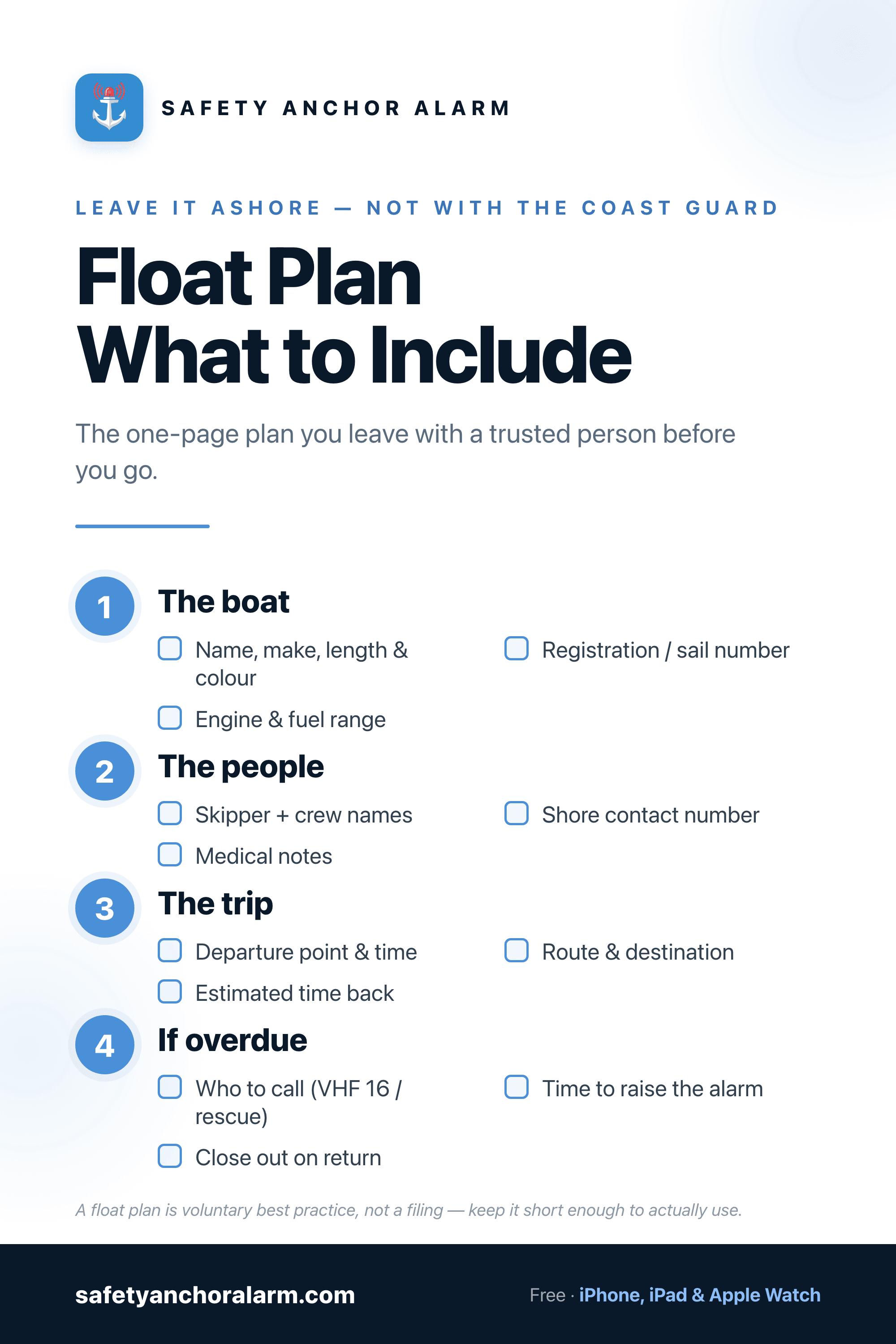
Keep it to one page — a float plan you can fill in during the pre-departure routine is one you will actually use. Four blocks cover it:
| Block | What to write |
|---|---|
| The boat | Name, make, length and colour; registration or sail number; engine and fuel range |
| The people | Skipper and crew names; a shore contact number; any medical notes rescuers should know |
| The trip | Departure point and time; intended route and destination; estimated time back |
| If overdue | Who to call (Coast Guard / VHF 16 / local rescue); the exact time to raise the alarm; a note to close the plan out on return |
Who to Leave It With
The plan is only as good as the person holding it. Leave it with someone who will be reachable while you are out, who understands the deadline, and who is willing to make the call without second-guessing. A partner at home, a level-headed friend, or a marina or harbour office all work. What doesn't work is leaving it with someone who will be asleep, offline, or the type to assume “they're probably just running late.” Spell out the one job: if you haven't heard from me by this time, call this number.
Close It Out — Every Time
The failure mode of float plans isn't forgetting to leave one; it's forgetting to close it. If you get back an hour early, turn your phone off and go to the pub, your shore contact is left watching a deadline you have already beaten — and a false alarm that launches a lifeboat is both dangerous for the crew and costly for everyone. Make the last step of every trip a single message: “Back safe, stand down.” Agree in advance what happens if plans change mid-trip, too — a quick text to push the deadline back beats a scramble at dusk.
Paper, Text or App
A float plan can be a Coast Guard form on the chart table, a screenshot, or three lines in a text message — the format matters far less than the habit. A written one wins for a longer or unfamiliar trip because it captures the boat details a panicked phone call forgets; a text wins for a quick local hop because you will actually send it. The next step up is a logbook or sailing app that stores your boat's details once and lets you share a trip and a return time in a couple of taps, so the friction that stops people bothering disappears. Out of phone range, a satellite messenger keeps the check-ins coming, so your shore contact is not left guessing.
Float Plan vs Pre-Departure Check
These get muddled, so it is worth separating them cleanly. Your pre-departure checklist confirms the boat and crew are ready to leave — fuel, engine, life jackets, weather. The float plan is the slice of that routine you hand to someone ashore, so that if the trip goes wrong, help knows where to look and when to start looking. One keeps you safe on the water; the other brings help to you if the water wins. Do both, in the same five minutes before you cast off.
The Bottom Line
A float plan is a one-page note — boat, crew, route, and a raise-the-alarm time — left with a person ashore, not the Coast Guard. Fill it in during your pre-departure routine, give it to someone who will watch the clock, and close it out the moment you are back. It is the safety step that does nothing on a normal day and everything on the worst one. And for the nights the plan has you staying aboard at anchor, set an anchor alarm to your own swing circle so a drag at 03:00 wakes you long before anyone ashore would think to worry.

Safety Anchor Alarm
GPS-powered anchor monitoring for iPhone, iPad and Apple Watch. A float plan covers your passage; the anchor alarm covers the night you spend at anchor — set it to your own swing circle and it wakes you the moment the boat starts to drag.
Download FreeFrequently Asked Questions
What is a float plan?
Do you file a float plan with the Coast Guard?
What should a float plan include?
Who should you leave a float plan with?
What is the difference between a float plan and a pre-departure checklist?
Related Articles
Boat Pre-Departure Checklist
The five-minute check the float plan is part of — boat, crew, and the plan, before you cast off.
SafetyBoat Safety Equipment Checklist
What the Coast Guard requires by boat length, and the gear the law forgets.
SafetyNight Anchoring Safety Tips
The routine that turns a night at anchor from a vigil into actual sleep.
ToolAnchor Scope Calculator
How much rode to carry and what alarm radius to set for your depth and boat size.