EPIRB and PLB Registration: How to Register a Beacon in the US, UK, Australia and Canada, Renewal Rules, and What Rescuers See When It Goes Off
In 2025, the US mission control centre for search and rescue satellites handled 406 real distress alerts from beacons, and 23,748 false ones. More than 98% of the time, nobody needed help. So when a beacon goes off, the first thing a rescue centre does is not launch a helicopter. It looks up the registration and picks up the phone. Registration is not paperwork you do after buying a beacon; it is the first minute of your rescue, and the person who answers that call is part of it. This guide covers where to register by country, what the law says, how often to renew, the fields that matter, and what to change when you buy, sell, move or retire a beacon.
The short answer
Register every 406 MHz EPIRB and PLB with the registry of the country it is coded for; it is free everywhere. In the US, register with NOAA before installation (FCC rules make it mandatory for EPIRBs and PLBs) and renew every two years. In the UK, use the UK Beacon Registry; since 15 April 2026 PLBs on UK vessels must be registered as well as EPIRBs. In Australia, register with AMSA; registrations no longer expire since 4 November 2024. In Canada, the Canadian Beacon Registry asks you to re-validate every 12 months. Everywhere, update the registration when the boat, the owner or the contacts change, and call the rescue centre if you set the beacon off by accident.
Where to Register, by Country
A beacon can only be registered in the country its ID is coded for. The country code programmed into the ID is the same three-digit code that starts an MMSI, and each registry accepts only its own. The dealer or the registration card will tell you which country yours is coded for.
| Country | Registry | Codes accepted | Renewal | Law |
|---|---|---|---|---|
| United States | NOAA SARSAT (beaconregistration.noaa.gov) | 303, 338, 358, 366–369, 379, 536, 559 | Every 2 years; reminder from 2 months before; new decal each time | Mandatory for EPIRBs and PLBs (FCC, 47 CFR 80.1061 and 95.2993) |
| United Kingdom | UK 406 MHz Beacon Registry (MCA) | 232–235 | Update whenever anything changes | Mandatory on UK vessels and watercraft; PLBs too since 15 April 2026 |
| Australia | AMSA (beacons.amsa.gov.au) | 503 | No expiry since 4 November 2024; update when details change | Free; AMSA says mandatory by law in some cases |
| Canada | Canadian Beacon Registry (Department of National Defence) | 316 | Re-validate every 12 months, even with no changes | Required for Canadian-coded beacons |
| Anywhere else | National registry, or the Cospas-Sarsat IBRD (406registration.com) | That country's codes | Per country | Every country authorising 406 MHz beacons must keep a registry or allow the IBRD |
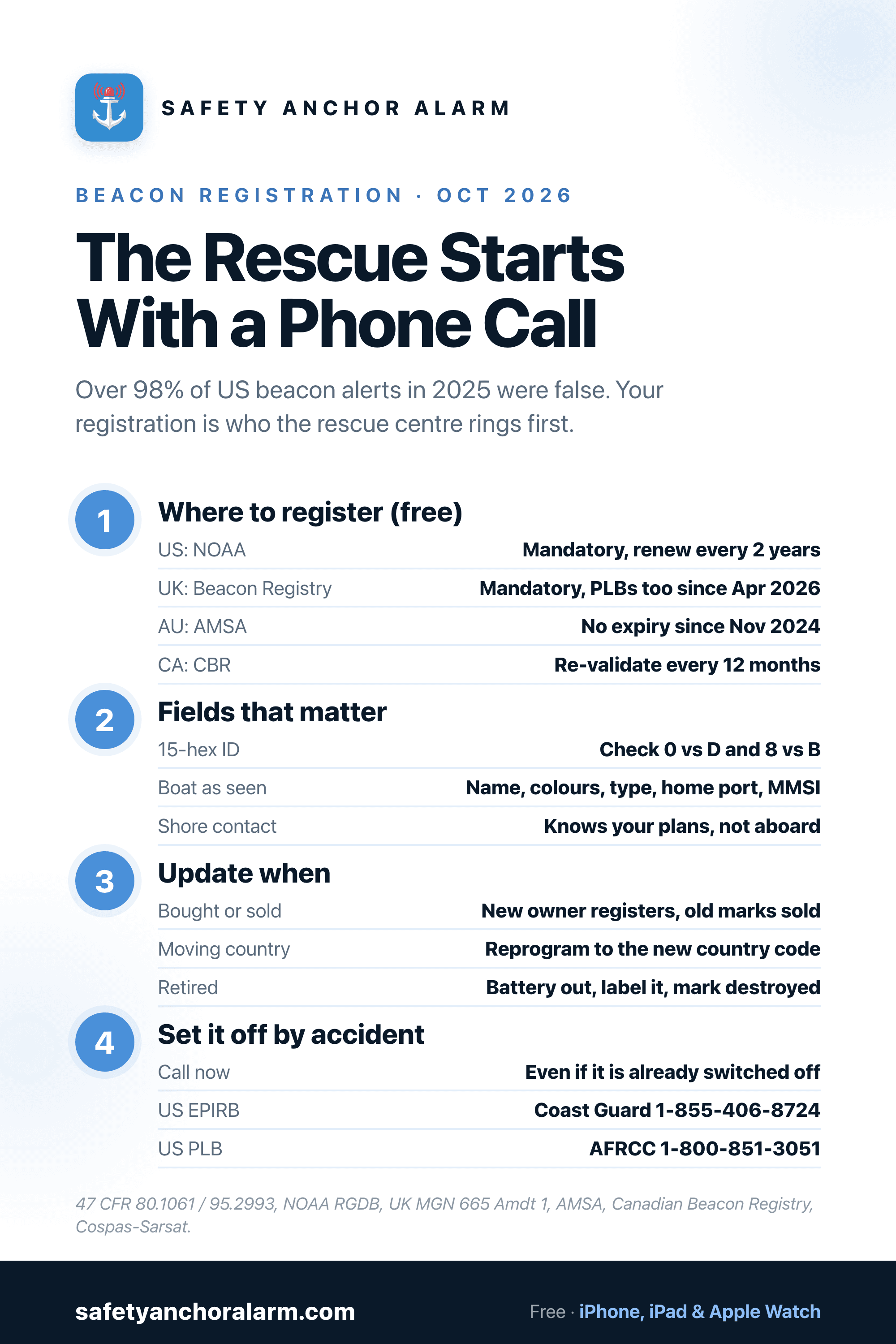
The Rescue Starts With a Phone Call
A 406 MHz EPIRB or PLB does not send your name. It sends an identity code, and, if it has GPS, a position. The Cospas-Sarsat satellites pass that to a mission control centre, which matches the code against the registration database and forwards the alert, with whatever the registration says, to the rescue coordination centre responsible for that patch of sea.
NOAA states the purpose of the database plainly: the data is used to help a rescue and to suppress the cost of false alarms, which would otherwise launch a rescue mission, use up limited resources and possibly cost lives, by letting rescuers contact the people involved or their alternate contact by phone or radio. With 23,748 false alerts against 406 real ones in 2025, that phone call is the triage. What the rescue centre can do in the first few minutes depends on what it finds:
| Registration | What the rescue centre sees | Its first move |
|---|---|---|
| Registered and current | Owner, boat name and description, home port, MMSI, two shore contacts | Phone the owner, then the contacts: 'are they out on the boat?' |
| Registered, but two years stale | The same, with old phone numbers and maybe the wrong boat | Phone numbers that ring out; then launch and look |
| Registered to the previous owner | Someone who sold the boat in 2023 | A confused phone call; a search for the wrong boat |
| Not registered | A country code, a hex ID and, with GPS, a position | Launch and look: nobody to ask |
Notice what an unregistered beacon still does: it still alerts, and with GPS it still gives a position. What it loses is the ability to be checked by a phone call. A false alert from an unregistered beacon costs a search to rule out. A real one waits while a crew is assembled, when the person ashore could have said in thirty seconds that you left for the Bahamas yesterday with four aboard in a white sloop with a blue sprayhood.
NOAA's 2026 forms show the same thinking. The PLB form now asks boat owners for their home port marina, because a beacon going off where the boat is normally kept is probably a false alert, and if it is not, rescuers can ring the marina and ask where the owner is.
What the Law Says
- United States. FCC rules make it “mandatory that each 406.0-406.1 MHz EPIRB be registered with NOAA before installation and that information be kept up-to-date” (47 CFR 80.1061), and say the same for PLBs (47 CFR 95.2993). Every beacon must carry a label telling the owner to register, and the registration card warns that failing to register could bring a monetary forfeiture. Owners must tell NOAA when the boat or the beacon changes hands, when the beacon moves to another boat, or when anything else in the registration changes. NOAA's own rule on top: renew every two years.
- United Kingdom. The Merchant Shipping (EPIRB and PLB Registration and Radiocommunications) (Amendment) Regulations 2026 require 406 MHz EPIRBs and PLBs carried on UK-flagged ships, hovercraft and watercraft, pleasure craft included, to be registered with the UK 406 MHz Beacon Registry. The PLB part came into force on 15 April 2026. Kayaks, paddleboards and other craft not mechanically propelled are outside it. The penalty in England and Wales is an unlimited fine and up to two years in prison, and the registry accepts only beacons coded 232, 233, 234 or 235.
- Australia. Registration with AMSA is free and, in AMSA's words, in some cases mandatory by law. Since 4 November 2024 registrations no longer expire; you update them when anything changes, and proof of registration is the SMS or email from your online account (AMSA stopped issuing stickers in 2015).
- Canada. Canadian-coded 406 MHz beacons that are required to be registered go on the Canadian Beacon Registry, run by the Department of National Defence, and owners are asked to re-validate the record every 12 months even when nothing has changed, and to tell the registry about any purchase, sale, export or loan.
- Everywhere else. Every country that authorises 406 MHz beacons must either run a registry or let its beacons be registered in the Cospas-Sarsat International Beacon Registration Database (IBRD), which is free.
How to Register, Step by Step
- Find the beacon ID. It is on the label on the beacon and on the registration card in the box: 15 hexadecimal characters for today's beacons, printed in groups of five (5-5-5). Second-generation beacons have 23 characters, printed 6-6-6-5; in the US, NOAA says second-generation EPIRBs and PLBs are not yet authorised for sale, so a US boat owner will almost always be entering 15.
- Copy it twice and compare. The ID uses 0 to 9 and A to F, and NOAA's own advice to manufacturers is about the characters people confuse: 0 and D, 8 and B. A registration with one wrong character is a registration for somebody else's beacon, or for nobody's.
- Register online with the registry for the beacon's country code (table above). Paper forms and fax still exist; online is faster and lets you update it later yourself.
- Describe the boat as a searcher would see it: name, registration number, length, hull and sail or canvas colour, type, home port, the MMSI and call sign, and any satellite phone number. For a PLB, NOAA now asks for the boat too.
- Choose the emergency contacts carefully (next section).
- Put the proof aboard. In the US, NOAA posts a decal with the expiry date; stick it on the beacon as instructed, and a new one comes with each renewal. Elsewhere, keep the confirmation email or SMS.
One US detail that catches people out: a first-generation US-coded beacon may not be programmed with the MMSI, so the MMSI goes in the registration instead. That field is what links the beacon to the boat's DSC radio and AIS identity, so fill it in.
The Emergency Contact Is the Most Important Field
The contacts are the people the rescue centre phones. NOAA asks for someone you are in regular contact with, who will usually know your travel plans, and who will not be with you. That rules out the obvious choice for a cruising couple: each other.
The right contact is the same person who holds your float plan. When the phone rings at 3 a.m., they should be able to say where you were going, when you left, how many are aboard, and whether you have a life raft. Tell them they are on the registration, tell them what the call might sound like, and update them before a passage. A registration that is current but names a contact who has no idea where you are is only slightly better than none.
When to Update It
Registration is not a one-off. These are the moments that change it:
| When | What to do |
|---|---|
| New beacon | Register before you fit it or take it aboard; stick the decal on. |
| Bought second-hand | Register it as yours; the registry will flag that it was registered before. Ask the seller to mark it sold. |
| Sold the boat or the beacon | Log in and set the status to Sold/Transferred (NOAA) or tell the registry. Do not leave your name on someone else's boat. |
| Moved it to another boat | Update the vessel details: name, description, MMSI, home port. |
| Moving country | The beacon stays coded to its country. To register where you now live, have it reprogrammed by an authorised dealer. |
| Cruising abroad | Nothing to change: Cospas-Sarsat is worldwide. Do update the shore contact with your plans. |
| Battery replaced or serviced | Check the ID label still matches the registration; a reprogrammed beacon has a new ID to register. |
| Retired the beacon | Battery out, label it deactivated, set the registration to destroyed or out of service. |
| Set it off by accident | Call the rescue centre now, even if it is already switched off. |
The second-hand case deserves a warning. A beacon that comes with a used boat may still be registered to the previous owner, and may have been bought, coded and registered in another country altogether. Look at the label before the survey is signed off: the country code, the battery expiry date and the hex ID. If the code is for a country you do not live in, budget for a reprogramming at an authorised dealer along with the battery.
Taking a beacon cruising is the opposite case: nothing to do. A US-registered EPIRB works in the Caribbean, the Mediterranean and the Pacific, because the satellite system is worldwide and the alert is routed to the rescue centre responsible for where you are, with your registration attached. The thing to update is the contact's knowledge of your plans.
If You Set It Off by Accident
Call the rescue centre immediately, even if you have already switched the beacon off, because the alert may already be in the system. In the US, NOAA's guidance is the Coast Guard on 1-855-406-8724 for an EPIRB and the Air Force Rescue Coordination Center on 1-800-851-3051 for a PLB; elsewhere, your national coastguard. Accidental activations are common and nobody is in trouble for one. The trouble is the one nobody explains, which turns into a search. A current registration is your backstop if you did not notice: the rescue centre rings you before it launches.
Avoid making one in the first place by using the self-test as the manual describes, never the live activation, and by not lifting an automatic EPIRB out of its bracket in the rain or the wash-down: many switch themselves on once they are out of the bracket and wet.
Retiring a Beacon
NOAA describes beacons thrown away with their batteries in, and activating from landfills and dumpsters, as an increasing problem for rescuers. The Cospas-Sarsat guidance has three steps:
- Have the battery removed, and recycle it properly.
- Label the beacon on the outside as deactivated.
- Update the registration to show you have disposed of it (destroyed or out of service).
Many dealers and service centres take old beacons back. When you replace a beacon, the new one has a new ID: register it, and close the old one, so the database does not hold two beacons for one boat.
At Anchor
A beacon is for the worst night of a boat's life, and it is worth getting the registration right for that night alone. But be clear about what it is not. It does not watch anything. It knows nothing about whether your anchor is dragging, and it calls the coastguard, not you. Most anchoring emergencies never need it, because the fix is to wake up, start the engine and re-anchor, and the danger is only that nobody wakes up.
That is the job of the anchor alarm: it watches the boat's position all night and wakes the people on board, the only ones who can fix a drag in its first minute. Keep the beacon registered and in date for the night when that is no longer enough, and set the alarm every night, as part of the night anchoring routine, so that it rarely gets that far.
The Bottom Line
Register every 406 MHz beacon, free, with the registry of the country it is coded for: NOAA in the US (mandatory, renewed every two years), the UK Beacon Registry (mandatory for EPIRBs and, since April 2026, PLBs), AMSA in Australia (no expiry since November 2024) or the Canadian Beacon Registry (re-validated yearly). Copy the hex ID carefully, describe the boat as a searcher would see it, and pick an emergency contact ashore who knows your plans. Update it when you buy, sell, move or retire a beacon. Almost every alert is false, so the rescue starts with a phone call; make sure it reaches someone who can answer.

Safety Anchor Alarm
Registration makes sure the coastguard's first phone call reaches someone who knows where you are. The anchor alarm makes sure the first alarm of a dragging night reaches you. Keep the beacon registered; run the alarm every night.
Download Free