Inboard vs Outboard vs Sterndrive (Inboard/Outboard): Differences, Pros and Cons, and Which Is Safer
The names are about where the engine sits, but the differences that matter are about two other things: where the propeller is and where the exhaust comes out. Those decide whether you can take the boat onto a sandbar, whether anyone can wakesurf behind it, what you check before you turn the key, and what happens to a swimmer near the transom. This guide compares outboards, sterndrives (also called inboard/outboards or I/Os) and inboards on all of it, with pod drives as a footnote, the Coast Guard's 2024 incident figures by engine type, and what each means when the boat is at anchor and people are in the water.
The short answer
An outboard is a self-contained engine and propeller on the transom: it tilts out of the water, frees the hull and is the easiest to service or replace, which is why most new US boats have one. An inboard sits inside the hull and turns a shaft to a propeller under the boat, steered by a rudder: it keeps the propeller away from the stern, which is why wake boats, trawlers and sailboats use it. A sterndrive (inboard/outboard) puts the engine inside and a tilting drive leg on the transom: an open swim platform and inboard power, with the most maintenance. Gasoline inboards and sterndrives must run a blower for 4 minutes before starting. Never wakesurf behind an outboard or sterndrive. At anchor, switch any engine off before people swim.
Outboard, Sterndrive and Inboard Side by Side
The Coast Guard's definitions are the cleanest place to start. An outboard is “an engine with propeller or water jet integrally attached, which is usually mounted at the stern”. An inboard is mounted inside the vessel and powers a drive shaft that runs through the bottom of the hull to a propeller (or turns a water jet). A sterndrive is mounted in front of the transom and drives, through shafts and gears, a unit on the transom “similar to the lower unit of an outboard”, also known as an inboard-outdrive or inboard-outboard.
| Outboard | Sterndrive (I/O) | Inboard | |
|---|---|---|---|
| Engine | Outside, on the transom | Inside, in front of the transom | Inside, usually amidships or under the deck |
| Propeller | On the engine's leg, behind the transom | On a drive leg through the transom, behind it | On a shaft under the hull, in front of the transom |
| Steering | The whole engine turns | The drive leg turns | A rudder behind the propeller |
| Shallow water | Tilts fully clear of the water | Trims up; the leg stays in the water | Fixed: shaft, propeller and rudder below the hull |
| Exhaust | Mostly underwater, through the propeller hub | Through the propeller underway; also at the transom | Through the transom, near the swim platform |
| Space | Frees the whole hull; engine fills the transom | Engine box aft; open swim platform | Engine box or hatch inside; clear transom |
| Gasoline blower | Not needed | Required: 4 minutes before starting | Required: 4 minutes before starting |
| Wakesurfing | Never | Never | Yes: what wake boats are built for |
| Typical boats | Center consoles, bay boats, pontoons, RIBs, tenders | Bowriders, deck boats, small cruisers | Ski and wake boats, sportfishers, trawlers, sailboats |
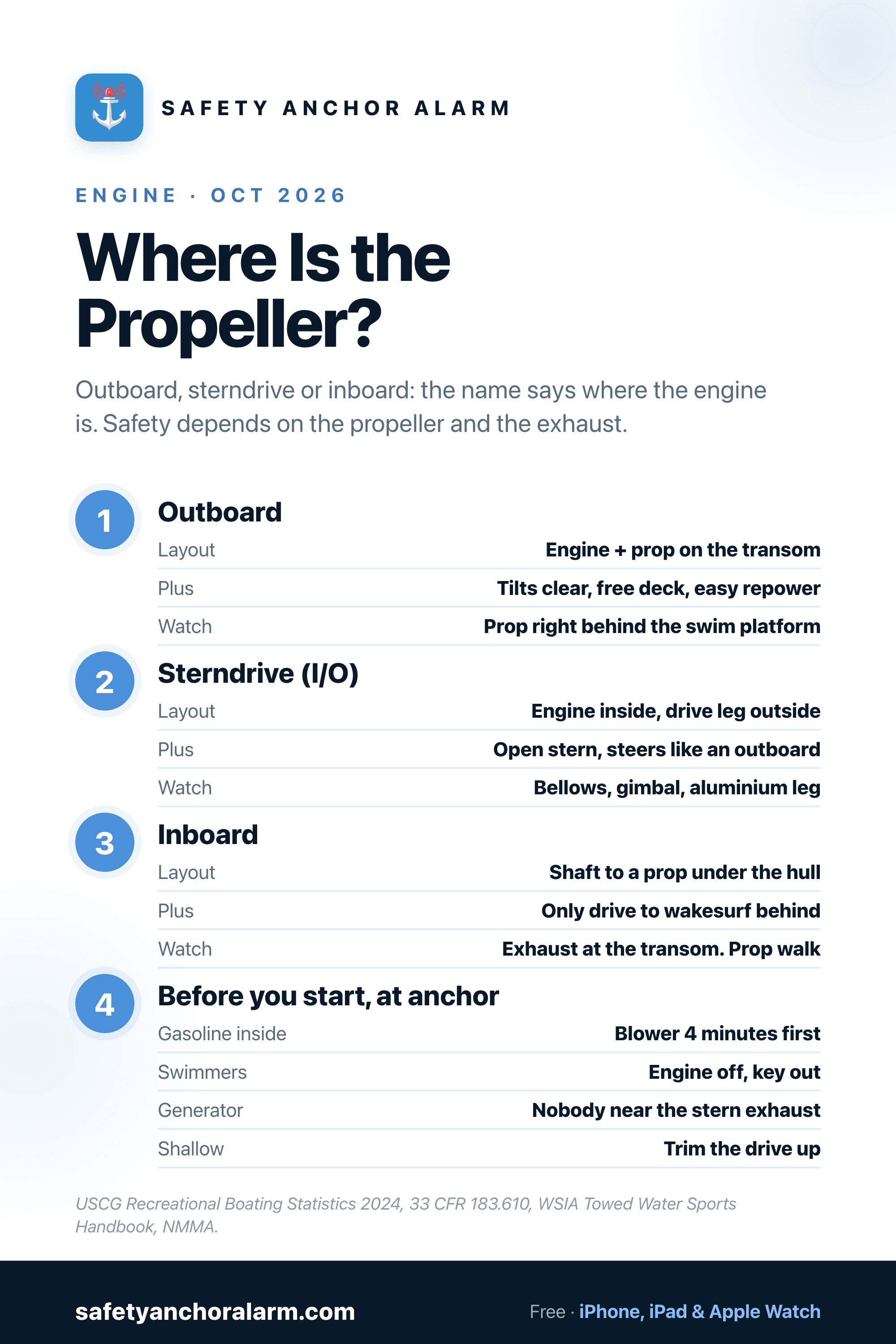
Outboards: Why Most New Boats Have One
In the twelve months to April 2025, the National Marine Manufacturers Association counted about 134,000 new outboard boats sold at retail in the US, against about 9,700 inboard boats and 5,600 sterndrive boats. For every new sterndrive boat, roughly 24 outboard boats were sold. In 2025, 267,000 outboard engines were sold in the US, and the biggest single class was 300 hp and up.
The reasons are practical:
- The hull is free. No engine box, no shaft, no through-hull drive. Center consoles, bay boats and pontoons get the whole deck.
- It tilts clear. Trimmed all the way up, the propeller and leg come out of the water, for beaching, shallow flats, trailering and keeping the leg out of the sea at a mooring.
- It is a module. The engine can be serviced on a stand, swapped, or replaced by a newer model with the same mounting, without touching the boat's interior. Adding a second or third engine for range and redundancy is common.
- It steers by thrust. The whole engine turns, so the boat responds even at idle, including in reverse.
The costs: the engine hangs off the transom, where it takes up the stern and is exposed to the weather, spray and theft, and the propeller is right behind the swim area. On a small boat, an outboard also puts a lot of weight in one place at the very back.
Sterndrives (Inboard/Outboard): The Middle Option
Volvo Penta and designer Jim Wynne showed the first sterndrive, the Aquamatic, at the New York Boat Show in 1959, and it became the standard for runabouts and small cruisers for decades. The engine sits inside, ahead of the transom, often under a sunpad, and drives a leg that steers and trims like an outboard's lower unit. You get a clean, open swim platform and a quiet, enclosed engine, with outboard-style steering and trim.
The price is complexity. A sterndrive has everything an inboard engine has, plus a drive with its own gears, plus a transom assembly with rubber bellows and a gimbal bearing, where the leg passes through the hull. Those parts age and need replacing on a schedule, and a split bellows can let water into the boat. The leg is aluminium and lives in the water when the boat is kept afloat, so it depends on its anodes; the galvanic corrosion guide explains why aluminium drives suffer most in a marina. Sterndrive boats are now the smallest of the three categories in new US sales.
Inboards: Shafts, V-Drives and Diesels
A conventional inboard turns a shaft that leaves the hull through a seal and runs to a propeller under the boat, with a rudder behind it. A direct drive puts the engine amidships with the shaft running straight aft; a V-drive puts the engine at the back, facing forward, and turns the drive back under itself, which frees the middle of the boat. Ski and wake boats use both. Larger sportfishing boats, trawlers and nearly all cruising sailboats use inboard diesels.
Inboards keep the propeller under the hull and the transom clear, carry weight low and central, and suit big, slow-turning engines. Two things take getting used to. First, the rudder only steers when water is moving over it, so at very low speed and in reverse an inboard handles less precisely, as the Water Sports Industry Association's handbook warns for docking. Second, the propeller pulls the stern sideways in reverse (prop walk), so backing in a straight line takes practice. The shaft, propeller and rudder also set the boat's minimum depth: nothing tilts up.
Pod Drives
The Coast Guard counts pods separately: an engine in front of the transom attached through the bottom of the hull to a steerable propulsion unit. Volvo Penta's IPS, launched in 2005, brought them to production boats, and with a joystick paired pods can move a boat sideways into a berth. They are a feature of larger, more expensive boats, and in the 2024 incident tables they appear twice.
Maintenance: What Fails First
Every marine engine needs oil, cooling and a spring recommissioning. The differences are in the drive:
| Drive | Routine | The part to watch |
|---|---|---|
| Outboard | Fresh-water flush after salt, gear oil, water pump impeller, anodes | Corrosion on the aluminium leg; the whole unit can be lifted off for service or replaced |
| Sterndrive | Engine oil and cooling like an inboard, plus drive gear oil and anodes | Rubber bellows and gimbal bearing at the transom: a split bellows lets water into the boat |
| Inboard | Engine oil, raw-water impeller, cooling, shaft seal and alignment | The shaft seal and cutless bearing; a leaking seal is a hole in the bottom |
For outboards the season starts and ends with the winterizing steps, and the most common call-out is an outboard that will not start. Gasoline inboards and sterndrives add a ventilation system to keep working, and an enclosed engine space is one of the things that makes a fire extinguisher required even on a small boat.
The Four-Minute Rule
Gasoline vapour is heavier than air. In a closed engine compartment it sinks into the bilge, and one spark from a starter or a switch can ignite it. So US federal rules for boat builders (33 CFR 183.610) say every compartment with a permanently installed gasoline engine with a starter must either be open to the atmosphere or have an exhaust blower, with its intake low in the compartment, and the boat must carry this label by each ignition switch:
“WARNING—GASOLINE VAPORS CAN EXPLODE. BEFORE STARTING ENGINE OPERATE BLOWER FOR 4 MINUTES AND CHECK ENGINE COMPARTMENT BILGE FOR GASOLINE VAPORS.”
That covers gasoline inboards and sterndrives. Outboards sit outside the hull and are exempt, and diesel is much less volatile and is not covered by the gasoline rule. The Coast Guard's 2024 incident tables show why the label exists: among boats with propellers involved in reported incidents, an engine fuel fire or explosion was the primary incident for 53 of 1,022 inboards (5.2%) and 35 of 401 sterndrives (8.7%), against 30 of 2,231 outboards (1.3%). These are shares of reported incidents, not rates per boat on the water, but the pattern follows the enclosed engine space.
Propellers, Exhaust and People in the Water
Here the drives trade places, and it is the part worth remembering. The Coast Guard's 2024 report breaks down the boats with propellers that were involved in incidents by engine type:
| 2024, boats in incidents | Inboard | Outboard | Sterndrive |
|---|---|---|---|
| Boats in incidents | 1,022 | 2,231 | 401 |
| Primary incident: carbon monoxide | 4 | 0 | 1 |
| Primary incident: engine fuel fire or explosion | 53 (5.2%) | 30 (1.3%) | 35 (8.7%) |
| Primary incident: person struck by propeller | 6 | 16 | 8 |
The table counts each boat once, by its primary incident, so it shows the pattern rather than every injury. It is not a risk rate: nobody counts how many hours each type spends on the water.
Propellers: The Outboard and Sterndrive Are Behind You
In 2024 there were 169 incidents in which at least one person was struck by a propeller, with 30 deaths and 158 injuries. An outboard or sterndrive propeller is directly behind the swim platform, at the height of a swimmer's legs. That is why the Water Sports Industry Association's handbook is blunt: never wakesurf behind an outboard or inboard/outboard (sterndrive) boat; the exposed propeller can cause severe injury or death, and in several states it is now illegal. Wake boats are inboards because the propeller is under the hull, well forward of a surfer riding a few feet behind the transom. An inboard propeller is still a propeller, and swimmers still go under boats, but it is not the first thing a swimmer meets.
Exhaust: The Inboard Breathes on the Swim Platform
Carbon monoxide runs the other way. An outboard sends most of its exhaust out underwater through the propeller hub. An inboard, and a generator, usually exhaust through the transom or the hull side, right where people sit, swim and climb aboard. In the 2024 tables, the boats whose primary incident was carbon monoxide exposure were four inboards, one sterndrive and no outboards.
The worst case is a boat sitting still with an engine or generator running. NIOSH researchers measured carbon monoxide on houseboat stern decks with transom-exhausted generators running and recorded a mean of about 457 ppm and peaks of 1,200 ppm, the level NIOSH treats as immediately dangerous to life and health; they counted 309 houseboat carbon monoxide poisonings from 1990 to April 2008, 26 of them fatal. Rerouting the exhaust up a dry stack cut stern-deck levels by more than 98%. Since the 2010 model year, US emission rules have held gasoline sterndrive and inboard engines to a carbon monoxide limit of 75 g/kWh, which builders meet with catalytic converters, but generators and older engines are not covered by that change, and the gas is still odourless.
Which One Should You Choose?
- Fishing, flats, pontoons, trailering, tenders: outboard. Shallow draft, a free deck, simple service, easy repower.
- Wakesurfing and wakeboarding: inboard, direct or V-drive. It is the only safe choice for surfing.
- Family runabout or small cruiser with an open swim platform: sterndrive or outboard. The sterndrive gives a cleaner stern; modern outboard bowriders give the same layout with less to maintain.
- Long-range cruising, trawlers, sailboats: inboard diesel, with an outboard on the dinghy.
- Larger boats where docking is the hard part: pods, if the budget allows.
At Anchor
An anchored boat is where the drive differences become personal, because that is where people go in the water. A short routine covers all three:
- Engine off, key out, before anyone swims. It takes the propeller and the engine exhaust out of the picture in one move. If a generator must run, nobody swims, sits or hangs off the stern near its exhaust, and nobody holds onto the swim platform while it runs.
- Set the anchor with the drive you have. When you back down to set it, an outboard or sterndrive steers in reverse; an inboard walks its stern to one side and barely steers, so let the wind straighten you out and back down gently.
- Trim the drive up in shallow water. An outboard tilted up or a sterndrive trimmed up is less likely to touch bottom as the boat swings at low tide, and less likely to catch the rode when the boat rides over it at the turn of the tide. Check the swing circle's depth on the chart against your draught with the drive down, because you will need it down to leave.
- Know your restart time. On a gasoline inboard or sterndrive, the blower runs 4 minutes before the engine starts. An outboard tilted up must be lowered first. A cold diesel may need glow plugs. If the anchor drags in the night, that is the time between waking up and having power.
That last point is where the anchor alarm earns its place. At anchor, every engine is off, so nothing holds the boat but the anchor. The alarm raises the alarm the moment the boat leaves its circle, and the earlier it does, the more of those minutes you have before the boat reaches the shore, the rocks or the boat behind. Read the signs of a dragging anchor to know what to do first.
The Bottom Line
An outboard is an engine and propeller on the transom: it tilts clear, frees the hull, is simplest to service and replace, and sells about 24 to 1 against sterndrive boats in the US. A sterndrive (inboard/outboard) puts the engine inside and a tilting drive leg on the transom: a clean stern and inboard power, with bellows, a gimbal bearing and an aluminium leg to maintain. An inboard turns a shaft to a propeller under the hull, steered by a rudder: the only safe drive for wakesurfing, and the standard on trawlers and sailboats. Gasoline inboards and sterndrives must run the blower for 4 minutes before starting. Outboards and sterndrives put the propeller behind the swim platform; inboards and generators put the exhaust there. At anchor, switch the engine off before anyone swims.

Safety Anchor Alarm
Engine off, swimmers in, anchor down. The anchor alarm watches the boat's position and raises the alarm the moment it starts to drag.
Download Free