Life Rafts Explained: Coastal vs Offshore, ISO 9650 Types, Packs, Servicing, and Why the Boat Is the Best Life Raft
A life raft is the most expensive piece of safety gear most owners will never open. It sits in a valise or a white canister for years, goes away every few years to be unpacked and tested, and has one job: to keep people alive after the boat is gone. This guide explains what the labels mean, which raft fits which kind of sailing, who is actually required to carry one, how stowage and the hydrostatic release work, how big a raft to buy, what a service involves and costs, and how to launch and board one. It ends with the lesson the 1979 Fastnet Race taught about the raft, which is mostly a lesson about the boat.
The short answer
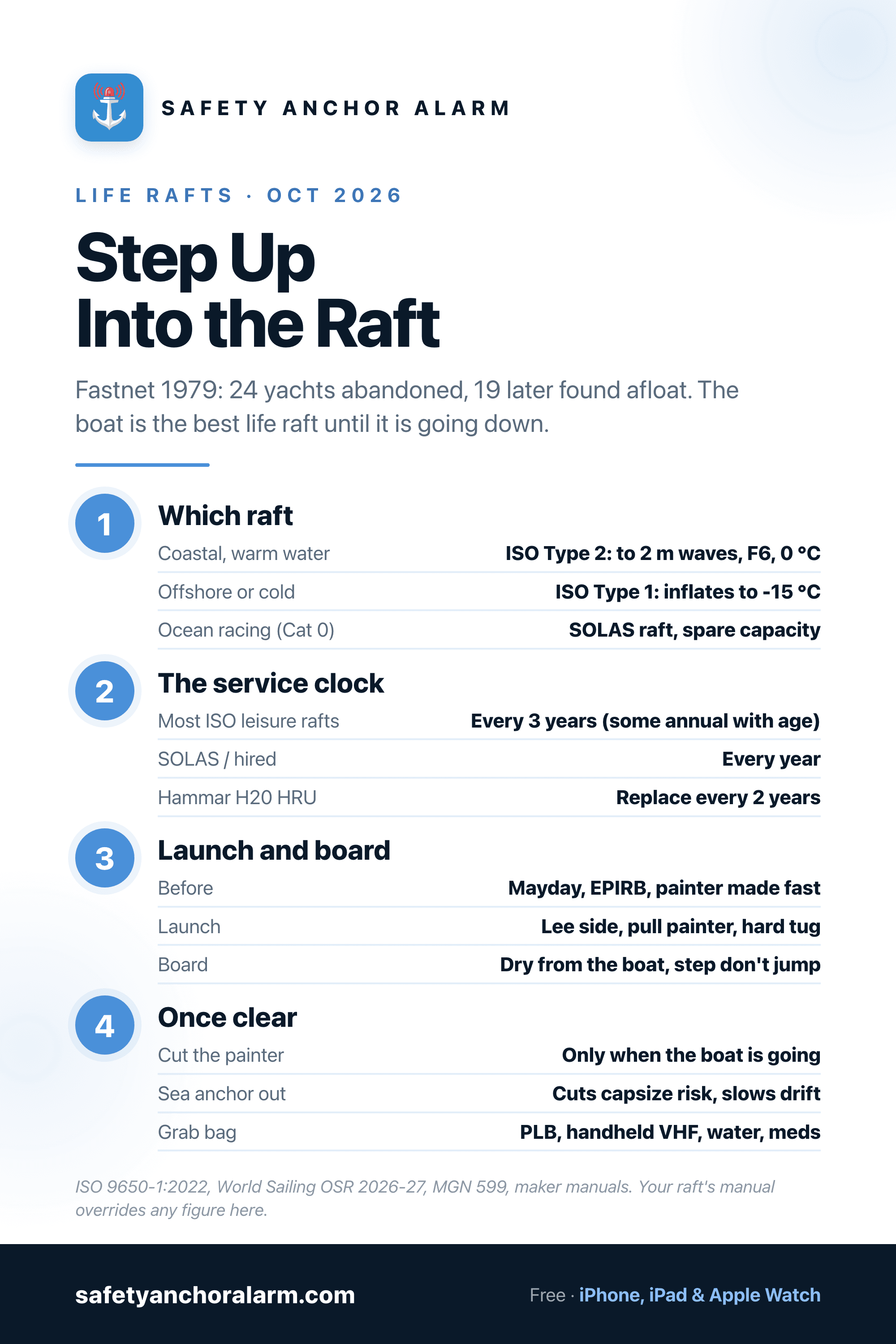
Leisure rafts are built to ISO 9650-1, which since 2022 holds both types: Type 2 for coastal sailing (up to 2 m significant wave height, force 6, air above 10 °C) and Type 1 for offshore passages without outside help, which must inflate down to -15 °C. Ships and trans-ocean racing use SOLAS rafts. A recreational boat in the US is not required to carry one, nor is a UK pleasure boat under 13.7 m; World Sailing requires one in race Categories 0 to 2. Most current leisure rafts are serviced every three years, some every two or annually with age, SOLAS rafts annually, always to the maker's interval. And the raft is the last resort: in the 1979 Fastnet, 19 of the 24 abandoned yachts were later found afloat. Step up into the raft, only when the boat is going down beneath you.
The Four Kinds of Life Raft
Weights are for four- and six-person rafts from current manufacturer specifications; prices are US and UK retail for four to eight persons in October 2026, before any emergency pack upgrade.
| Raft | Built for | Must inflate | Service | Weight | Price |
|---|---|---|---|---|---|
| Coastal, non-ISO | Light raft for near-shore use; not built to ISO 9650 | Maker's rating | Revere Coastal Compact: 2 yrs, then annual | 7-9 kg | $1,400-1,600 |
| ISO 9650-1 Type 2 (coastal) | Up to 2 m significant wave height, force 6, air above 10 °C | 0 to +65 °C | Usually 3 yrs | 30-40 kg | about $2,800 (6p) |
| ISO 9650-1 Type 1 (offshore) | Extended voyages, high wind and waves, no outside help expected | -15 to +65 °C | Usually 3 yrs (Seago annual after year 12) | 28-42 kg | $3,800-7,400 (4-8p) / £985-1,150 (4-6p) |
| SOLAS (LSA Code) | Ships' standard; required for World Sailing Category 0 | Ship standard | Annual | Heavier | Highest |
Reading the Label: ISO 9650 Type 1 and Type 2
For leisure boats the standard is ISO 9650, written for rafts of 4 to 16 persons on craft up to 24 m, launched from no higher than 6 m. Until 2022 it came in two parts, and most chandlery copy and older articles still talk that way: ISO 9650-1 was the offshore raft, ISO 9650-2 the coastal one. The 2022 edition merged them. Both now sit in ISO 9650-1, as Type 1 and Type 2, and the old groups were tidied up. What the two types are for has not changed:
- Type 1 is designed for extended voyages where high wind and significant waves can be met, though not hurricanes or polar waters, and for serious emergencies without expectation of outside assistance. It must inflate correctly between -15 °C and +65 °C. This is the old Type 1 Group A, the one World Sailing's racing rules and the UK's rules for larger yachts still name by its 2005 title.
- Type 2 is designed for conditions up to a significant wave height of 2 m and Beaufort force 6, with air temperatures above 10 °C, and need only inflate between 0 °C and +65 °C. It is a raft for a coastline with help nearby.
The temperature range is not a detail. A raft inflates from a CO2 cylinder, and cold slows the inflation. A raft rated to 0 °C in a February North Sea is outside its design. That is why UK advice points at the -15 °C raft, and why the offshore raft has an insulated floor: in cold water the floor is where a survivor loses heat.
Two other labels turn up. SOLAS rafts are built to the ships' Life-Saving Appliances Code; they are heavier, serviced every year, and required for trans-ocean racing. And in the US you will meet light coastal rafts that are not ISO rafts at all, such as the Revere Coastal Compact at about 7 to 9 kg. For a day sailor in warm water one may be the raft that actually gets carried; just do not mistake it for an offshore raft.
The Emergency Pack: Under or Over 24 Hours
Every raft comes with a pack sealed inside, and its size is a guess about how long you will wait. An ISO raft is sold with a pack for rescue within 24 hours or beyond 24 hours. Viking's two packs show the difference: the near-shore pack carries 3 litres of water and three hand flares and no food; the offshore pack carries 9 litres of water, six hand flares, 3 kg of rations and two thermal protective bags. SOLAS rafts have their own A and B packs, the A pack being the full ocean version.
The pack is a floor, not a plan. Whatever the raft contains, the grab bag is what you hand in after it: a personal locator beacon or the EPIRB, a handheld VHF with DSC, a handheld GPS, water, seasickness tablets, glasses, medication, a knife, a torch and copies of the boat's papers. The beacon comparison covers which distress beacon goes where.
Who Has to Carry One
Far fewer boats than most people assume.
- United States. The federal equipment list for recreational boats has no life raft. The safety equipment checklist covers what is required.
- United Kingdom. Pleasure vessels under 13.7 m are not covered by any statutory requirement to carry life-saving appliances (MGN 599). At 13.7 m and over, a pleasure yacht follows the MCA's equivalent standards, scaled by distance from the coast, and since 1 January 2024 an old ORC raft no longer counts: it must be a SOLAS/MED raft or an ISO 9650-1 Type 1 Group A.
- Europe and the Mediterranean. National rules, usually tiered by distance offshore, and the charter company has already met them for its own boats.
- Racing. World Sailing's Offshore Special Regulations are where rafts become mandatory, and the 2026-2027 edition is specific:
| OSR category | Racing | Raft | Minimum pack |
|---|---|---|---|
| Category 0 | Trans-oceanic | SOLAS only, enough spare capacity to lose one raft | SOLAS A |
| Category 1 | Long distance, well offshore | SOLAS, or ISO 9650-1 Type 1 Group A | SOLAS A, or ISO pack over 24 h |
| Category 2 | Along or not far from shore | SOLAS, or ISO 9650-1 Type 1 Group A | SOLAS A, or ISO pack under 24 h |
| Categories 3 and 4 | Protected water, short daylight races | Not required by the OSR |
The same rules are a sensible yardstick for a cruising boat that is not racing. A boat that crosses oceans is a Category 1 boat in all but name; a boat that hops along a coast with help a few hours away is closer to Category 2, and in warm summer water to a Type 2 raft.
Valise or Canister, and the Hydrostatic Release
A valise is a soft bag that lives in a locker. It is cheaper, lighter and protected from sun and spray, and it has one weakness: it has to be dug out, carried and thrown, in the worst conditions of your sailing life, by someone who is already frightened. A four-person offshore raft weighs 28 to 38 kg. A canister is a hard shell in a cradle on deck or on the transom, ready to go, and it can do something a valise cannot: float free if the boat sinks under it.
That is the job of the hydrostatic release unit (HRU). The common Hammar H20 sits in the strap that holds the canister down. If the boat sinks, water pressure at 1.5 to 4 m fires a knife that cuts the strap; the raft floats up, the painter tied to the boat comes taut and pulls the inflation, and a weak link in the line then breaks so the sinking boat does not drag the raft down with it. The H20 needs no service and is replaced every two years, dated from installation. A valise in a closed locker cannot float anywhere, so it never has one.
World Sailing's racing rules set the standard worth copying for any stowage: the raft must be on deck or in the cockpit, or in a dedicated weathertight locker opening onto the cockpit, deck or transom, and it must be possible to get it to the lifelines or launch it within 15 seconds. A valise under the sail bags at the bottom of the cockpit locker fails that test. Time yourself at the dock.
How Big a Raft
Size the raft for the people you actually sail with, not the berths. The RYA says it outright: the capacity does not have to match the number of berths. A raft is stabilised by weight in its floor and water in its ballast pockets, and an eight-person raft with two people in it has less of both per square metre. Discover Boating's advice is the common-sense version: a couple with occasional guests buys a four-person raft. Not every maker agrees that an empty raft is unstable, and good ballast and a sea anchor do much of the work, but no one argues that the bigger raft is easier to lift. If the crew grows for a passage, hire a second raft for it.
Servicing: The Clock Belongs to the Raft
A service is not a look at the bag. The station opens the raft, inflates it and holds pressure in every chamber, Viking's for 60 minutes; weighs or tests the gas cylinder; replaces anything in the pack that has expired, from flares to water to batteries; and issues a new certificate. The interval is the manufacturer's, and it varies more than people expect:
| Raft | Service interval |
|---|---|
| Viking RescYou | 3 years |
| Ocean Safety Ocean ISO | 3 years |
| Seago (Sea Cruiser, Sea Master) | 3 years to age 12, then annual |
| Revere Coastal Compact | 2 years from purchase, then annual |
| Any SOLAS raft | Annual |
| Hired raft (World Sailing races) | Annual |
On cost, Seago's UK price list gives a feel: £329 for a six-person Sea Cruiser and £379 for a six-person Sea Master, each buying a three-year certificate, with a cylinder hydrostatic test added after seven years. In the US, a coastal six-person service has been quoted at $600 to $900, and offshore rafts with full packs run higher. Ask for a quote first and ask to watch the inflation test; most stations are happy to show you, and seeing your own raft open is the best training you will get.
There is no legal age limit on a leisure raft. The limit is the maker's: Seago's current rafts have an 18-year warranty and life, its older ones a 15-year life, and a station will not recertify a raft past that, however good it looks. Put the service date and the end-of-life year in the boat's records next to the flare and extinguisher dates; the maintenance checklist has the same items on its multi-year clock.
Why the Boat Is the Best Life Raft
The most important fact about life rafts is in the inquiry into the 1979 Fastnet Race, the storm in which 15 crew from racing yachts died. Twenty-four yachts were abandoned. Five were lost. The other nineteen were later recovered, still afloat. The inquiry's own summary is blunt: life rafts failed to provide the safe refuge many crews expected; seven lives were lost in incidents associated with rafts, three of them directly attributable to the failure of the raft, and the yachts those seven people abandoned were all found afloat and towed to harbour. In about 25 hours spent in rafts the inquiry counted six capsizes, and twelve rafts were washed overboard.
The same paragraph records the other side, and it is why boats still carry them: fourteen lives were saved by crews who took to rafts from yachts that were never recovered. The raft works when the boat is really gone. The sailors' rule that came out of Fastnet is to step up into the life raft: leave the boat only when it is so low in the water that you step up from its deck into the raft. Until then a swamped, dismasted or holed boat is bigger, warmer, more stable and much easier for a helicopter to find than a 2 m orange tent.
Fire is the exception. A fibreglass boat burning beyond what the extinguishers can do is not a refuge, and that is a decision to make early.
Launching and Boarding
- Mayday first, on DSC and voice, with the position. Activate the EPIRB. Everyone in life jackets and harnesses, the grab bag at the companionway.
- Check the painter is made fast to a strong point on the boat. The raft inflates when the painter is pulled, and a raft launched without its painter tied is a raft that blows away.
- Launch on the lee side, where the boat gives a little shelter, and throw the raft well clear.
- Pull out the painter, which is 6 to 10 m long on leisure rafts, to the mark near its end, then give a hard tug to fire the cylinder. Seago allows up to about two minutes for full inflation depending on temperature. Keep the raft alongside on a short line.
- Board dry if you can, straight from the boat, and step in rather than jump onto the canopy. Spread the weight as people come aboard.
- Cut the painter only when the boat is going, with the safety knife at the entrance, then paddle clear of the wreckage and stream the sea anchor.
If the raft inflates upside down, it is righted from the water, from the side where the gas cylinder is, by climbing onto it, pulling the righting strap and leaning back, so the heavy cylinder does not come down on your head. It is far easier to understand at a sea-survival course in a pool than from a paragraph, and in the UK the one-day RYA course does exactly this.
The Anchor That Is Meant to Drag
Every life raft carries an anchor of its own. It is a sea anchor, a small fabric cone on a line, and World Sailing's rules call it critical to the safe use of a raft: streamed to windward, it dramatically reduces the chance of a capsize, and its secondary job is to slow the raft's drift, which keeps it near the position in the Mayday and the EPIRB fix. Fastnet's six capsizes are the reason it is the first thing to deploy once you are clear of the boat. One of those rafts capsized while still on a short painter, which snapped.
It is the only anchor on a boat designed to drag. Everything on the anchor watch side of this site is about the opposite: the ground anchor that must not move, and the alarm that tells you within seconds when it has. The two meet in an honest place. A raft is built for open water, where rescue takes hours; a cruising boat at anchor is usually a few hundred metres from rocks, and if it drags at night the raft is not the answer, because there is no time and no sea room for it. The answer there is to know about the drag while the boat is still a boat, which is what a dragging alarm is for.
The Bottom Line
Coastal sailing in warm water: an ISO 9650-1 Type 2 raft, or a light coastal raft if that is what will actually be carried, sized for the usual crew. Offshore or cold water: Type 1, the old Group A, with the over-24-hour pack and a grab bag that holds the beacon and the handheld VHF. Stow it so it can be launched in 15 seconds, give a canister an HRU and replace the HRU every two years, and service the raft on its maker's clock, not the one you remember. Then hope you never use it, and if the day comes, remember Fastnet: the boat is the best life raft until it is going down, and you step up into the raft, not down.

Safety Anchor Alarm
The life raft is for the day the boat is lost at sea. The anchor alarm on your phone is for the far more common night, when the boat starts to drift towards the shore and nobody is awake. Service one every few years; run the other every time you drop the hook.
Download Free