Boat Flares and Visual Distress Signals: Coast Guard Requirements, the 42-Month Rule, Electronic Flares, and What to Do With Old Ones
A flare does not call for help. Nobody hears it, nothing relays it, and nobody comes because of it unless they were already looking. What a flare does is the last part of a rescue: it shows a boat or a helicopter that is already searching exactly where you are. The pistol-launched parachute flare says so on its own label: use only when an aircraft or vessel is sighted. This guide takes the requirements straight from the regulation: where visual distress signals are required, which devices count and how many, when they expire, what the electronic alternatives are, how and when to fire one, what to do with the old ones, and the distress signals that boats show by accident at anchor.
The short answer
Under 33 CFR 175 Subpart C, visual distress signals are required only on US coastal waters: the territorial sea, the Great Lakes, and the bays and rivers connected to them until they narrow to 2 nautical miles. There, every boat 16 ft and over carries approved signals for day and night, such as three handheld red flares, or an orange distress flag plus an electric SOS light. Boats under 16 ft, paddle craft, open sailboats under 26 ft without an engine and boats in an organised race need only night signals, and only between sunset and sunrise. Pyrotechnics expire no more than 42 months after manufacture; a flag and a light never do. Electronic lights, including the cyan and red-orange eVDSD, meet the night requirement only. Firing any distress signal when nobody needs help is illegal.
Every Approved Signal, and How Many You Need
From 33 CFR 175.130 and its table, with the minimum performance from each device's approval specification in 46 CFR. The “number” is how many of that device alone meet the requirement it is listed for. Each one must carry its approval number, or the manufacturer's certification statement for the flag and the light.
| Device | 46 CFR | Counts for | Number | Minimum performance |
|---|---|---|---|---|
| Handheld red flare | 160.021 | Day and night | 3 | At least 2 minutes, 500 candela |
| Aerial red flare (meteor or parachute) | 160.066 | Day and night | 3 | At least 5.5 seconds; some need a launcher |
| Pistol-launched parachute flare | 160.024 | Day and night | 3 | Opens at 150 ft or higher, 30 seconds, 20,000 candela; needs a 160.028 launcher |
| Handheld rocket parachute flare | 160.036 | Day and night | 3 | Opens at 500 ft or higher, 30 seconds, 20,000 candela |
| Handheld orange smoke | 160.037 | Day only | 3 | At least 50 seconds of smoke |
| Floating orange smoke | 160.022 / 160.057 | Day only | 3 | 4 or 15 minutes of smoke, floats |
| Orange distress flag | 160.072 | Day only | 1 | At least 3 × 3 ft, black square and disc, never expires |
| Electric distress light | 161.013 or RTCM 13200.0 | Night only | 1 | Flashes SOS automatically, 6 hours or more |
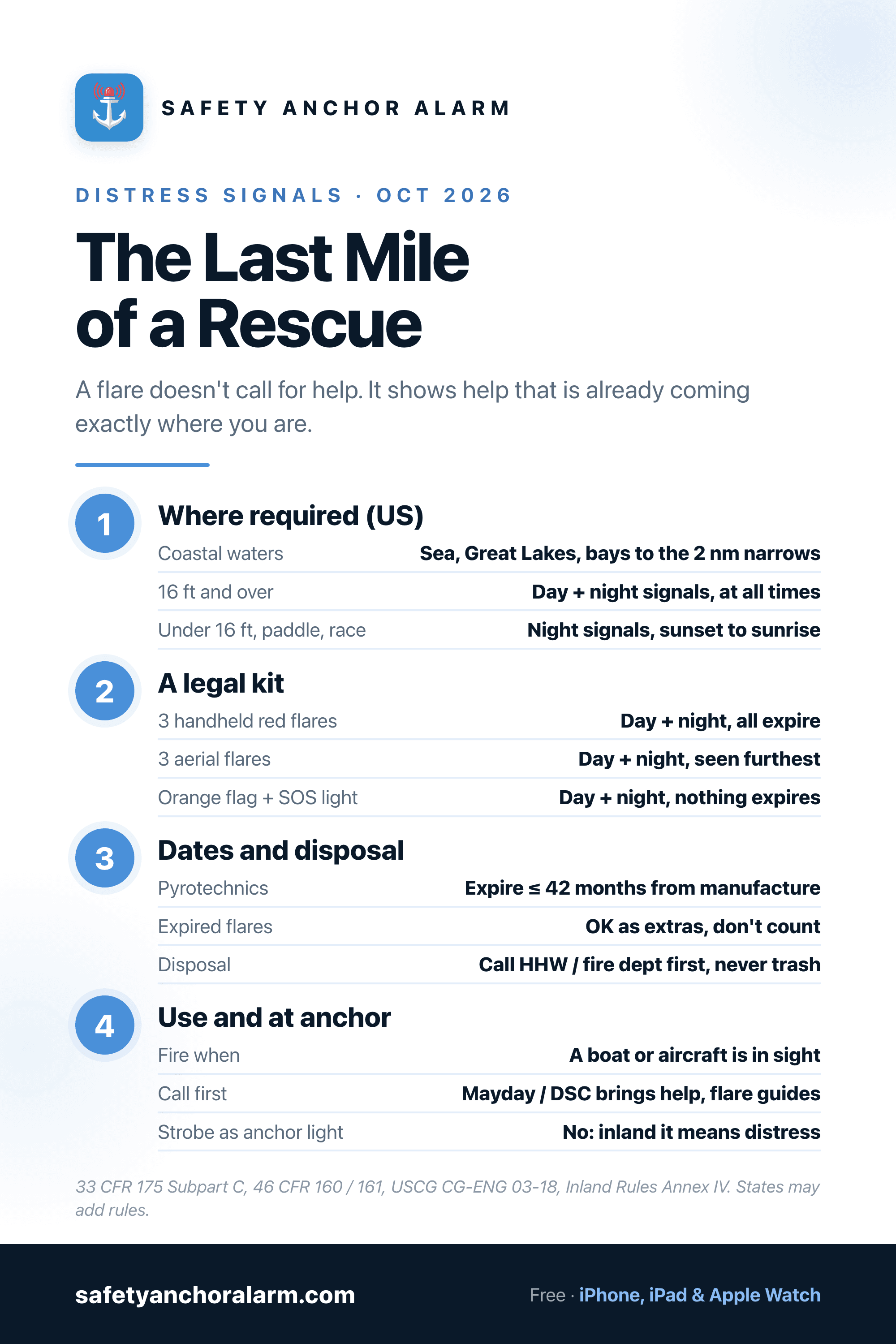
Flares Are the Last Mile of a Rescue
A rescue has three jobs: raising the alarm, getting someone to the area, and finding the boat once they are there. Flares do only the third. The alarm is raised by the VHF, by the red DSC button (which sends your position and your MMSI), by an EPIRB or PLB, or by a float plan that tells someone ashore you are overdue. Those are the tools that get a boat or a helicopter heading towards you, and the beacon and messenger comparison covers them. In the last mile, though, a position on a screen is not the same as a boat in a seaway at night, and a small hull among waves is very hard to see. That is the job of the flare, the smoke and the flag.
This explains how to use them. A handheld red flare burns for two minutes; an aerial flare for seconds to half a minute. Fired at an empty horizon, they are gone and nobody saw them. Fired when you can see a boat, hear an aircraft or see lights ashore, they are the thing that turns a search into a pick-up.
Where Signals Are Required: Coastal Waters and the 2-Mile Rule
The subpart applies to boats on the coastal waters of the United States, and to US-owned boats on the high seas beyond them. The regulation defines coastal waters in three parts:
- The US Great Lakes: Erie, Huron, Michigan, Ontario and Superior.
- The territorial sea.
- Waters directly connected to either, such as bays, sounds, harbours, rivers and inlets, whose entrance is wider than 2 nautical miles, up to the first point where the water narrows to 2 miles between shorelines, as shown on the current NOAA chart. Islands and points of land count as shoreline.
So Chesapeake Bay, Long Island Sound and Puget Sound are coastal waters, and so is the lower part of a wide river; the river above the 2-mile narrows is not, and neither is an inland lake. This is why many people who keep their boat on a lake have never owned a flare, and why the same boat needs them the day it is trailered to the coast.
Which Boats Need Day and Night Signals, and Which Only Night
On coastal waters the rule splits boats into two groups:
- Boats 16 ft and over, and any boat carrying passengers for hire as an uninspected passenger vessel, must carry signals suitable for day use and for night use, or signals suitable for both, at all times, day or night.
- Night signals only, and only between sunset and sunrise: boats under 16 ft; manually propelled boats such as kayaks, canoes and rowing boats; sailboats under 26 ft of completely open construction with no engine; and anyone competing in an organised parade, regatta or race.
Three more conditions apply to every signal counted towards the requirement. It must be readily accessible, not in the bottom of the cockpit locker under the fenders. It must be serviceable and in date. And it must be legibly marked with its Coast Guard approval number or certification statement. Flares that came with a second-hand boat, faded and unlabelled, do not count. If a flare needs a launcher, such as a pistol-launched parachute flare, an approved launcher must be aboard too.
Legal Kits: Five Ways to Meet the Rule
Any combination of the approved devices works as long as it adds up to the required number for day and for night. The regulation gives two worked examples itself, and between them they cover most of what is sold as a “flare kit”:
| Kit | Day | Night | What expires | Note |
|---|---|---|---|---|
| 3 handheld red flares | Yes | Yes | Every flare | The cheapest compliant kit, and the shortest-lived |
| 3 aerial flares (meteor or parachute) | Yes | Yes | Every flare | Seen from much further; over in seconds |
| 2 handheld red + 1 parachute flare | Yes | Yes | Every flare | The Coast Guard's own example of a mixed kit |
| 3 handheld orange smoke + 1 electric light | Yes | Yes | Smoke only | Also the Coast Guard's example |
| Orange flag + electric light (or eVDSD) | Yes | Yes | None | Never expires; batteries are the only date |
The legal minimum and the useful minimum are not the same thing. Three handheld flares are legal, but a handheld flare is held at arm's length a few feet above the water, and from another boat it disappears behind the first wave. If you go more than a few miles off, add aerial flares, which put a red light hundreds of feet up. And whatever you carry, keep the day signals in mind: an electric light, however bright, is not a day signal.
The 42-Month Rule
Every approved pyrotechnic carries a service life expiration date, and the approval specifications say it may be no more than 42 months, three and a half years, from the date of manufacture. The handheld flare spec spells out the label: service life expiration date, month and year manufactured, lot number. The regulation then bans counting any signal whose marked date has passed.
Two practical consequences follow. First, the clock starts at the factory, not at the shop, so a kit that sat in a chandlery for a year has about two and a half years left: read the date before you buy. Second, an expired flare is not illegal to carry. It simply does not count, and many crews keep the previous set aboard as extras. Store them separately and mark them, so that nobody reaches for the old ones first in the dark.
Store all of them in a watertight, clearly marked container, away from fuel and heat, somewhere you can reach from the cockpit. Check the dates on the same day you check the fire extinguishers and the inflatable life jacket cylinders, at launch and at haul-out.
Electronic Flares: The SOS Light and the eVDSD
There are two kinds of electronic signal the Coast Guard accepts, and both meet the night requirement only.
- The electric distress light (46 CFR 161.013). A white light that flashes SOS in Morse code automatically when switched on, floats, has a waterproof switch and its own batteries, and must still be flashing SOS three to five times a minute after six hours. It may not have a switch that holds a steady beam: it is a distress light, not a torch.
- The electronic visual distress signal device (eVDSD). In December 2018 the Coast Guard's policy letter CG-ENG 03-18 accepted lights built to RTCM Standard 13200.0 as equivalent to the 161.013 light. They flash SOS in two colours, cyan and red-orange, chosen so that a searcher can tell them from navigation lights and lights ashore. The label reads differently from the older lights (it says the device complies with RTCM Standard 13200.0) but the Coast Guard tells its examiners that it counts.
Pair either one with an orange distress flag, at least 3 by 3 ft with a black square and a black disc, for the day requirement and you have a kit with nothing to expire, nothing to dispose of, and nothing that burns. Many electronic kits come with the flag in the box.
Be honest about the trade. A handheld flare must reach an average of at least 500 candela; a parachute flare 20,000. An SOS light is far dimmer, sits near the water, and is visible over a shorter distance, but it keeps signalling for hours, which matters when help is a long way off. Many offshore crews end up carrying both: the light and the flag as the legal kit, and a few in-date aerial flares for the moment a boat or aircraft is close.
When and How to Use a Flare
The decision matters more than the technique. Fire when someone can see it: a boat in sight, an aircraft heard or seen, lights on a shore close enough to see you. At night, red flares; by day, orange smoke, which shows up better against a bright sky than a flame does. Then:
- Read the instructions now, in daylight, not in the dark with wet hands. Every type is opened and fired differently, and the instructions are printed on the device.
- Call first. Mayday on VHF 16 or the DSC button, then flares. The call brings help; the flare shows them where you are.
- Handheld flares and smoke over the lee side, held at arm's length and pointed away from the boat, so hot slag and smoke blow away from you and the sails. Wear gloves if you have them, and do not look into the flame.
- Aerial flares one at a time, with a pause, the way the Rules of the Road describe the distress signal: rockets throwing red stars fired one at a time at short intervals. A second one in sight confirms the first; three at once is three chances used in one go.
- Keep one back. When the rescue boat or helicopter is close and searching, that is when the last flare or the smoke is worth most.
Never for Fun: the Ban on False Signals
33 CFR 175.140 is one sentence: no one in a boat on coastal waters may display a visual distress signal except where help is needed because of immediate or potential danger to the people on board. The Rules of the Road add that distress signals may not be used for anything else, and neither may signals that could be confused with them. Every red flare seen from shore is reported, and every report starts a search. Firing old flares on the Fourth of July or New Year's Eve is exactly that, multiplied across a coastline. If you want to practise, and you should, the Coast Guard Auxiliary, Power Squadrons and many fire departments run supervised sessions with expired flares.
What to Do With Expired Flares
This is where the system works least well. A pyrotechnic flare is hazardous waste, and there is no federal take-back programme.
- In the US: call your county household hazardous waste programme, fire department or police and ask; not all of them accept flares, so call before you drive. The Coast Guard Auxiliary does not collect them, though some local units take them for training. Some boating organisations run collection days. In California, about 174,000 flares expire every year and no facility in the state holds the permit to treat them; the legislature passed a manufacturer take-back bill in 2024, the governor vetoed it, and a successor, SB 561, was introduced in 2025.
- In the UK: HM Coastguard stopped accepting flares from private individuals at the end of 2022. The RYA points owners to registered disposal services, listed by The Green Blue, which typically charge £2 to £3 a flare, and suggests asking a liferaft service station, a chandler that sells flares, or the local port or marina.
- Never put flares in household rubbish or a skip, throw them in the water, burn them, take them apart, or fire them to get rid of them. Flares thrown out with the rubbish have ignited at waste sites.
The disposal problem is the strongest argument for an electronic night signal and an orange flag. They are the only legal kit that will never leave you with a box of old pyrotechnics.
Distress Signals at Anchor
Read the full list of distress signals in Annex IV of the Rules of the Road and two of them describe things boats do at anchor without meaning to.
A strobe at the masthead. On US inland waters, “a high intensity white light flashing at regular intervals from 50 to 70 times per minute” is a distress signal. The international rules do not list it, but they say strobe lights should be avoided when attracting attention for the same reason. A strobe is not an anchor light, however visible it is. The anchor light is a steady all-round white light, as the navigation lights guide explains.
A horn that keeps sounding. “A continuous sounding with any fog-signaling apparatus” is also a distress signal, so it is the wrong way to wake a neighbour. If the boat upwind is dragging down on you at 3 a.m. and the crew is asleep, Rule 36 is the one to use: it lets any vessel make light or sound signals that cannot be mistaken for a distress signal, and point a searchlight in the direction of the danger. Short blasts on the horn, a shout, and a light on their deck. Keep the long continuous blast for when you are the one in danger: if your own boat is dragging onto rocks, it is a legitimate call for help to a whole anchorage of sleeping neighbours, any of whom could be alongside in a dinghy within minutes.
Which is where the jobs divide honestly. Flares and horns are for when the anchor has already let go and the boat is in danger. The anchor alarm exists so that it does not get that far: it watches the boat's position all night and wakes you while the boat is still only dragging, when the fix is to start the engine and re-anchor, not to call for help. Set it up with the rest of the night anchoring checklist, and keep the flares where you can reach them from the cockpit anyway.
The Bottom Line
On US coastal waters, a boat 16 ft and over carries approved day and night signals: three handheld red flares, three aerial flares, a mix, or an orange flag plus an electric SOS light. Smaller boats, paddle craft and open engineless sailboats need night signals after dark. Pyrotechnics expire 42 months from manufacture, so read the date when you buy; the flag and the light never expire, and the electronic light counts for night only. Call for help first and fire flares when someone can see them, never for fun. And when the old ones expire, call before you drive, because disposal is the hard part.

Safety Anchor Alarm
Flares are for the last mile of a rescue, when help is already in sight. The anchor alarm on your phone is for the first minute of a drag, when the only help you need is to wake up. Keep the flares in date by the companionway; run the alarm every night.
Download Free